Transdermal Patch to Knowledge™
Transdermal Patch to Knowledge is a speculative learning-interface concept that must be framed carefully. It should not imply that knowledge can literally be transferred through a patch, nor should it make medical, neurological, or drug-delivery claims. A safer public interpretation is to treat it as a controlled idea space for wearable learning support, haptic prompting, study reminders, sensory cueing, biofeedback-assisted focus, or fictional-to-engineering translation. The concept belongs in Commercial Products only as a speculative product placeholder with strict public-language discipline. Future development may connect to Cognitive Systems, EduForge, attention engineering, wearable interfaces, and learning-support tools. Any biological or transdermal implications require private review, scientific evidence, and regulatory caution before public expansion.
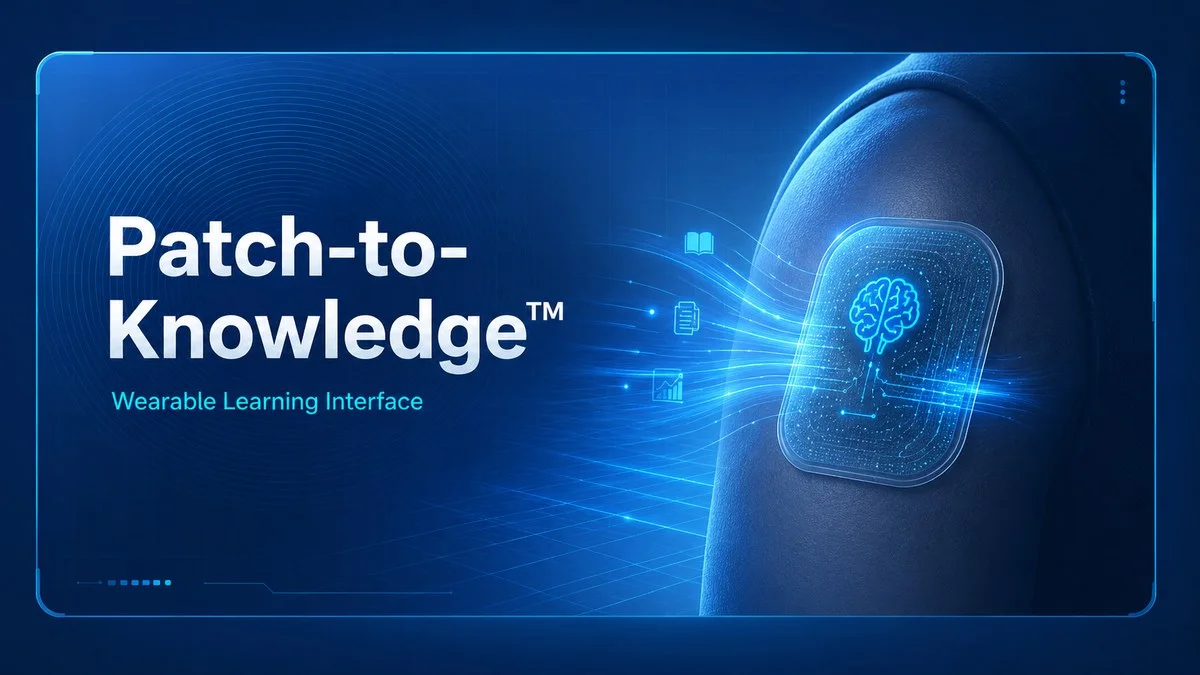
Section Purpose
This page is structured for future product summaries, public-safe diagrams, prototype notes, render galleries, licensing preparation, controlled-release visuals, and eventual longer narrative pages when the concept requires deeper explanation.
Commercial concept active
Public-safe summary
Commercial Products
Transdermal Patch to Knowledge™
A speculative wearable-learning interface research concept exploring whether future skin-adjacent systems could support guided learning, prompting, sensing, or cognitive-assistance workflows.
Training and knowledge transfer remain time-intensive, while wearables are becoming more capable of continuous sensing and personalized assistance.
Explore a patch-form factor as a future interface for safe sensing, prompting, biofeedback, and tightly bounded learning-support functions.
Research organizations, training environments, accessibility applications, specialty education, and human-machine interface studies.
R&D partnerships, licensed interface concepts, prototype studies, and future medical/cognitive collaborations only after evidence supports them.
The format is compact and compelling, but the concept must remain clearly separated from unsupported claims of direct knowledge upload.
Define a realistic physiological interface, safety envelope, measurable function, ethics controls, and regulatory classification before any product claims.