STB • 40–120 kHz human-facing study envelopeHuman operation only in validated assisted-care modes; no animal use on this modelExperimental / calibration / future quantum-sensor modes: empty-only
STB • Elder Care / Mobility Support
Sonic Bath / Assisted-Care System
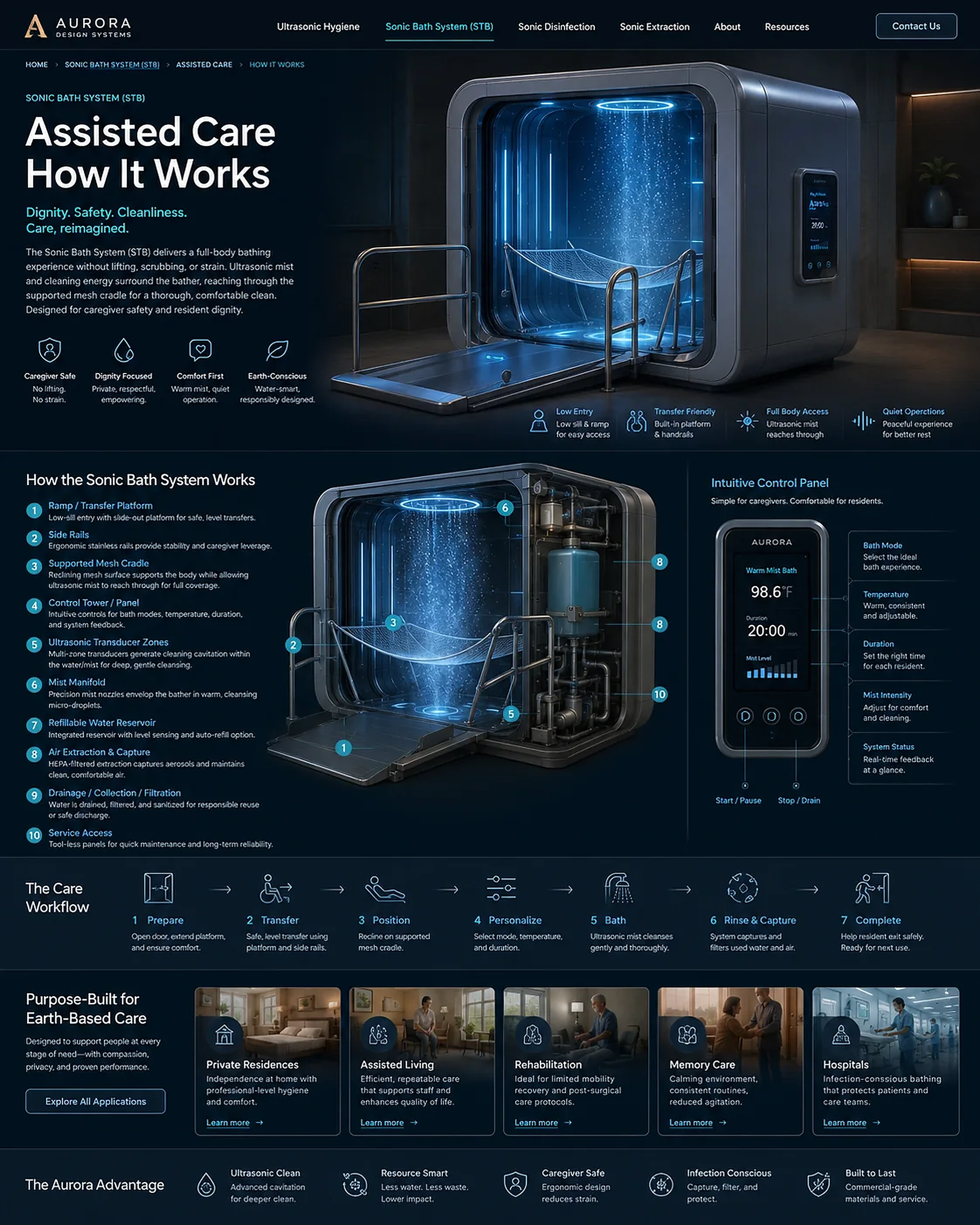
A supported hygiene system for elderly and mobility-limited users using transfer assistance, reclining permeable mesh support, low-water cleaning, external caregiver controls and controlled drying.
Assisted-care configurations stay separate from the overview
The overview now stays clean and product-focused. Detailed support studies, caregiver workflow, transfer concepts and future CAD views live on the daughter pages where they can be shown large enough to read. The assisted-care seating concept uses a permeable mesh support so cleaning mist, airflow and validated acoustic treatment can reach the back and posterior body surfaces instead of being blocked by solid upholstery.
Occupancy RuleHuman-use only in validated assisted-care modes
Water / Fluid InterfaceSmall reservoir / low-volume supply with recovery path
ElectricalCommon UST electrical architecture; final rating TBD
Frequency values shown here are current UST concept-study ranges from the program architecture, not released product specifications or human exposure limits.
Operating Experience
Selectable modes
Assisted Warm
Body-neutral/warm comfort with caregiver supervision.
Gentle Clean
Reduced acoustic and airflow limits.
Caregiver Assist
External control authority and extended transition times.
Low Stimulation
Reduced noise, light and cycle intensity.
Quick Refresh
Short hygiene-support cycle.
Adaptive
User profile + sensor-bounded control.
Control Interface
Ten control / status functions to define
The final interface may use physical buttons, sealed switches, touch controls, indicators or a combination. The website shows functions, not a frozen hardware layout.
Main power / standbyFinal label, icon, hardware and control behavior remain subject to HMI engineering.
Caregiver enableFinal label, icon, hardware and control behavior remain subject to HMI engineering.
Transfer / support position statusFinal label, icon, hardware and control behavior remain subject to HMI engineering.
Comfort temperatureFinal label, icon, hardware and control behavior remain subject to HMI engineering.
Cycle modeFinal label, icon, hardware and control behavior remain subject to HMI engineering.
Acoustic enable statusFinal label, icon, hardware and control behavior remain subject to HMI engineering.
Mist / reservoir statusFinal label, icon, hardware and control behavior remain subject to HMI engineering.
Extraction / condensate statusFinal label, icon, hardware and control behavior remain subject to HMI engineering.
Emergency stop / immediate releaseFinal label, icon, hardware and control behavior remain subject to HMI engineering.
Cycle complete / fault / service indicationFinal label, icon, hardware and control behavior remain subject to HMI engineering.
Public-Safe Architecture
How the system works without exposing proprietary geometry