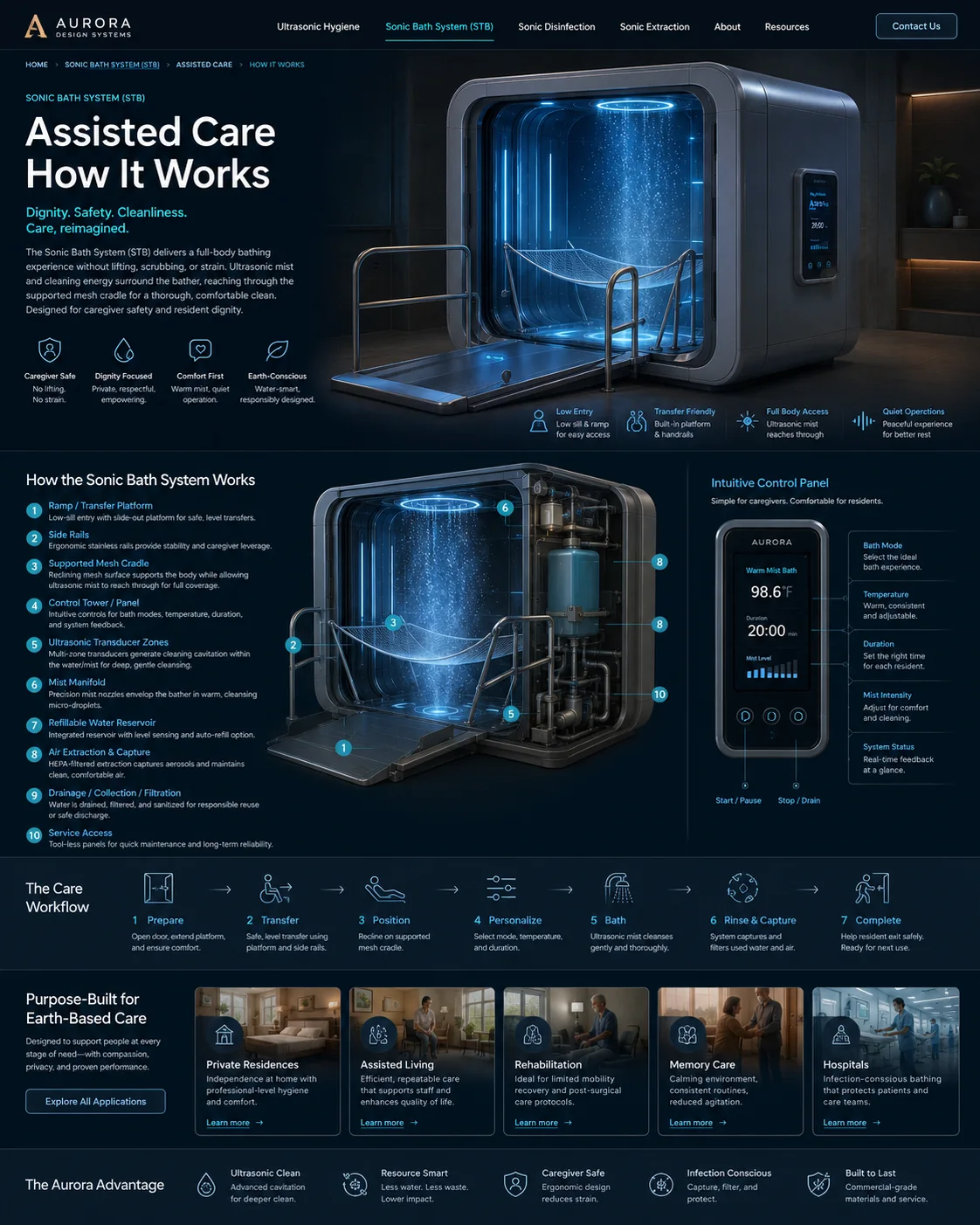
How Sonic Bath / Assisted-Care System Works
A public-facing functional explanation. It deliberately omits production transducer count, exact placement, wiring, mounting geometry, detailed reservoir dimensions and proprietary control parameters.
Five-stage conceptual cycle
Deploy ramp/bridge or assisted transfer interface.
Position user on reclining/open support structure.
Deliver controlled mist and bounded acoustic hygiene.
Extract moisture and contamination to capture path.
Dry, return support to transfer position and release safely.
System-level modules
Zoned energy delivery with product-specific operating limits.
Only the amount and form of moisture required for that product's coupling strategy.
Extraction, separation, filtration and drying paths as required.
Real-time monitoring constrains the product to its approved operating state.
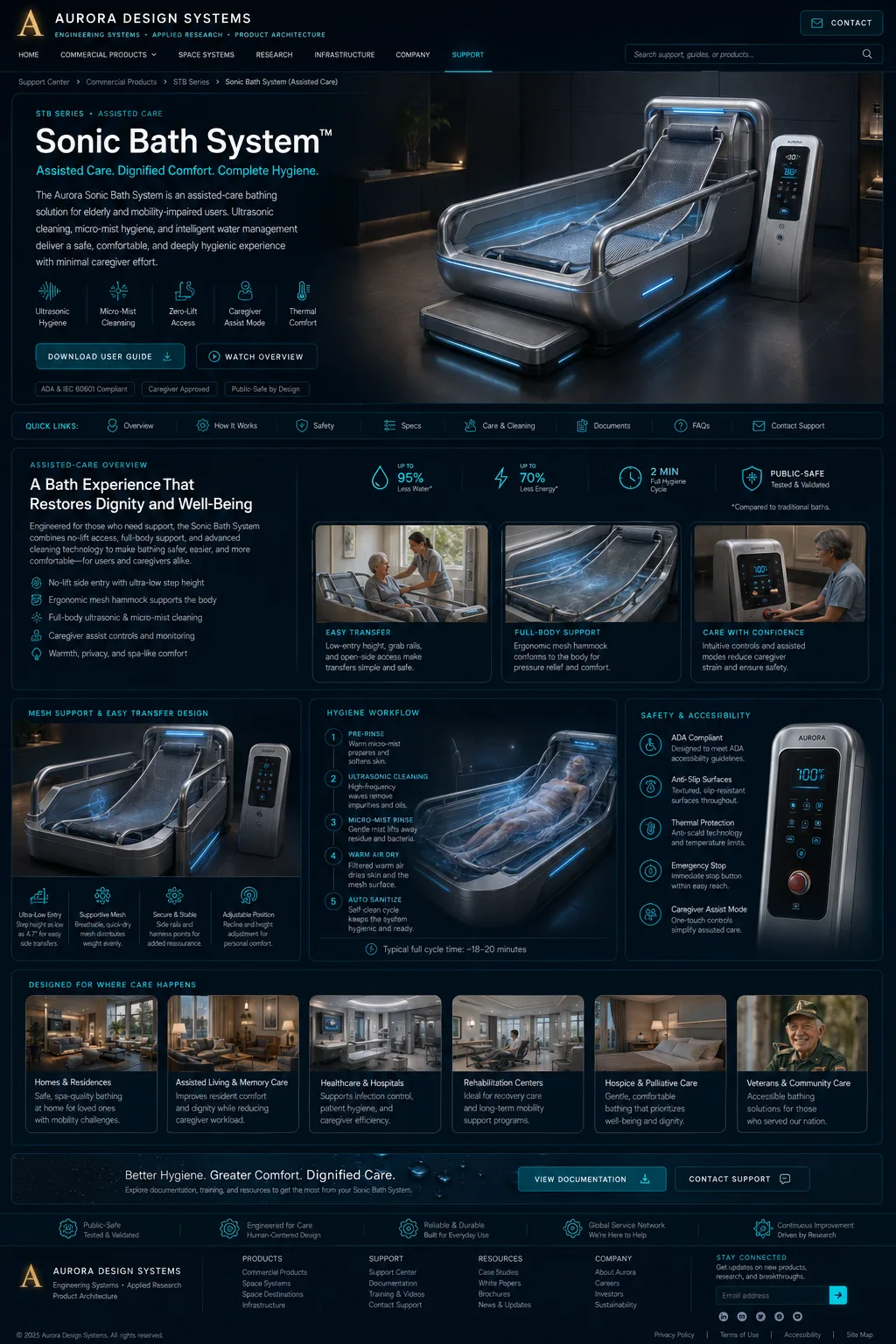
What detailed design will eventually lock
Installation width, height, depth, clearances and service zones.
Sheet-metal/composite panels, bends, stiffeners, doors, seals and isolation.
Drivers, power supplies, sensors, blowers, pumps, valves and harness routing.
Filters, reservoir access, condensate/drain paths and replaceable modules.
Cleaning access cannot stop at the chair
A solid vinyl or foam back would shield substantial body area. The assisted-care concept therefore uses a supportive open mesh surface that allows drainage, airflow and treatment access around the back, hips and legs while maintaining secure body support.
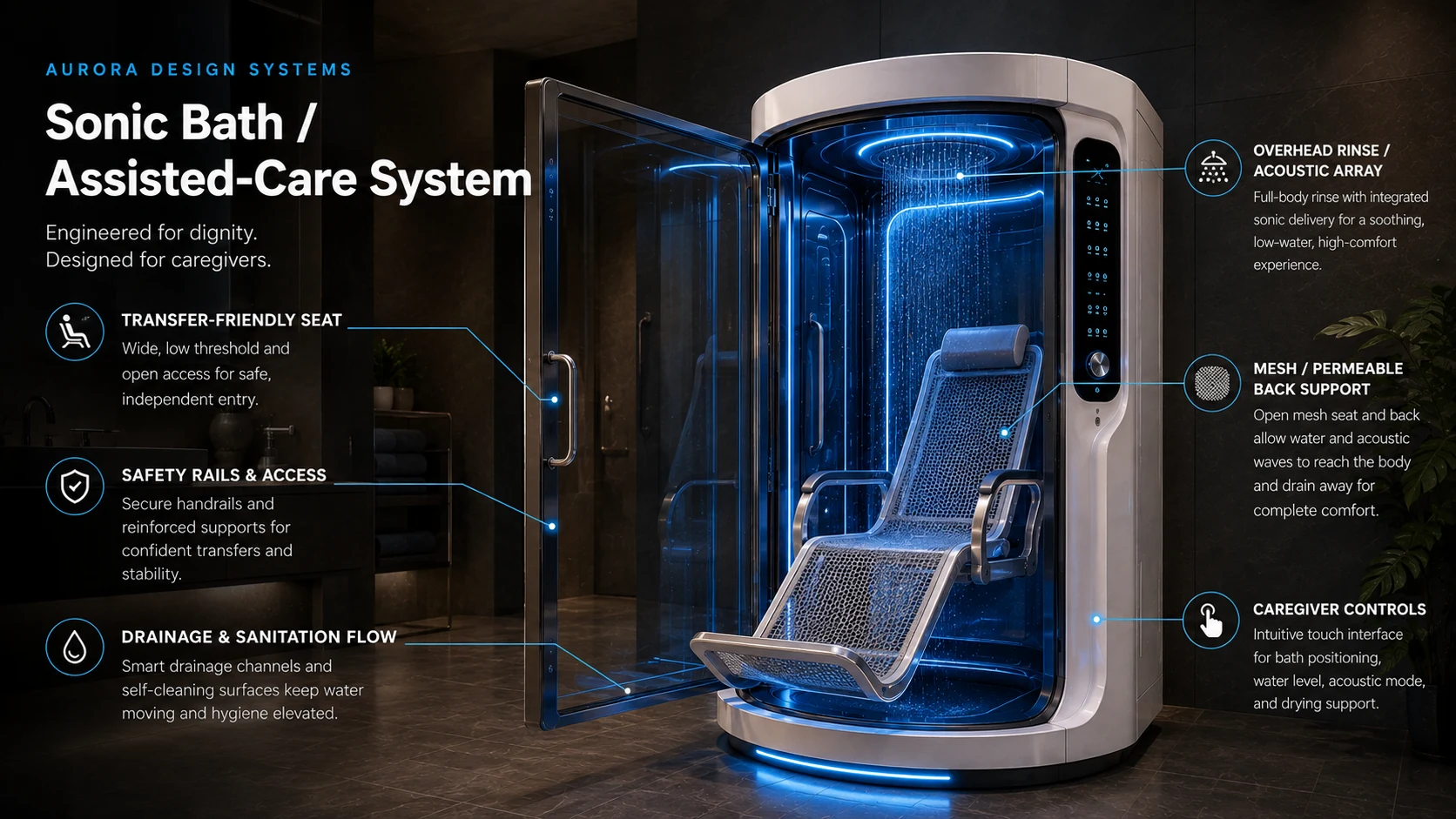
Operating permissions are conditional
Mechanical support and emergency exit remain independent of acoustic operation.
Final product must define supervision requirements through human-factors validation.
Not a veterinary or pet-cleaning unit.
Calibration/engineering modes are occupancy-inhibited.
Acoustic cycle cannot start until support and transfer hardware report safe position.
Conservative temperature limits and multiple independent sensors.
Unexpected movement triggers pause or safe shutdown.
External caregiver controls can stop the cycle immediately.
Wet-zone electrical isolation and leak detection are mandatory design requirements.
Experimental sensing or future high-sensitivity sensor modules do not override the occupancy/interlock architecture. Any diagnostic or calibration mode that has not been explicitly validated for occupied operation remains inhibited when people or animals are detected.