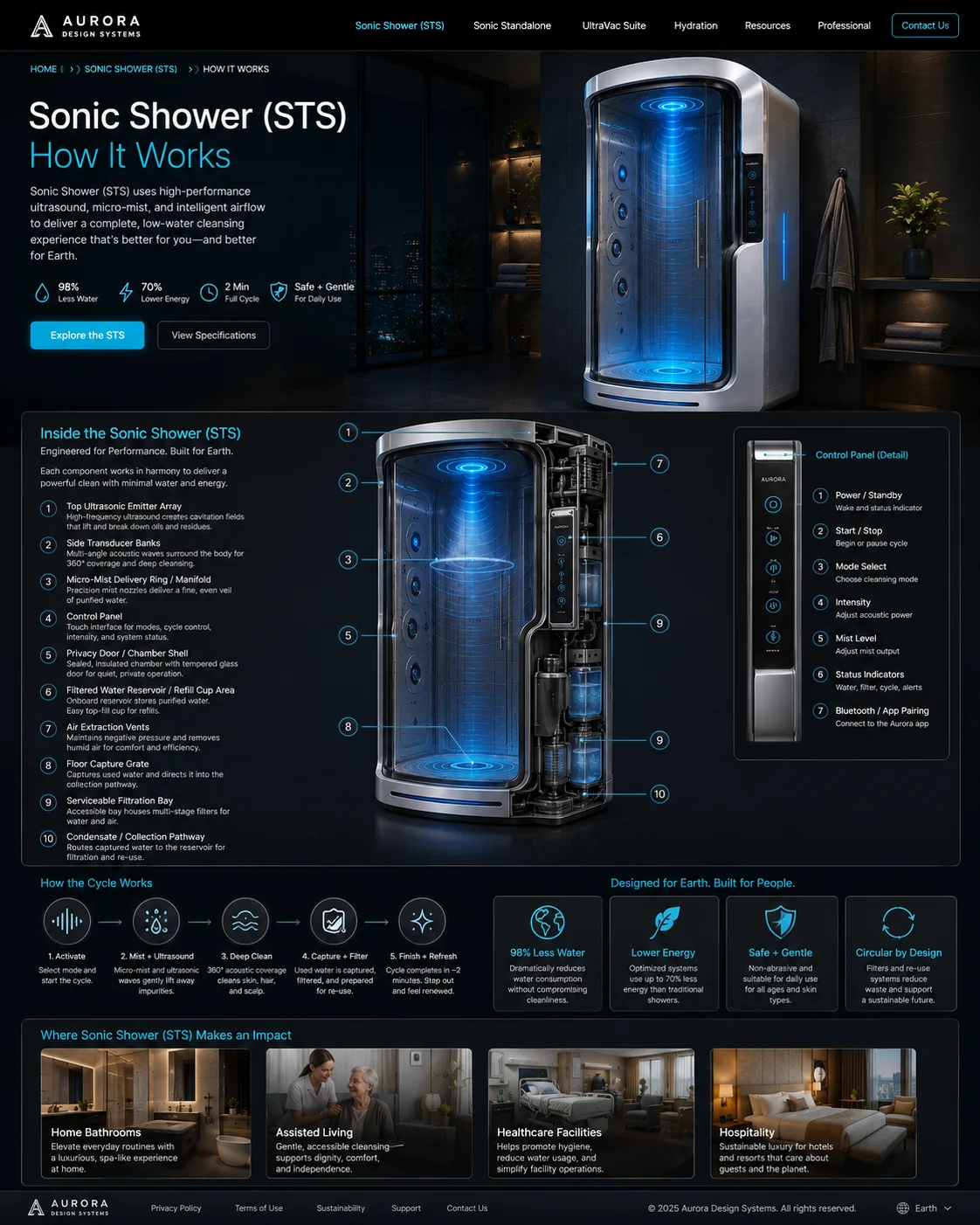
How Sonic Shower Works
A public-facing functional explanation. It deliberately omits production transducer count, exact placement, wiring, mounting geometry, detailed reservoir dimensions and proprietary control parameters.
Five-stage conceptual cycle
Confirm user position and safe operating geometry.
Apply a controlled low-volume moisture layer.
Use bounded, monitored surface-agitation modes.
Move moisture and loosened contamination toward capture.
Finish with controlled airflow / thermal comfort.
System-level modules
Zoned energy delivery with product-specific operating limits.
Only the amount and form of moisture required for that product's coupling strategy.
Extraction, separation, filtration and drying paths as required.
Real-time monitoring constrains the product to its approved operating state.
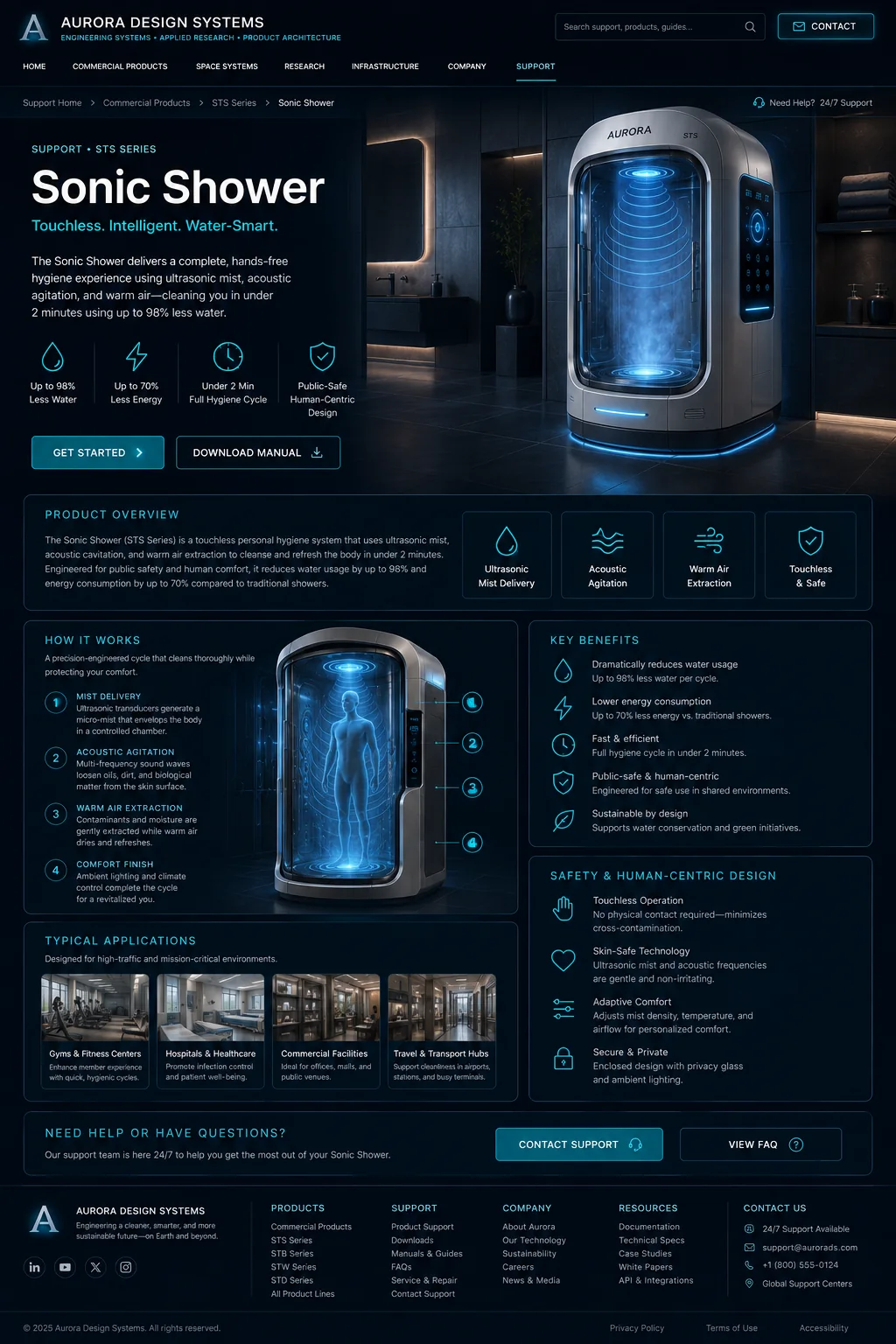
What detailed design will eventually lock
Installation width, height, depth, clearances and service zones.
Sheet-metal/composite panels, bends, stiffeners, doors, seals and isolation.
Drivers, power supplies, sensors, blowers, pumps, valves and harness routing.
Filters, reservoir access, condensate/drain paths and replaceable modules.
Operating permissions are conditional
Only validated hygiene modes may run while occupied.
Animals require a separately validated product/mode.
High-output calibration and engineering test modes require an empty enclosure.
Opening the enclosure or emergency release inhibits acoustic drive.
Temperature limits trigger derating, pause or shutdown.
Field feedback constrains output and detects abnormal conditions.
Control logic must reduce exposure around protected regions.
Disagreement or missing critical sensors forces safe degradation or shutdown.
Blocked extraction, abnormal humidity or leaks inhibit the cycle.
Experimental sensing or future high-sensitivity sensor modules do not override the occupancy/interlock architecture. Any diagnostic or calibration mode that has not been explicitly validated for occupied operation remains inhibited when people or animals are detected.