
Qualified feedstocks
Identity, condition, compatibility, storage history, expiry, and contamination controls.
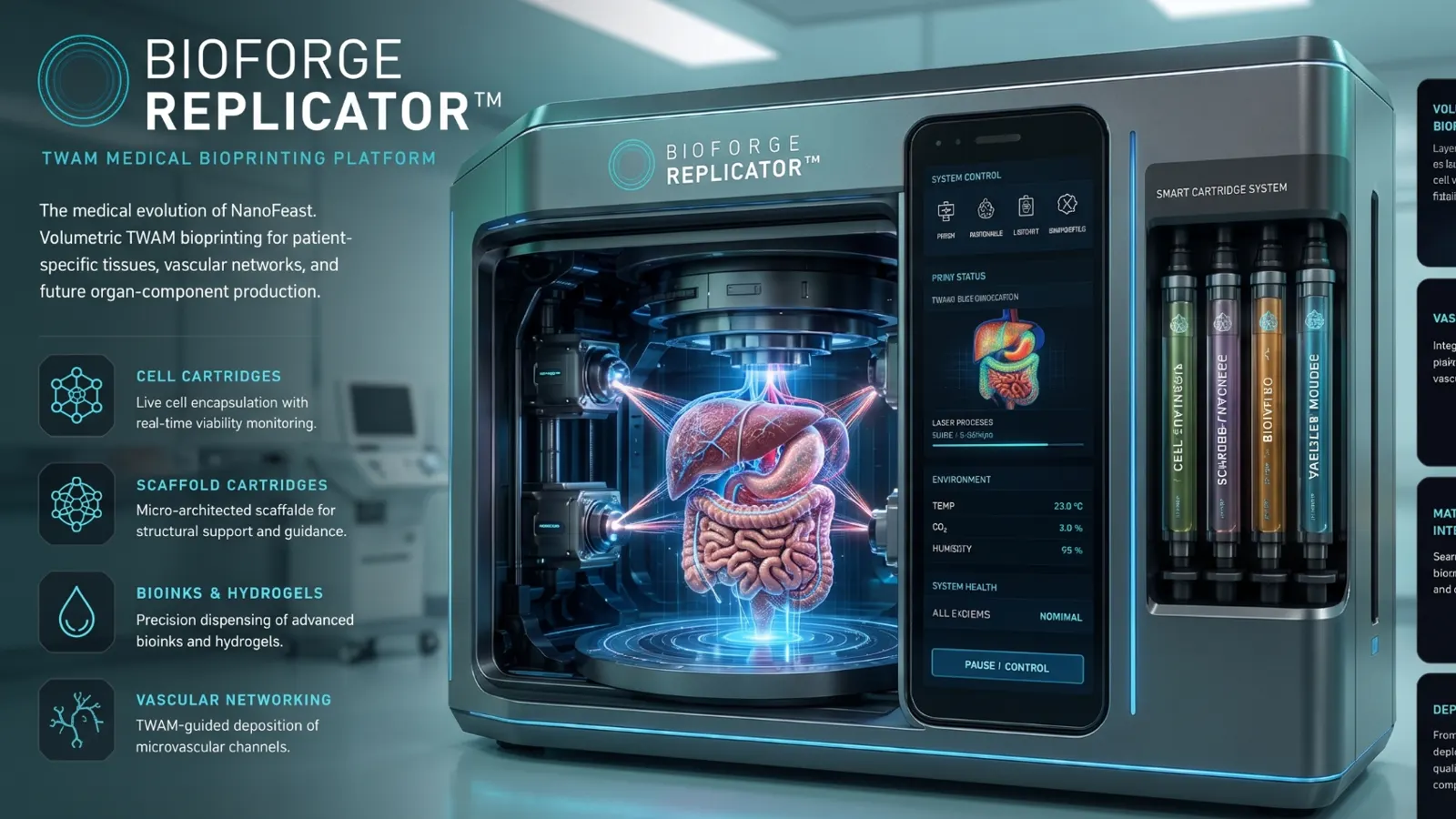
Aurora BioSystems · Unified fabrication architecture
A controlled program architecture connecting sterile feedstock and cartridge handling, biomedical fabrication, organ-component research, planned regulated manufacturing, and future clinical deployment.
Material paths, cartridges, chambers, service boundaries, and cleaning states are treated as controlled interfaces.
Feedstock identity, pattern provenance, process history, and chain of custody remain linked to each build.
Inspection and release gates separate a fabricated article from anything represented as clinically usable.
No fabrication platform substitutes for medical judgment, regulatory authorization, or configuration-specific evidence.
Parent architecture
BioFabrication Systems is not a single machine. It is the integration layer that defines how digital patterns, qualified biological inputs, sterile handling, process control, inspection, storage, transport, and clinical release relate to one another.
The public architecture intentionally stops short of unpublished recipes, process windows, tissue protocols, manufacturing methods, and other implementation details that require technical, regulatory, safety, and intellectual-property review.

System progression
Each stage adds controls, evidence, material restrictions, and release authority. A successful upstream concept does not automatically validate a downstream medical use.
Consumer and commercial pattern, cartridge, and fabrication concepts establish an early architecture lineage.
Medical adaptation introduces restricted materials, sterile handling concepts, traceability, and configuration control.
Biomedical fabrication research adds controlled chambers, sensing, process monitoring, and verification interfaces.
Organ-component research explores patient-specific fabrication pathways without implying clinically validated whole-organ production.
Planned GMP-aligned scale-up, quality systems, batch records, environmental control, and independent release testing.
Alpha Hospital provides the future operational context for authorized use, specialist oversight, logistics, and longitudinal follow-up.
Architecture pillars
Public renderings can show the ambition. Engineering credibility depends on the less glamorous interfaces connecting biology, machinery, data, operators, and clinical governance.
Identity, condition, compatibility, storage history, expiry, and contamination controls.
Versioned geometry, material assignment, provenance, approval state, and patient linkage where permitted.
Environmental monitoring, calibration status, process observations, alarms, and safe interruption.
Structural, biological, functional, and documentation gates appropriate to the declared intended use.
Packaging, custody, environmental limits, transport, receiving checks, and disposition of exceptions.
Specialist review, patient consent, regulatory boundaries, post-use monitoring, and recall capability.
Primary program pages
The parent architecture coordinates these branches; it does not erase their separate validation, documentation, and regulatory obligations.
Medical cartridge logic, sterile-interface concepts, and controlled pattern lineage.
Open program → FABRICATION PLATFORMCanonical biomedical fabrication platform and subsystem architecture.
Open program → ORGAN COMPONENTSOrgan-component manufacturing research and SVOS integration pathway.
Open program → ENABLING TECHNOLOGYTemporal Wave Assembly Manufacturing research supporting future fabrication precision.
Open program → QUALITY TRANSLATIONPlanned GMP-aligned scale-up, documentation, quality, and regulated manufacturing interfaces.
Open program → DEPLOYMENT CONTEXTFuture clinical deployment reference for advanced medicine facilities and specialist operations.
Open program →Public boundary
No displayed concept is represented as an approved medical device, validated tissue-manufacturing process, transplant-ready organ system, or authorized clinical service. Those conclusions require a frozen configuration, verified materials and processes, applicable regulatory review, independent evidence, and qualified clinical oversight.