Click-first visual index
The gallery is organized as a presentation-friendly visual doorway. Each card opens a figure page with metadata, description, and related links.
 AURORA DESIGN SYSTEMSEngineering Systems • Applied Research • Product ArchitectureContact
Visual gallery landing page for Warp Probe theory, ship-development tracks, AWP vehicle families, drone systems, transition monitoring, and master figure sheets. The gallery separates warp-theory material from vehicle development so ships, theory diagrams, and program sheets do not look like competing versions of the same thing.
The gallery is organized as a presentation-friendly visual doorway. Each card opens a figure page with metadata, description, and related links.
Program grid thumbnails are overview references. Individual AWP pages are detailed sheets. Alternate concept sheets are separated from the baseline AWP sequence.
Only public-safe descriptions are used on these pages. Implementation specifics remain in controlled technical documents.
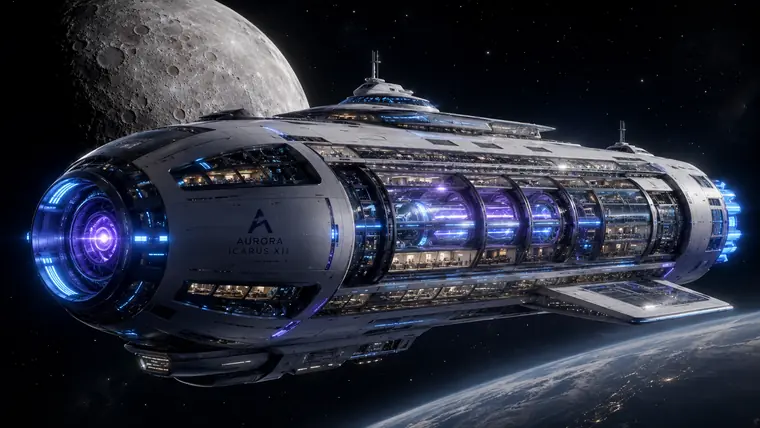
Use these three doorway cards first. They keep warp theory, Warp Probe ship development, and the Icarus X11 flagship concept from being mixed together.
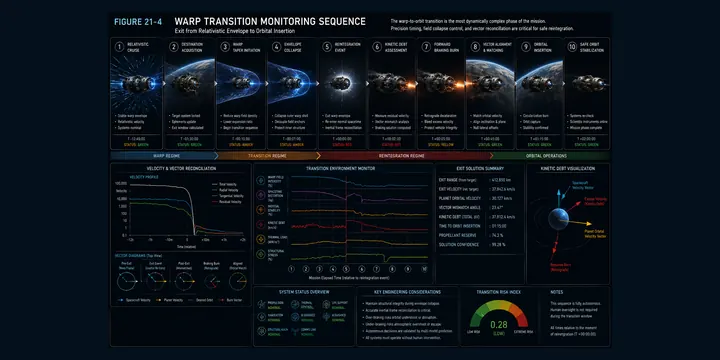
Public-safe explanation path for envelope behavior, transition monitoring, reintegration, and orbital insertion.
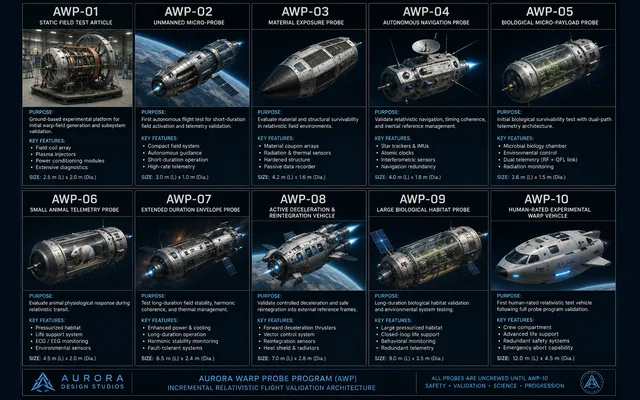
AWP-01 through AWP-10, Mark I-X, baseline vehicles, alternate concepts, drones, and crew-rated branch.
Dedicated page for the large crew-rated ship with deep-space, lunar-landing, and bridge/habitation visuals.
Secondary reference cards used for presentations and appendices. For the cleanest flow, start with the Primary Navigation Tracks above.
Dedicated transition page for exit, reintegration, vector reconciliation, kinetic-debt assessment, and orbit insertion framing.
Visual button matrix for ship-development families and presentation-ready entry points into deeper concept pages.
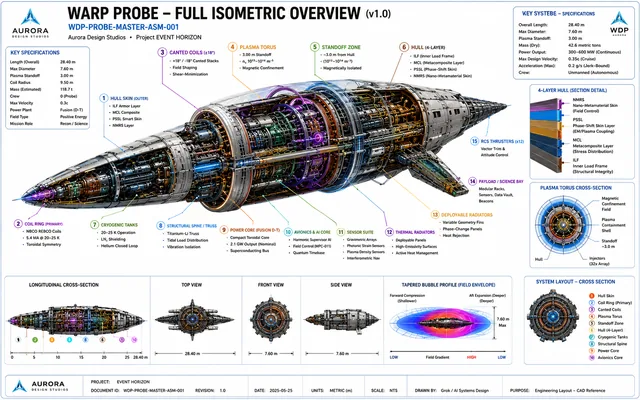
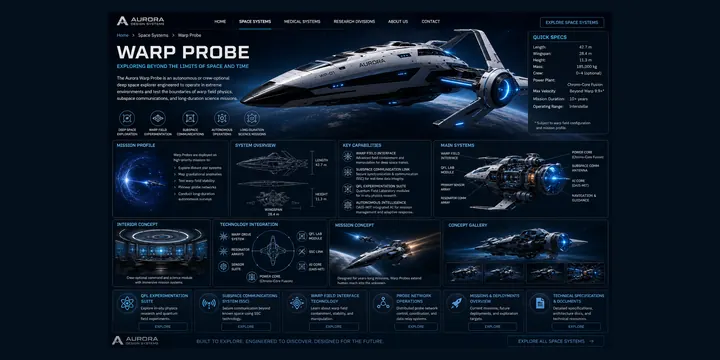
Master systems sheet for the baseline Warp Probe configuration, useful as a technical appendix reference.
These are master overview sheets, not extra vehicle models. They explain the whole program and the staged validation logic.
White-background program grid showing the staged AWP progression from ground test article through human-rated transport vessel.
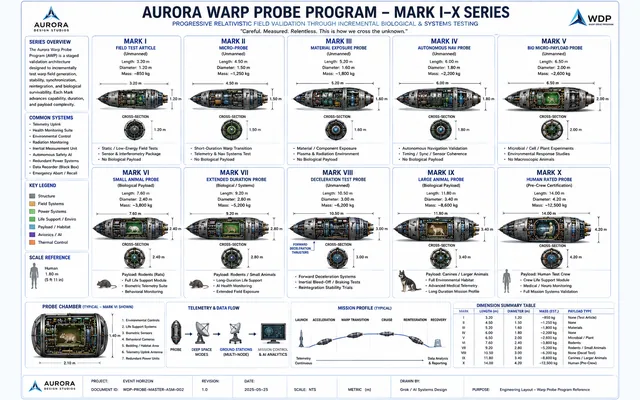
Reference sheet showing staged validation increments, common systems, scale references, payload classes, and development progression.
Full isometric systems overview of the primary Warp Probe configuration, including zones, cross-section callouts, and subsystem placement.
Primary AWP-01 through AWP-10 sheets. AWP-10 is treated as the first detailed human-rated transport sheet; the smaller AWP-10 shown in the program grid is only its overview marker.
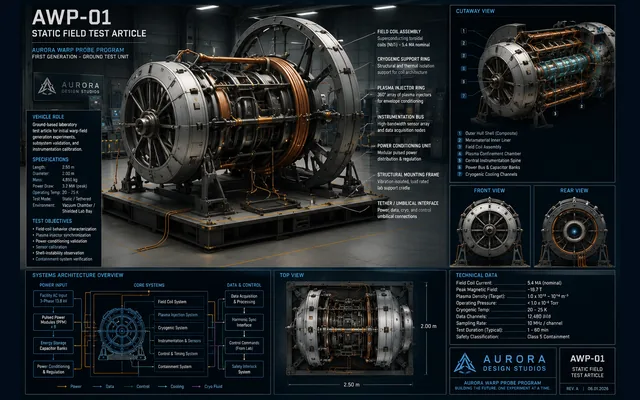
Ground-based experimental platform used for early subsystem validation, field coil behavior, power conditioning, and instrumentation calibration.
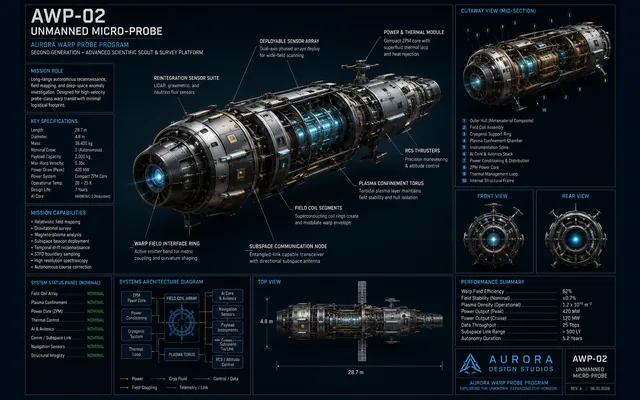
Autonomous micro-probe concept for short-duration field activation, telemetry validation, and early autonomous guidance studies.
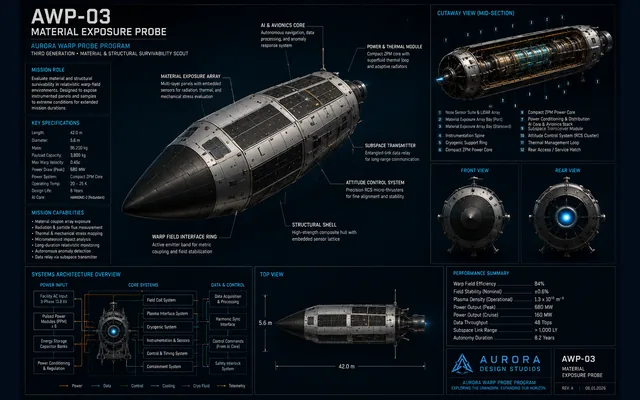
Material exposure platform for studying structural survivability, thermal response, radiation monitoring, and passive data recovery.
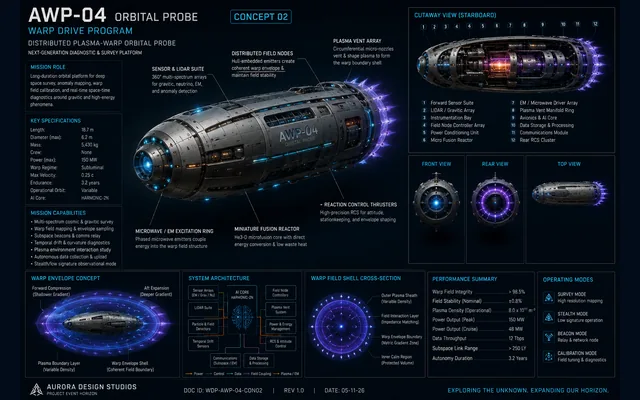
Orbital probe concept for autonomous navigation, survey operations, field calibration, and space-time diagnostic mapping.
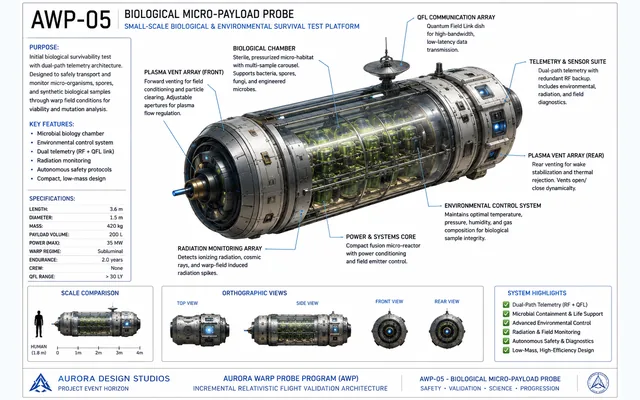
Biological micro-payload platform for environmental validation, telemetry architecture, containment monitoring, and survivability study framing.
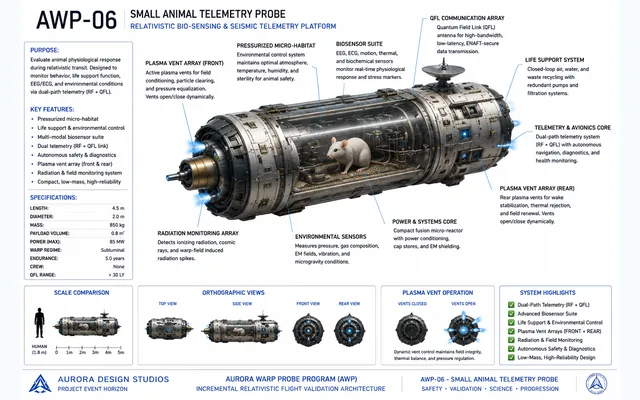
Small animal telemetry concept for bio-sensing, behavior monitoring, environmental control, and dual-path telemetry presentation material.
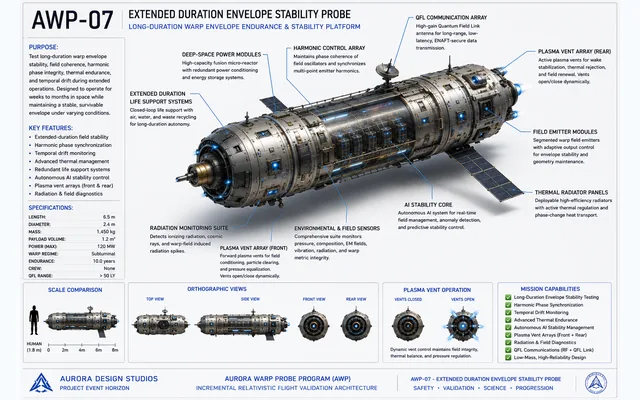
Extended-duration platform for envelope stability, thermal endurance, harmonic synchronization, drift monitoring, and long-duration autonomy framing.
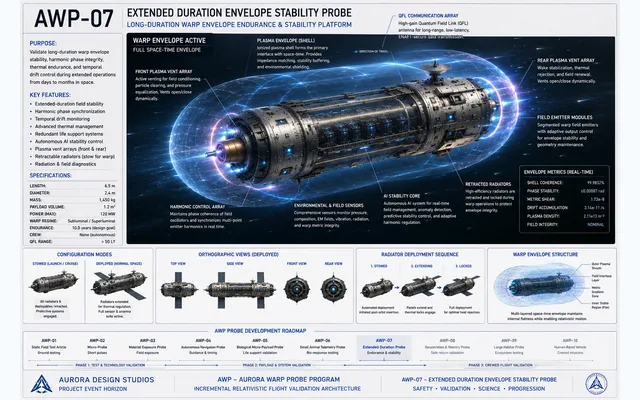
Active deceleration and reintegration concept for controlled return, reference-frame synchronization, safe envelope collapse, and recovery architecture.
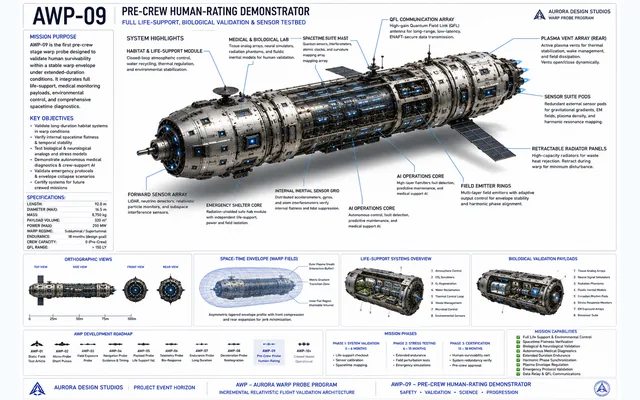
Pre-crew human-rating demonstrator for life-support validation, biological analogue testing, space-time diagnostics, and emergency protocol framing.
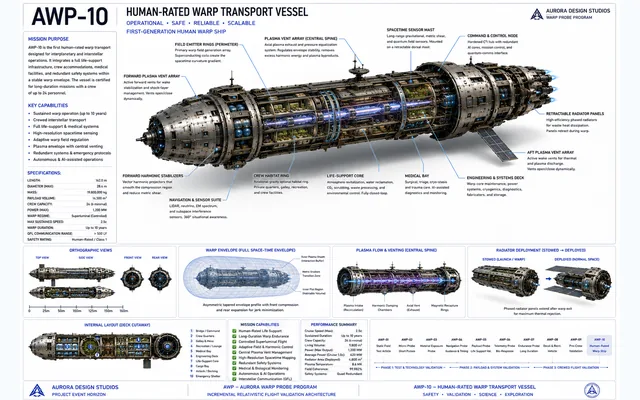
Detailed first-generation human-rated transport vessel sheet; the AWP-10 entry in the program grid remains the short overview marker.
These are not duplicates of the baseline sequence. They are alternate concepts or more detailed sheets for a specific design branch.
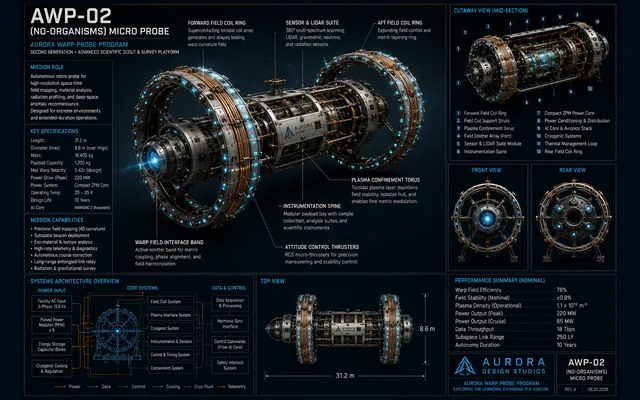
Alternate technical sheet for the AWP-03 material exposure configuration with additional cutaway and system architecture details.
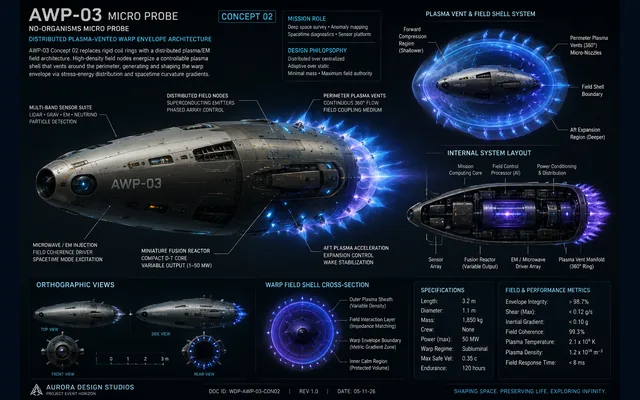
Concept 02 micro-probe design using distributed field and plasma-vent architecture for compact, public-safe spacecraft study.
Drone figures are grouped together so the compact surface drone program does not get mixed into the larger AWP vehicle sequence.
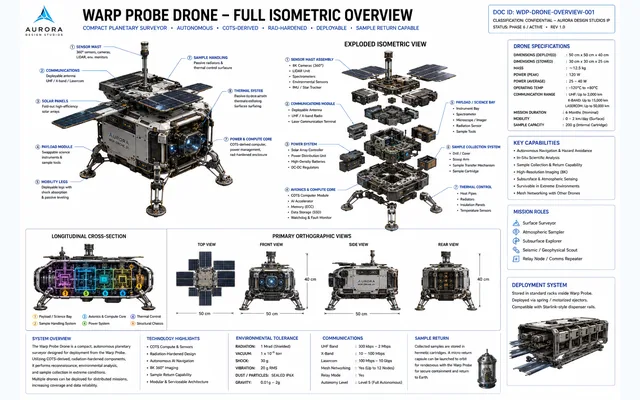
Compact autonomous planetary drone with deployable sensors, solar panels, mobility legs, sample handling, and return-capable mission framing.
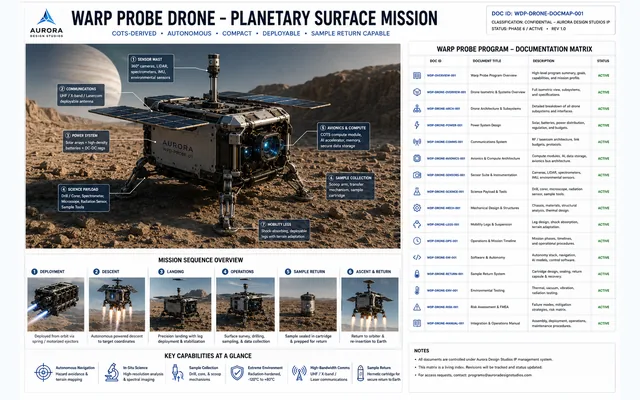
Planetary surface mission concept and documentation matrix for the compact Warp Probe drone system, including sequence overview and capability framing.