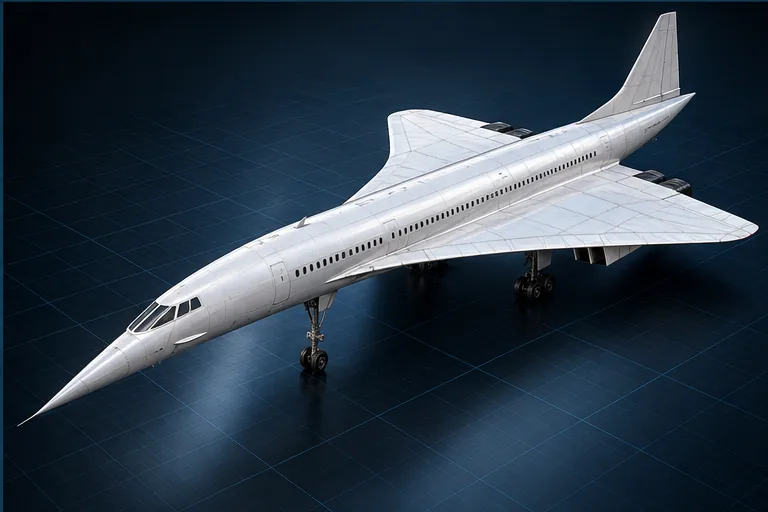
Aircraft technical study · BAC / Aérospatiale
Concorde Civil supersonic transport
Retired United Kingdom / France 1976–2003
1 2 3 Model-specific technical values
Key specifications Cruise speed Mach 2 (≈1,350 mph); operator-published service figure PRIMARY SOURCE VERIFIED Evidence ↗ Maximum speed Mach 2.04 maximum permitted cruising Mach REFERENCE VALUE / PENDING INDIVIDUAL SOURCE REVIEW Evidence ↗ Maximum altitude Up to 60,000 ft in service; not absolute ceiling PRIMARY SOURCE VERIFIED Evidence ↗ Propulsion 4 × Rolls-Royce/SNECMA Olympus 593 turbojets with reheat PRIMARY SOURCE VERIFIED Evidence ↗ Fuel / energy Kerosene aviation turbine fuel REFERENCE VALUE / PENDING INDIVIDUAL SOURCE REVIEW
Crew 3 flight crew: 2 pilots and 1 flight engineer PRIMARY SOURCE VERIFIED Evidence ↗ Max passengers 100 airline seats (British Airways arrangement); certified maximum not independently checked PRIMARY SOURCE VERIFIED Evidence ↗ Additional original dimensions / historic notes Wingspan 25.56 m
Length 61.66 m
Top speed 2,179 km/h
Engines 4 × Olympus 593
Primary-source values are checked by model; other values carry a review warning. Maximum speed may differ from maximum cruise speed; certified ceilings differ from achieved flight altitudes.
Data shown for the named aircraft or development program. Prototype figures and targets are explicitly labeled; performance varies with flight conditions and configuration.
Program status
Retired
Performance evidence boundary Historical BA operated at around Mach 2 and up to 60,000 ft.
For research aircraft, demonstrator speeds are achieved flight points; for manufacturer proposals, published design speeds are targets, not flight certificates. Historic figures must name the variant and conditions.
Technical anatomy
Three engineering callouts Choose a numbered marker on the rendering to highlight its associated technical explanation.
1 Ogival delta wing Lift and stability over supersonic and landing regimes.
2 Four afterburning engines Olympus turbojets powered long-haul supersonic flight.
3 Droop nose Lowered to improve forward visibility during approach.
Engineering significance
Why this aircraft matters It demonstrated routine airline service at approximately Mach 2.
Engineering constraints & status limits
High fuel consumption, noise rules, cost and route limits constrained viability.
Illustration disclosure. The three-quarter artwork is an independently created educational likeness. Callout points identify design features, not certified engineering coordinates. Do not use it to infer hidden structure, dimensions, rotor clearance or aircraft airworthiness. Airframe-accurate CAD geometry requires a separate manufacturer drawing or licensed model.