
Privacy & Consent
Dream data is treated as inner-life material with stronger boundaries than ordinary media or telemetry.
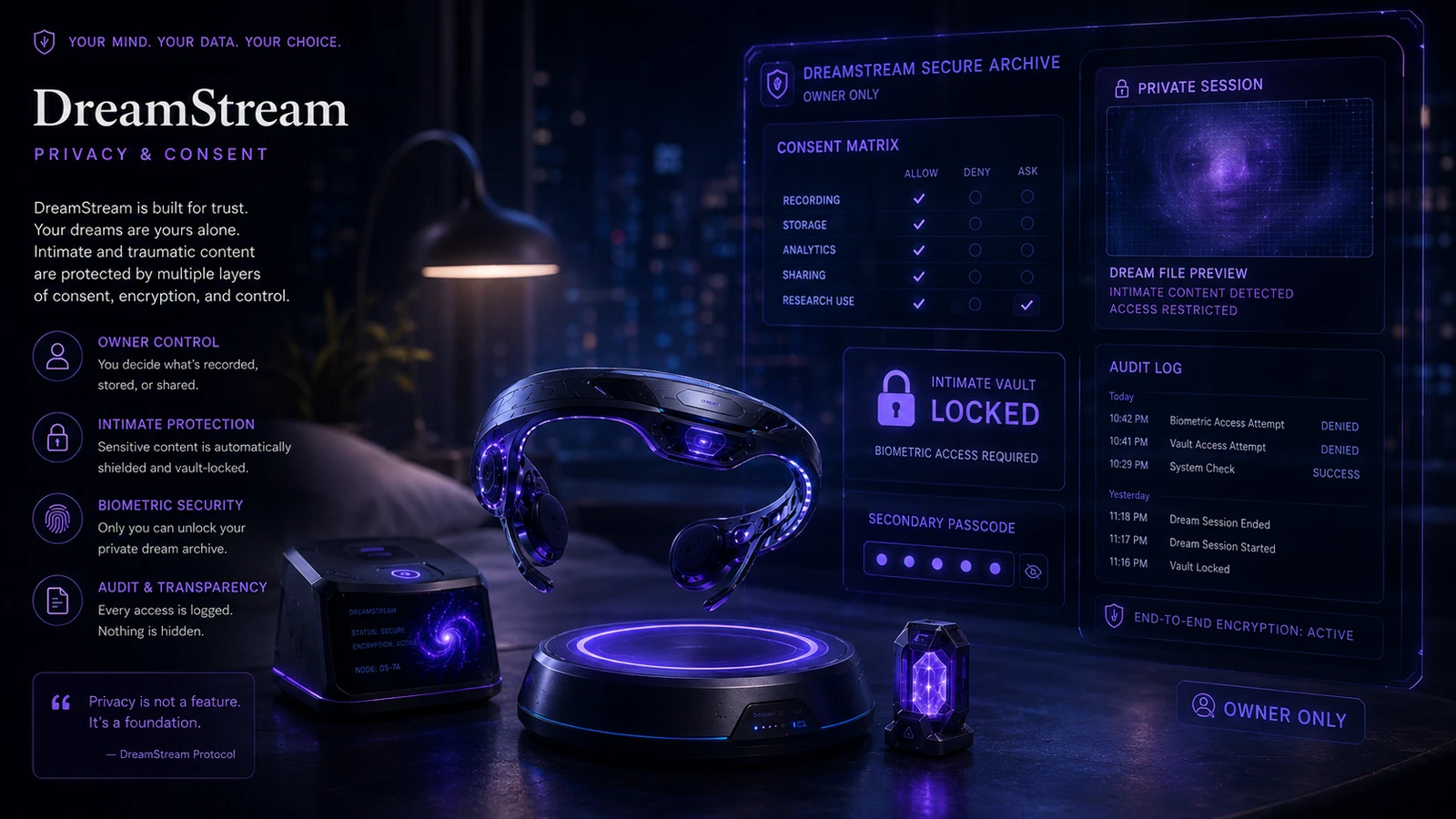
What this layer contributes.
DreamStream public pages describe roles, boundaries, and user protections without publishing proprietary implementation details.
Mental privacy
The architecture begins from a right to keep inner experience private.
Dream ownership
Capture does not transfer ownership to a platform, collaborator, employer, insurer, or institution.
Explicit sharing
Viewing, replay, collaboration, export, and secondary analysis are separately permissioned.
Revocation
Consent may expire or be withdrawn; possession of hardware does not imply perpetual access.
Deletion + silence
The user can restrict, purge, or silence records within the concept’s rights framework.
Auditability
Access and permission changes are intended to be visible rather than hidden in opaque backend systems.
Five visible stages.
The operating path is intentionally legible so the user can understand where control, uncertainty, and intervention enter the system.
Enough to understand the system—not enough to expose the implementation.
Consistent imagery for engineering and narrative continuity.
Renderings support concept communication, books, scripts, and future CGI development while remaining separate from validation claims.