
Research & Validation
The program separates credible enabling fields from frontier research and from story-world capabilities that remain speculative.
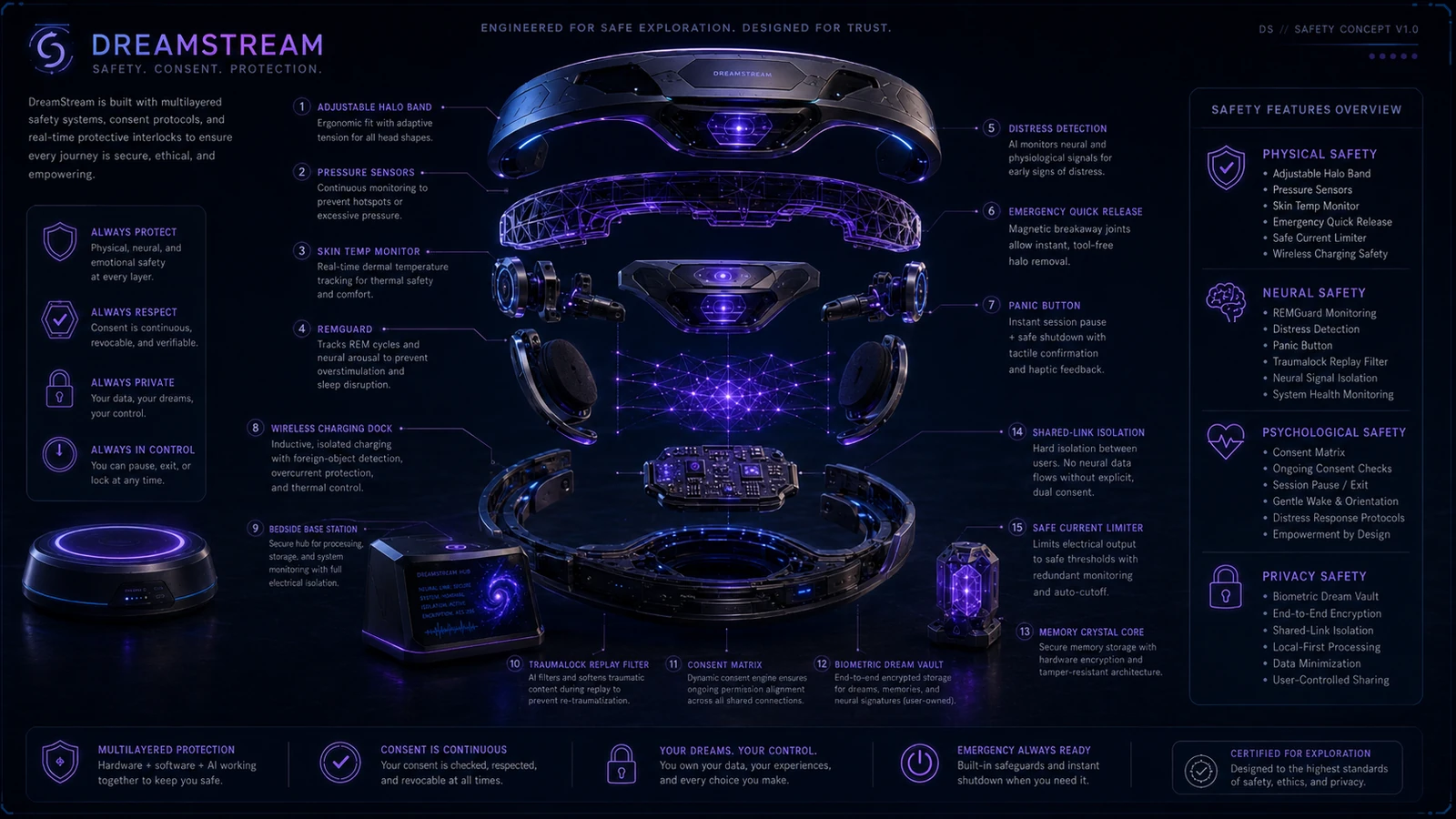
What this layer contributes.
DreamStream public pages describe roles, boundaries, and user protections without publishing proprietary implementation details.
Requirements before claims
Public-facing claims stay below the evidence actually available.
Bench + sensor testing
Hardware, signal quality, fault handling, and human factors would precede ambitious experience claims.
Research ladder
Prototype evidence, controlled studies, replication, and independent review are distinct stages.
Medical boundary
Diagnostic or therapeutic positioning would require its own evidence, quality system, and regulatory pathway.
Privacy + ethics
Research access does not suspend consent, data minimization, or participant protections.
Failure transparency
Null results, ambiguity, and false-positive risks are part of the engineering story, not something to hide.
Five visible stages.
The operating path is intentionally legible so the user can understand where control, uncertainty, and intervention enter the system.
Enough to understand the system—not enough to expose the implementation.
Consistent imagery for engineering and narrative continuity.
Renderings support concept communication, books, scripts, and future CGI development while remaining separate from validation claims.
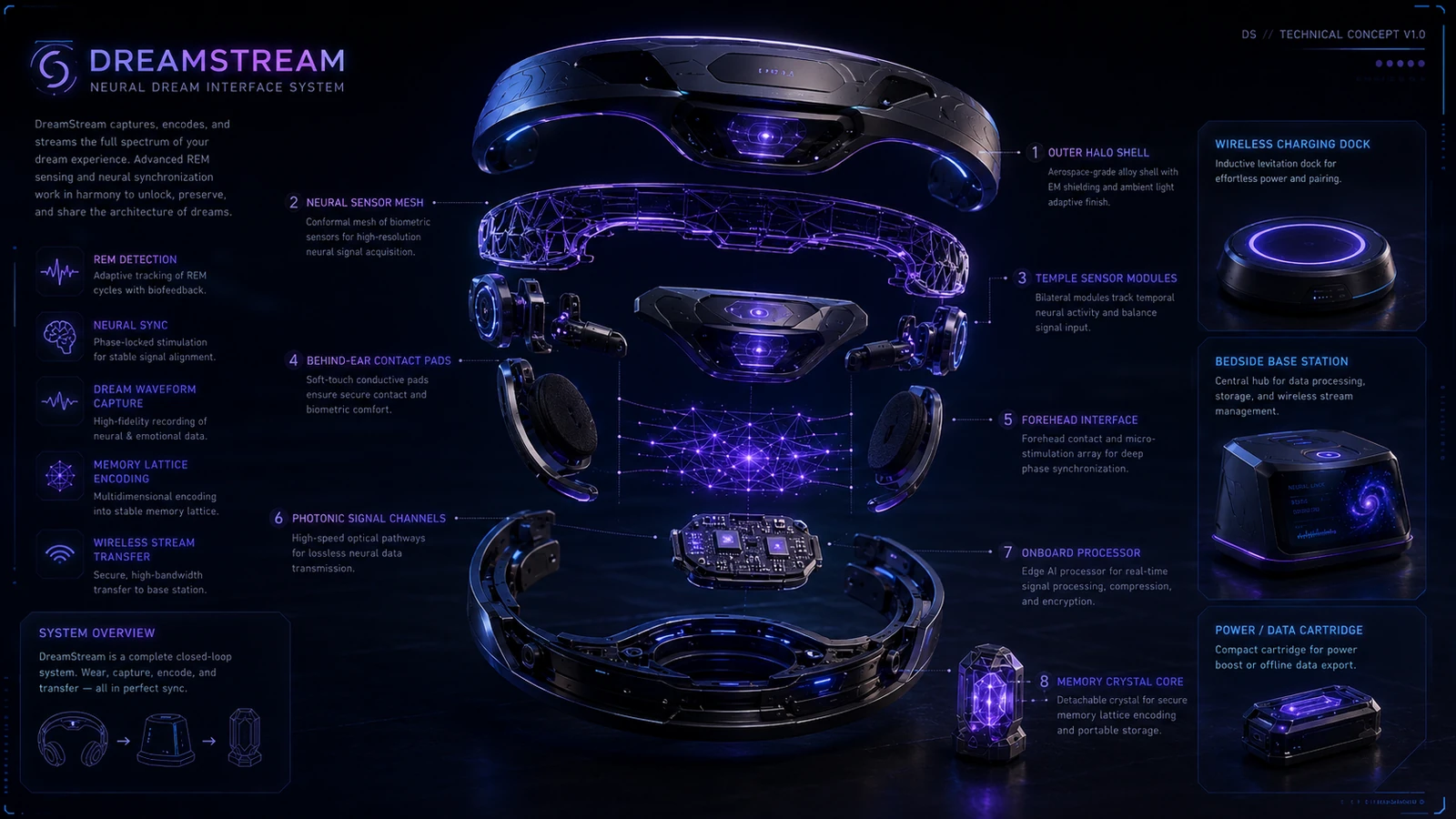
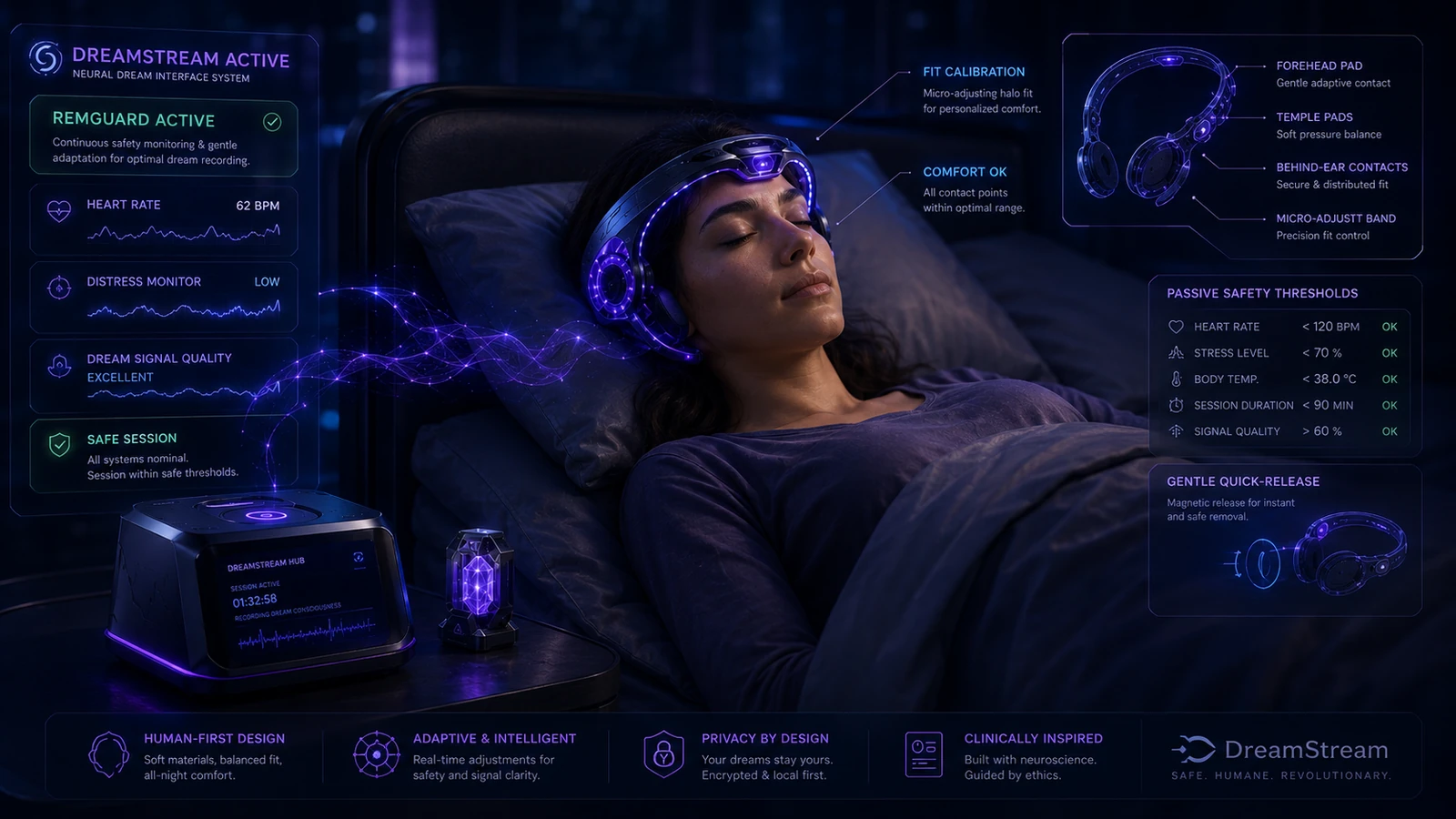
Reality, frontier, and speculation stay visibly separated.
This is a public concept architecture, not a substitute for laboratory or clinical evidence.
Reality
Noninvasive sensing, sleep-state monitoring, signal processing, privacy engineering, human factors, safety interlocks, and controlled software systems.
Frontier
Improved decoding of sleep-associated content, richer multimodal reconstruction, personalized modeling, and carefully bounded human-interface research.
Speculative
High-fidelity dream replay, shared dreamspace, persistent Dream Lattice behavior, and advanced consciousness-interface functions.