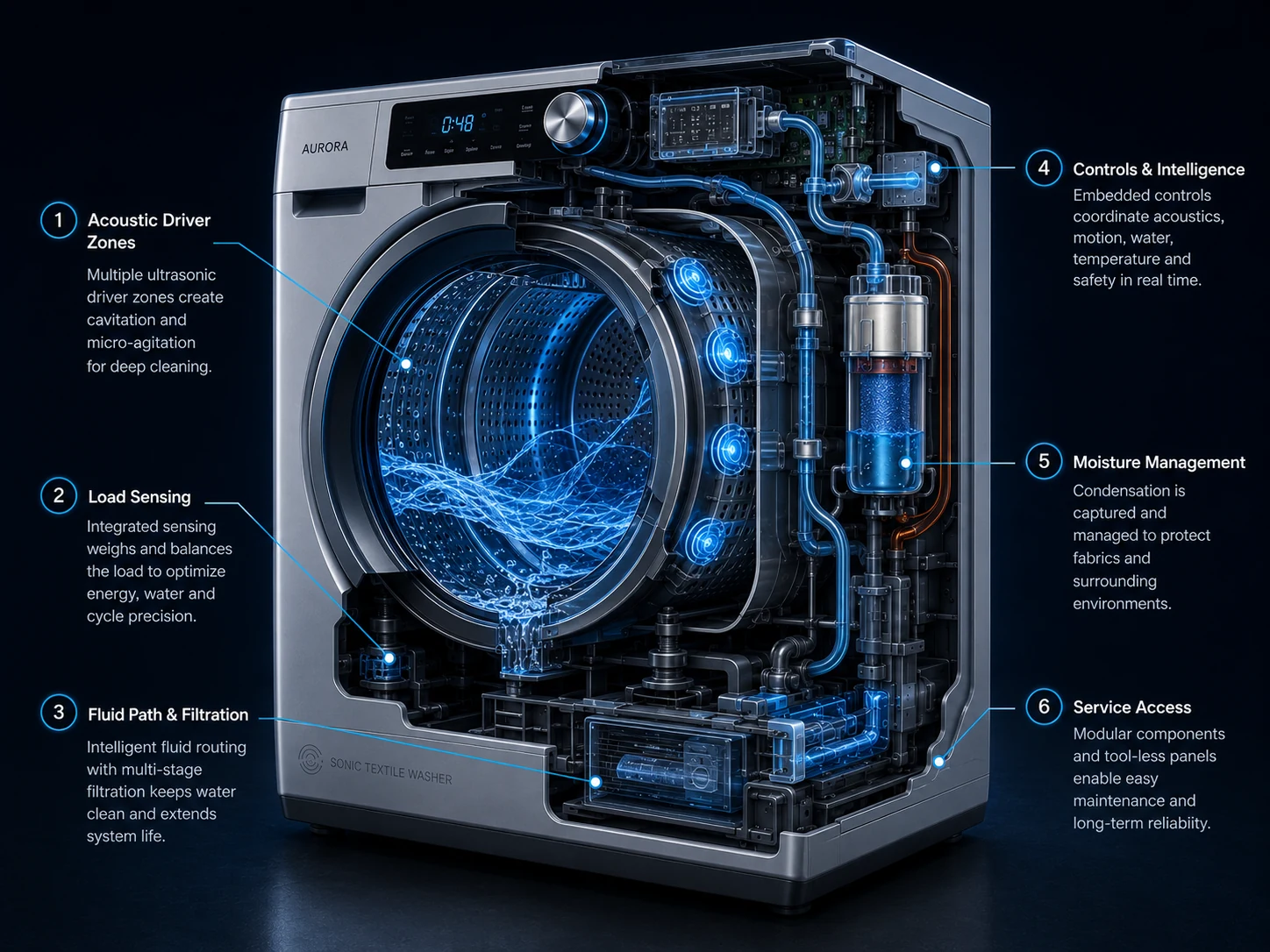
How Sonic Textile Washer Works
A public-facing functional explanation. It deliberately omits production transducer count, exact placement, wiring, mounting geometry, detailed reservoir dimensions and proprietary control parameters.
Five-stage conceptual cycle
Identify load geometry, density and anomalous objects.
Introduce controlled mist or thin-film fluid.
Apply zoned acoustic cleaning within fabric limits.
Move suspended contamination toward capture.
Rinse/condition and transfer to moisture-reduction phase.
Conceptual internals at full page width
This illustration communicates subsystem roles only. It is intentionally not a production layout and does not disclose final transducer placement, wiring topology, fluid routing or calibration values.
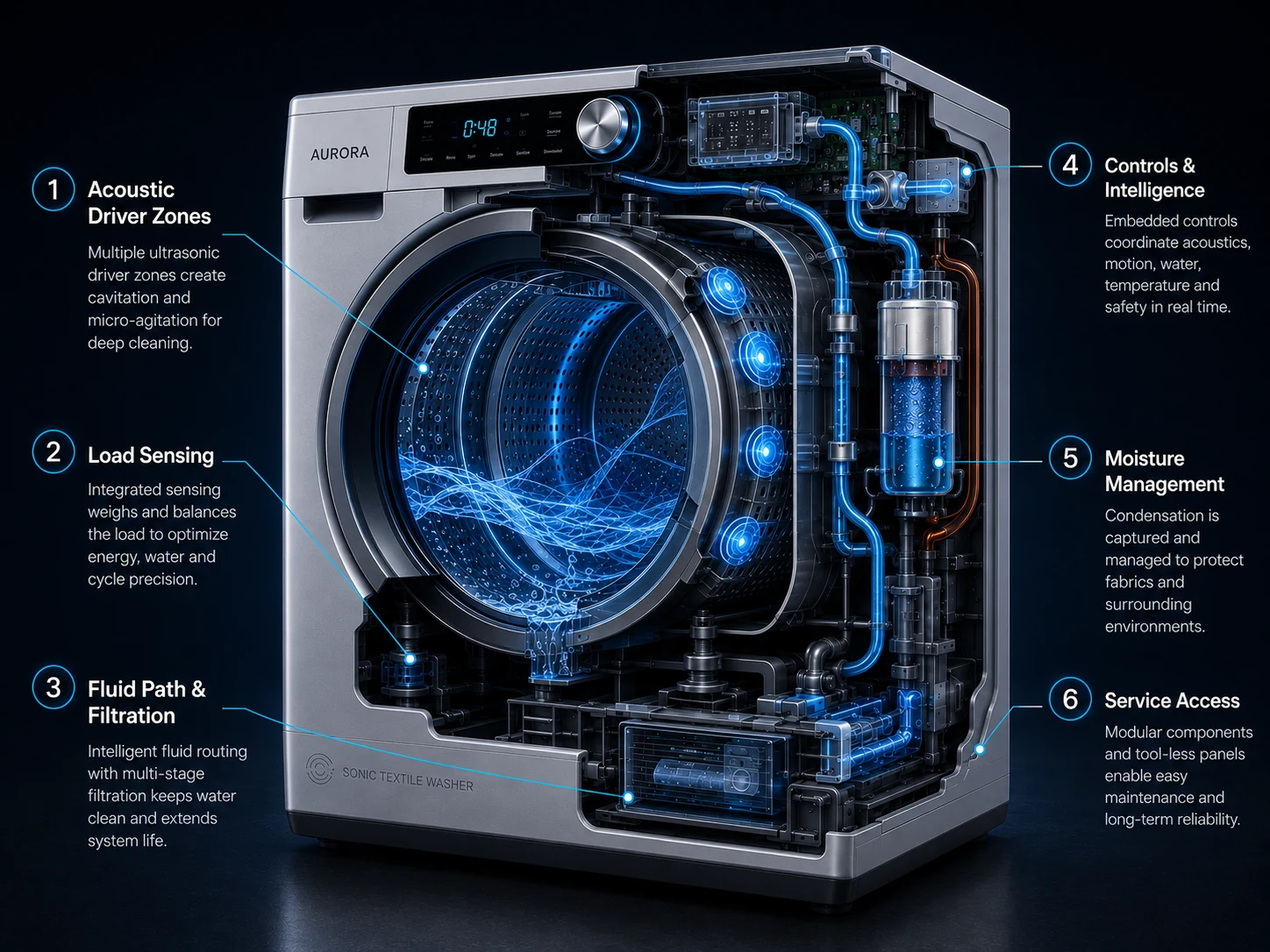
Zoned energy delivery with product-specific operating limits.
Only the moisture required for the validated coupling strategy.
Extraction, separation, filtration and moisture-management paths.
Real-time monitoring constrains the product to approved operating states.
What detailed design will eventually lock
Installation width, height, depth, clearances and service zones.
Sheet-metal/composite panels, bends, stiffeners, doors, seals and isolation.
Drivers, power supplies, sensors, blowers, pumps, valves and harness routing.
Filters, reservoir access, condensate/drain paths and replaceable modules.
Operating permissions are conditional
No human or animal may be inside; presence detection inhibits acoustic drive.
Opening the door removes acoustic drive and motion commands.
Unexpected metal/dense objects trigger reduced mode, pause or user alert.
Mechanical motion remains inhibited or reduced when unsafe imbalance is detected.
Transducer and driver temperatures remain inside safe operating region.
Abnormal impedance, resonance or field behavior triggers derating.
Acoustic modes requiring fluid coupling cannot run without validated coupling state.
Leak/moisture sensors protect electronics and floor environment.
Engineering test modes require an empty chamber and service access state.
Experimental sensing or future high-sensitivity sensor modules do not override the occupancy/interlock architecture. Any diagnostic or calibration mode that has not been explicitly validated for occupied operation remains inhibited when people or animals are detected.