Do No Greater Harm
Gaia Safeguard Doctrine
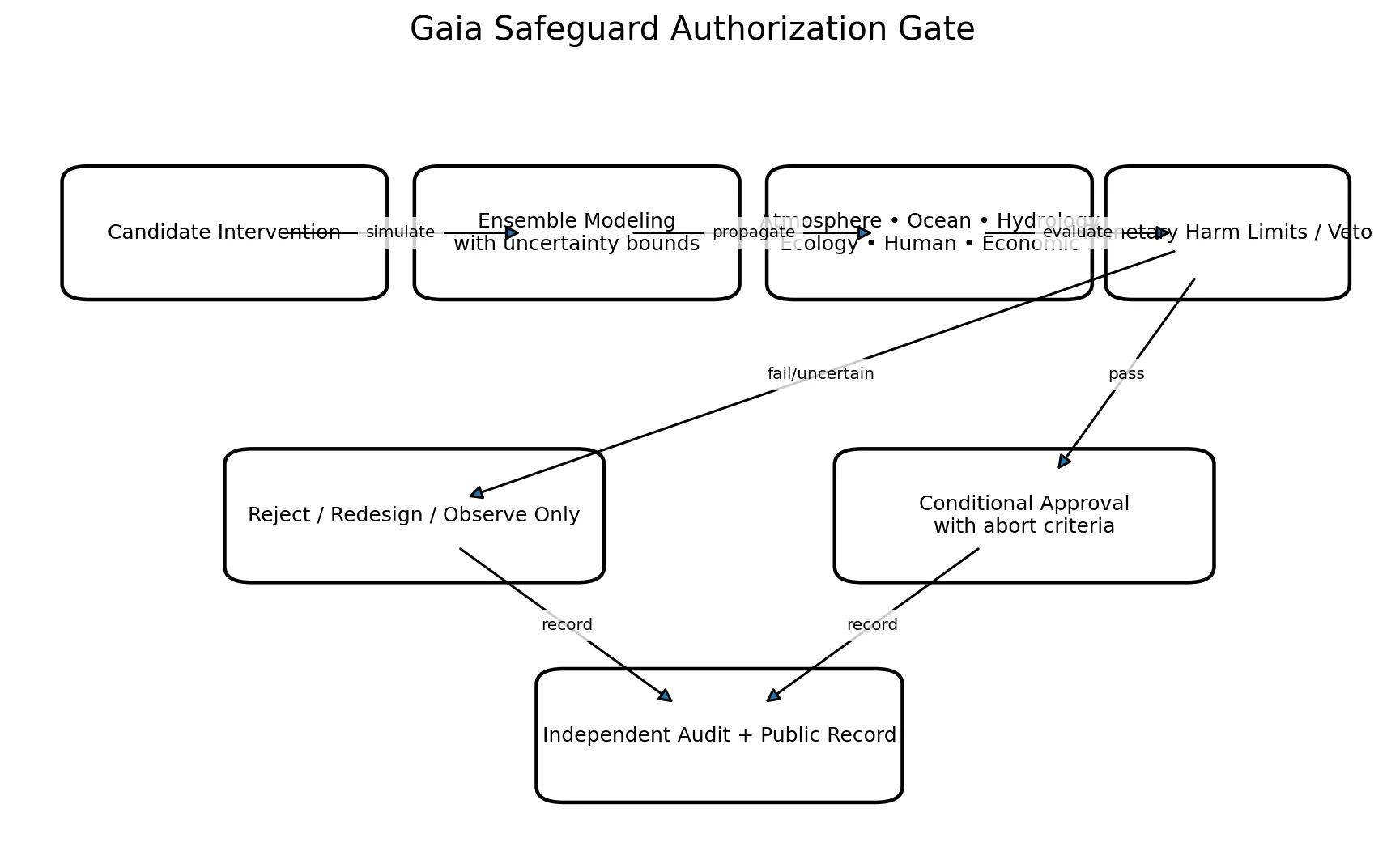
The governing safety doctrine for any GARN intervention research: consequence modeling, reversibility, bounded tests, transparent decision records, independent review, and human authorization.
No local benefit is allowed to hide a larger downstream harm.
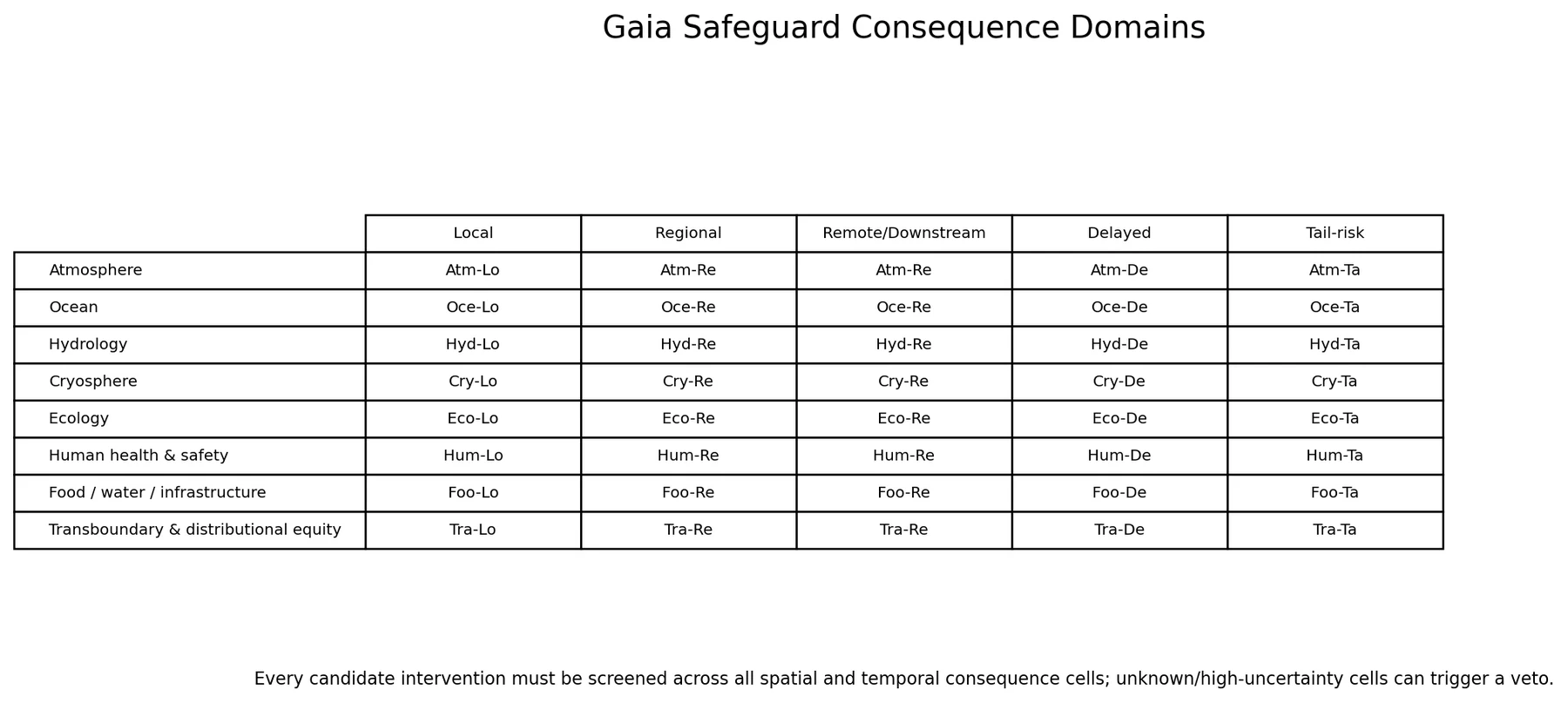
The Gaia Safeguard is a stop-work doctrine. Every proposed action is screened across atmospheric transport, ocean circulation, watersheds, ecosystems, vulnerable populations, infrastructure, food and water systems, and legal jurisdictions. Unknowns remain visible; they are not treated as zero.
Reversible where practicalPrefer interventions that can be stopped, withdrawn, or allowed to decay without locking in a new planetary state.
Bounded testsScale increases only after measured outcomes agree with model envelopes and independent review.
Downstream consequence modelingEvaluate remote as well as local receptors across coupled Earth-system pathways.
Human authorizationAI may advise, simulate, and flag hazards; independent human authority retains permission and stop rights.
Transparent recordsPreserve assumptions, uncertainty, dissent, affected-domain maps, abort observables, and residual risk.
No-action baselineEvery candidate is compared with no action and lower-risk alternatives before escalation.