
Rapid driver-driven compression; target inertia confines the fuel for a brief burn.
← Back to Fusion Reactor Systems
Inertial Confinement Fusion • Detailed Family
Inertial-Confinement Fusion
Inertial confinement uses intense drivers to compress and heat small targets for extremely brief fusion events. Laboratory ignition and target gain are important scientific milestones; they do not by themselves demonstrate repetitive operation, facility-level energy gain, durable chambers, closed fuel handling, or net electricity delivery.
Laser / Pulsed DriversTarget CompressionIgnition DemonstratedPower Systems Remain Research
ADS 43.9 • Phase 4B • Rev 1.0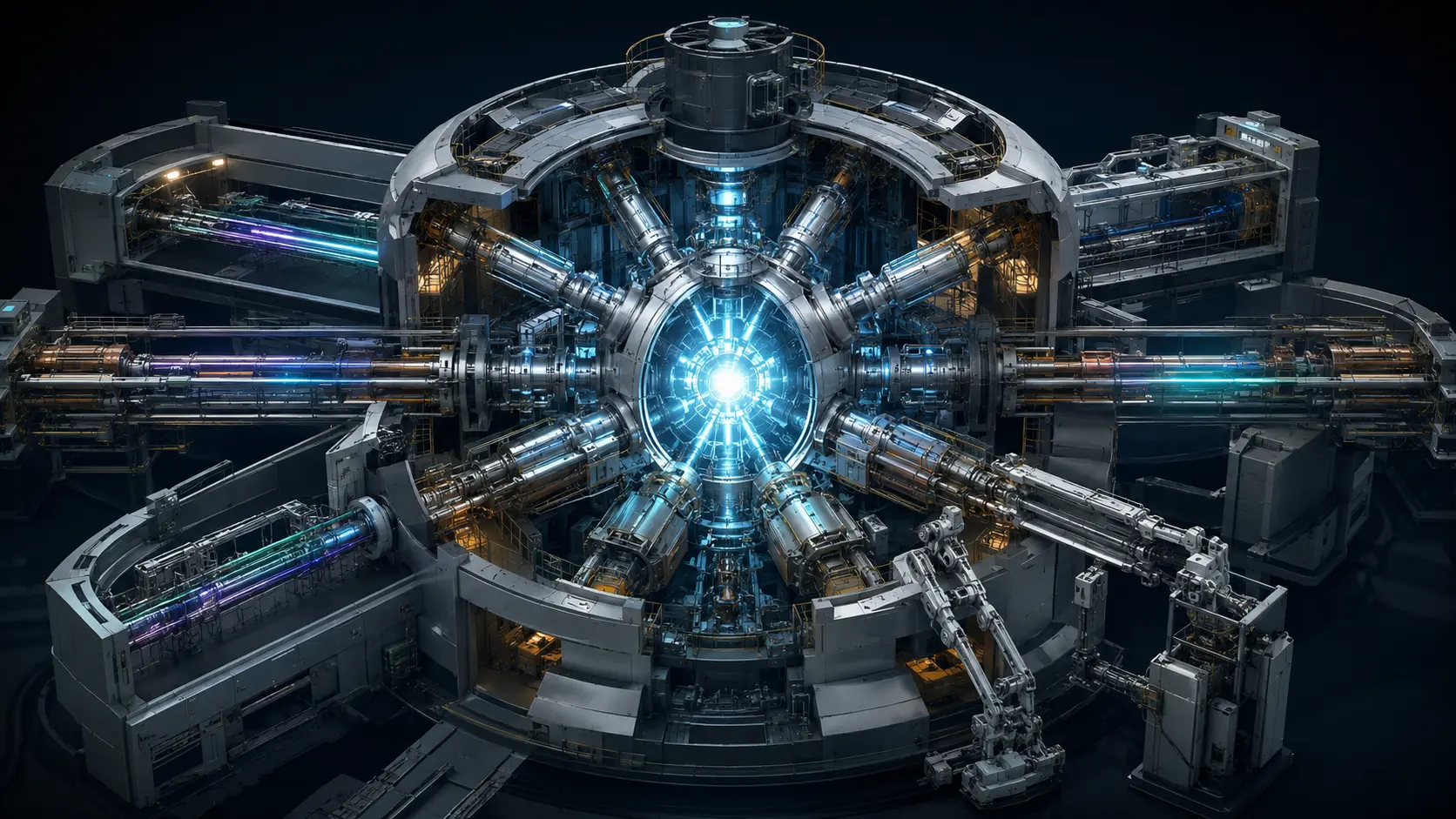
Phase 4B • Concise Comparison
Engineering comparison
Current ignition experiments principally use deuterium-tritium capsules and produce energetic neutrons.
Repeated laboratory ignition and target gain have been demonstrated; repetitive fusion-energy plants have not.
High-energy-density science, stockpile stewardship, ignition research, and longer-term inertial-fusion-energy development.
Driver efficiency and repetition rate, target manufacture and injection, chamber clearing and survival, heat capture, tritium recovery, remote maintenance, and total facility efficiency.
Major-Component Plausibility Review
Public-level system callouts
These callouts describe plausible subsystem roles without publishing dimensions, operating parameters, control logic, materials recipes, or build instructions.
- Central target chamber
- Symmetric driver or beam ports
- Target delivery and tracking interface
- Diagnostic and neutron-measurement systems
- Replaceable chamber-protection region
- Driver power, thermal and remote-maintenance support
Callouts were reviewed for family-level technical plausibility. Their arrangement is illustrative and does not represent a specific facility.
Applications
Where this family fits
Ignition science
Studies target compression, burn propagation, yield, and repeatability.
High-energy-density research
Supports controlled laboratory experiments in extreme states of matter.
Future energy research
Explores repetitive drivers, targets, chambers, fuel recovery, heat capture, and plant availability.
Engineering Reality Check
Maturity and claims boundary
What the artwork shows
A generalized public-facing concept intended to communicate architecture and subsystem relationships.
What it does not show
No proprietary geometry, device settings, operating windows, safety calculations, fuel-cycle recipes, procurement specifications, control logic, or construction instructions.
Public boundary: Technology classification and public research context only. Advanced fuels and direct conversion remain clearly labeled frontier research; neither is presented as commercially ready.
10-Phase Reactor Program • Phase 2
Fusion taxonomy specification
Standardized public-safe fields support comparison across every fission and fusion family. Values are intentionally qualitative; licensing data, dimensions, operating windows, calculations, control logic, and build instructions remain offline.
Laser, ion, or pulsed-driver target compression
Driver efficiency, target cost, repetition, chamber life, and thermal capture
D-T target systems retain neutron activation, tritium, and chamber waste
Ignition research established; energy plant unproven
Specification boundary: Family-level technology classification and lifecycle context—not a vendor datasheet, safety analysis, procurement specification, or construction package.
Ten-Phase Reactor Program · Phase 5
Safety, licensing and public-trust boundary
High-energy drivers, target fabrication and radioactive inventory, chamber pulses, debris and activated components, optics protection, vacuum, heat recovery, repetition, and maintenance exposure.
Near-term U.S. fusion systems are directed toward a Part 30 byproduct-material framework and associated regulations. Exact jurisdiction and license content depend on radioactive inventories, hazards, and facility activities.
Control and account for tritium and other radioactive materials; secure sources, targets, activated components, digital systems, and transfers. Fusion is not exempt from material control or security merely because fissile fuel is not the primary energy source.
Use a hazard- and inventory-based emergency plan under the applicable materials and facility framework. Lower accident potential cannot be translated into “no emergency plan” without an approved consequence analysis.
May say the concept is an active fusion research line with identified hazards and an emerging materials-based regulatory framework. Distinguish plasma milestones from plant safety and electricity.
Do not claim harmless, radiation-free, waste-free, maintenance-free, self-sustaining, net-electric, commercially licensed, no emergency planning, or “just a small sun.”
Classification only: This is not a safety finding, licensing opinion, emergency plan, security plan, or legal determination. Exact obligations belong to the applicable regulator and project authority.