
Compact-toroid magnetic configurations formed and sustained in linear or cylindrical chambers.
← Back to Fusion Reactor Systems
Advanced Fusion Research • Detailed Family
Field-Reversed Configuration and Spheromak
Field-reversed configurations and spheromaks are compact-toroid plasmas with substantial self-organized magnetic structure. They may offer simpler external magnet geometry than conventional toroidal systems, but formation, sustainment, stability, confinement quality, exhaust, component life, and integrated plant performance remain active research areas.
Compact ToroidsSelf-Organized Magnetic StructureFrontier ResearchNo Commercial-Readiness Claim
ADS 43.9 • Phase 4B • Rev 1.0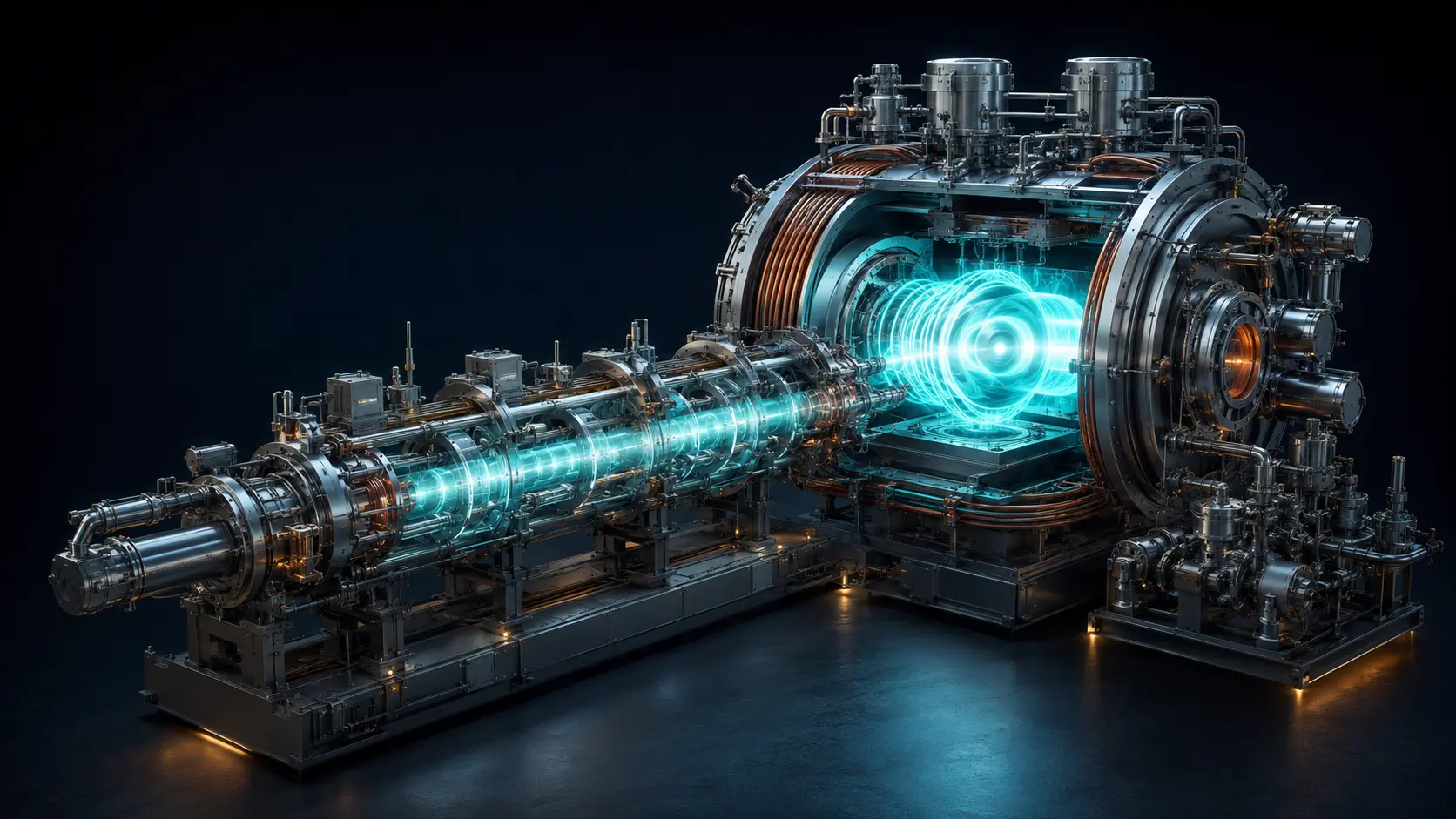
Phase 4B • Concise Comparison
Engineering comparison
Deuterium-tritium is the conservative near-term energy reference; advanced-fuel claims remain speculative.
Laboratory devices and continuing private and public research; no burning-plasma or commercial plant demonstration.
Compact-toroid physics, plasma formation and sustainment research, pulsed experiments, and possible future energy concepts.
Repeatable formation, stability, sustainment, particle and energy confinement, heating, impurity and exhaust control, neutron-facing structures, fuel cycle, maintenance, and net plant efficiency.
Major-Component Plausibility Review
Public-level system callouts
These callouts describe plausible subsystem roles without publishing dimensions, operating parameters, control logic, materials recipes, or build instructions.
- Plasma formation or injector section
- Cylindrical confinement chamber
- External guide and compression coils
- Heating and sustainment interfaces
- Vacuum and diagnostic modules
- Replaceable plasma-facing and maintenance sections
Callouts were reviewed for family-level technical plausibility. Their arrangement is illustrative and does not represent a specific facility.
Applications
Where this family fits
Compact-toroid research
Studies formation, translation, merging, sustainment, and stability.
Pulsed plasma experiments
Explores compression, heating, and transient operating regimes.
Future energy research
Requires burning-plasma evidence plus credible blankets, fuel cycle, heat extraction, maintenance, and availability.
Engineering Reality Check
Maturity and claims boundary
What the artwork shows
A generalized public-facing concept intended to communicate architecture and subsystem relationships.
What it does not show
No proprietary geometry, device settings, operating windows, safety calculations, fuel-cycle recipes, procurement specifications, control logic, or construction instructions.
Public boundary: Technology classification and public research context only. Advanced fuels and direct conversion remain clearly labeled frontier research; neither is presented as commercially ready.
10-Phase Reactor Program • Phase 2
Standardized fusion technical specification
Standardized public-safe fields support comparison across every fission and fusion family. Values are intentionally qualitative; licensing data, dimensions, operating windows, calculations, control logic, and build instructions remain offline.
Compact-toroid magnetic configurations in linear or cylindrical chambers
Improved sustainment and confinement, efficient formation/heating, simpler external coils
High-field guide coils; plasma-facing refractory materials; radiation-tolerant injectors; blanket and shield candidates
Conservative D-T operation retains neutron activation, tritium, shielding, blanket, and component-disposal requirements.
Thermal capture unless a future charged-particle fuel and converter are proven
Frontier laboratory research
Compact plasma geometry does not prove compact plant geometry or net electrical output.
Specification boundary: Family-level technology classification and lifecycle context—not a vendor datasheet, safety analysis, procurement specification, or construction package.
Ten-Phase Reactor Program · Phase 5
Safety, licensing and public-trust boundary
Pulsed power, formation and sustainment hardware, magnetic stored energy, injectors, vacuum, fuel inventory, activation, heat and particle exhaust, direct-conversion claims, and maintenance.
Near-term U.S. fusion systems are directed toward a Part 30 byproduct-material framework and associated regulations. Exact jurisdiction and license content depend on radioactive inventories, hazards, and facility activities.
Control and account for tritium and other radioactive materials; secure sources, targets, activated components, digital systems, and transfers. Fusion is not exempt from material control or security merely because fissile fuel is not the primary energy source.
Use a hazard- and inventory-based emergency plan under the applicable materials and facility framework. Lower accident potential cannot be translated into “no emergency plan” without an approved consequence analysis.
May say the concept is an active fusion research line with identified hazards and an emerging materials-based regulatory framework. Distinguish plasma milestones from plant safety and electricity.
Do not claim harmless, radiation-free, waste-free, maintenance-free, self-sustaining, net-electric, commercially licensed, no emergency planning, or “just a small sun.”
Classification only: This is not a safety finding, licensing opinion, emergency plan, security plan, or legal determination. Exact obligations belong to the applicable regulator and project authority.