
Why the NCE family needs more than one physical envelope.
A role band is an architecture target, not a certification statement. Different environments put different pressure on thermal paths, packaging, service access, redundancy, sensor interfaces, latency and fault containment. The family therefore scales by mission and physical integration needs—not by simply enlarging one universal computer.
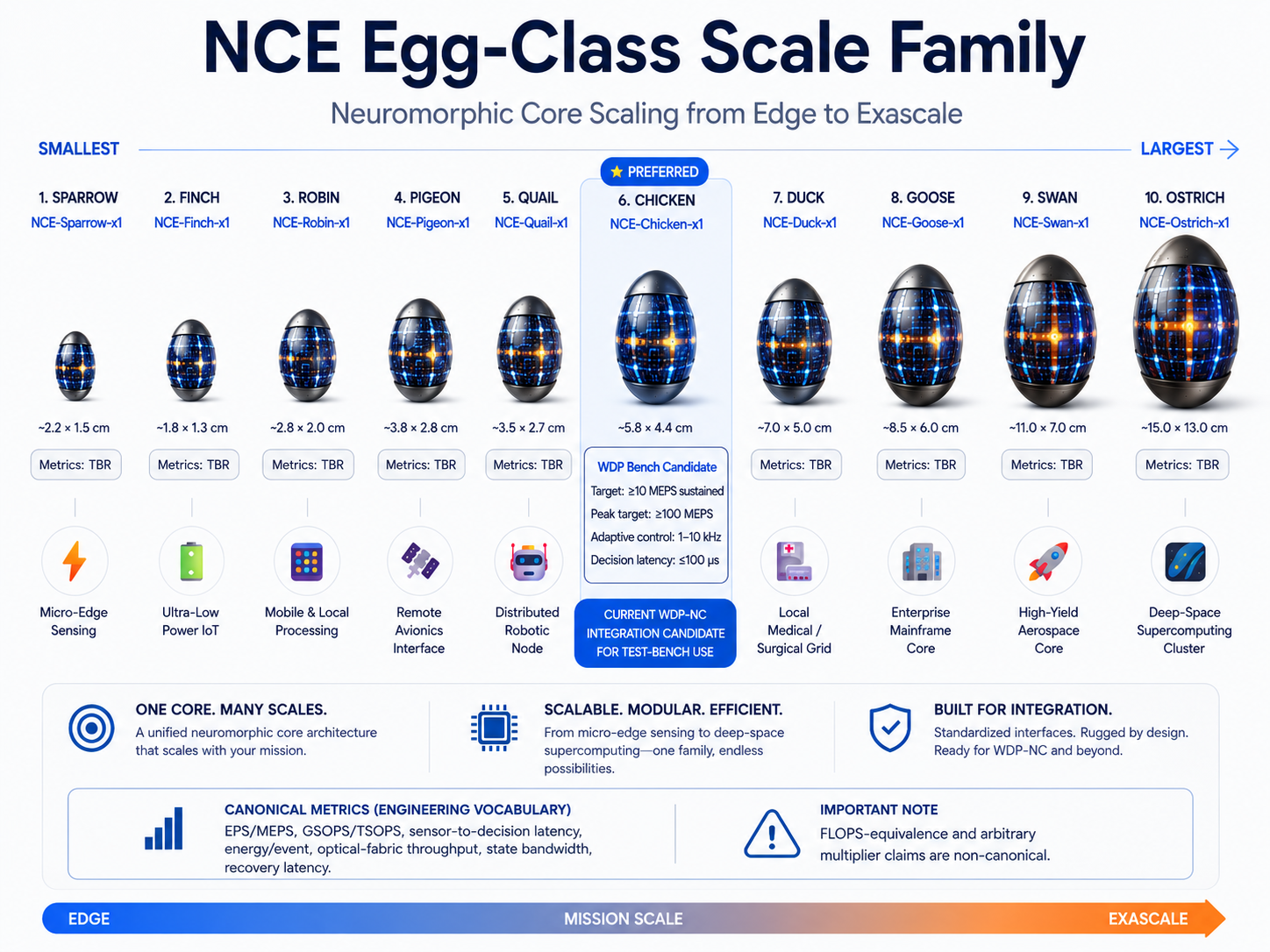
Sparrow targets micro-edge sensing and reflex-style preprocessing. Finch extends toward ultra-low-power IoT and instrument nodes. Robin moves into mobile and local processing where richer memory, routing and device integration become useful. Finch and Robin remain proposed intermediate aliases.
Pigeon is the proposed remote avionics interface band: compact local intelligence near sensors, buses and remote equipment. Quail is the proposed distributed robotic-node band, where event-driven perception, motor/sensor coordination and local fault awareness matter more than raw centralized throughput.
NCE-Chicken-x1 is the current desktop/workstation accelerator class and the current WDP-NC test-bench integration candidate. Its role is bounded experimental control, sensor fusion and metrology support with independent deterministic protection. The current WDP performance figures are TBR targets, not validated product specifications.
It occupies a practical middle envelope: large enough for richer service, thermal and I/O architecture, yet compact enough for a controlled laboratory installation and iterative test-bench integration.
Duck is the proposed local medical/surgical grid role band. Public wording should treat this as a target architecture for medical-device or clinical compute integration—not as a certified medical product. Reliability, isolation, human authority and platform-specific validation would govern any real deployment.
Goose is the existing NC-G enterprise/mainframe anchor. Swan is the proposed high-yield aerospace role band. Ostrich is the existing NC-O deep-space/datacenter cluster anchor. At these scales, service zones, active cooling, distributed health management, fault containment and xN system composition become first-order architecture concerns.
Role bands guide engineering; they do not freeze the future.
Future contextual renderings can show NCE modules integrated into control or sensing bays without claiming a released product design.
Aerospace depictions should emphasize ruggedized integration, redundancy, deterministic protection and environment-specific qualification.
Public visuals can communicate local intelligent instrumentation while keeping clinical efficacy and certification claims explicitly out of scope.
Cross-project technologies such as TFEM or CSSA can be shown later as separate supporting layers once their public interfaces are mature. This page intentionally does not force that convergence prematurely.