
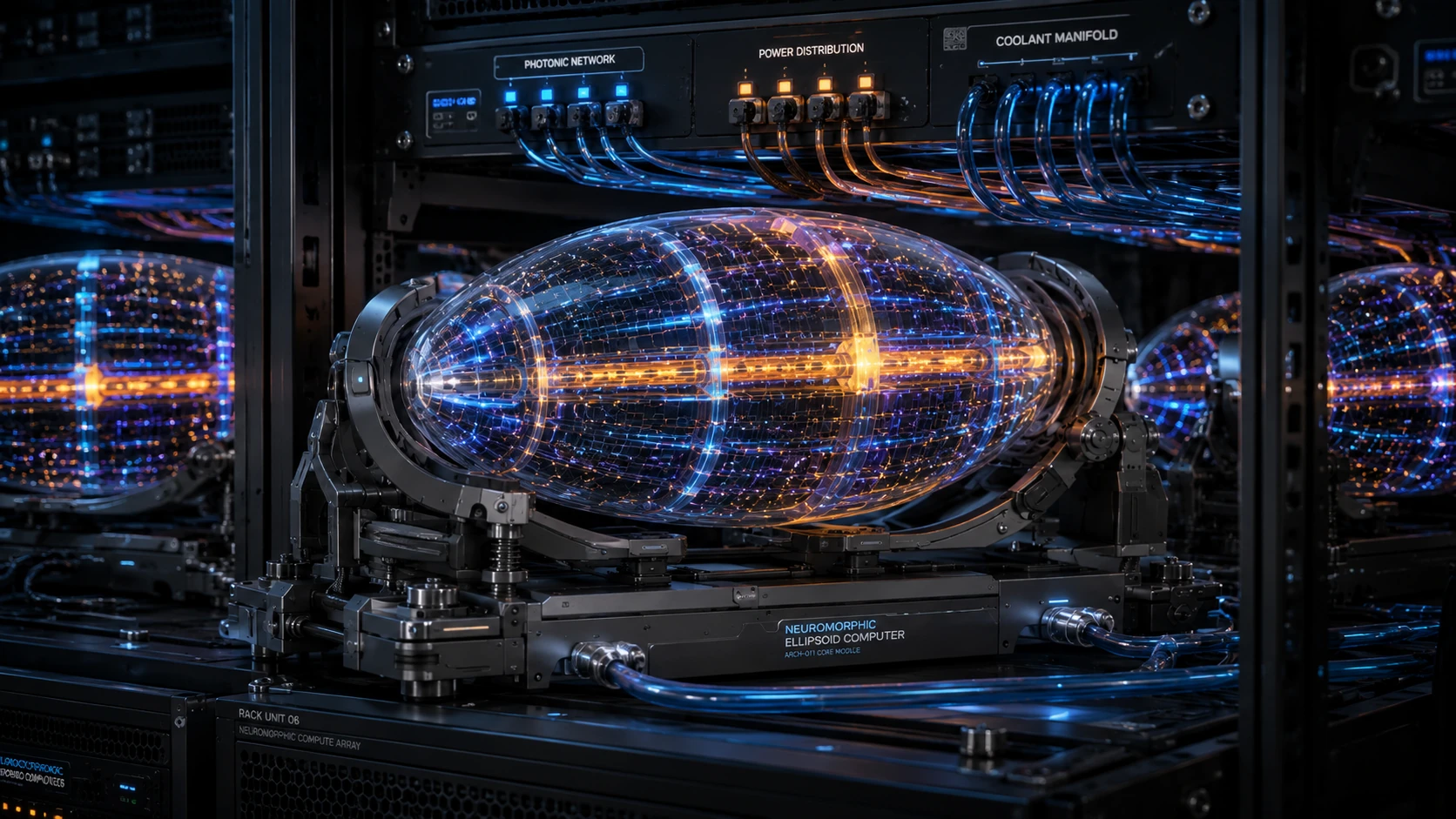
Scale out without losing control.
The NCE rack concept combines independently serviceable ellipsoid modules with explicit power, cooling, data/photonic, timing and maintenance planes. The cabinet rendering is conceptual—it is not a released production rack.
From a single ellipsoid to rack-scale egg-carton packaging.
The preferred designation remains NCE-<Species>-xN. xN is the active ellipsoid count in the assembly. Scale-out should preserve class identity, interface keying, service boundaries and independent protection before additional workloads are admitted.
The rack is an architecture, not just a shelf.
Each module needs controlled registration, support, access and a removal path that does not disturb neighboring cells unnecessarily.
Power architecture must expose reserve capacity, isolation, health state and bounded degraded operation rather than hiding shared failure modes.
Scale-out introduces shared heat rejection, local flow monitoring, thermal zoning and full-population validation before rack density is released.
Payload bandwidth, event routing latency, transport integrity and lane health become cluster-level concerns as xN grows.
Distributed modules require observable time correlation and bounded synchronization behavior across compute and sensor domains.
A failing module, lane or service plane must be isolatable without allowing adaptive behavior to defeat deterministic protection.
Prove the small cluster before claiming the big rack.
Demonstrate module identity, service behavior, power/cooling margins, transport health and failure isolation in representative compact assemblies.
Scale only after compact-system evidence closes key thermal, power, fabric, timing and maintenance risks.
Rack density remains TBR until full-population thermal, power, service and fabric behavior is tested under representative load.
Serviceability is a runtime system property.
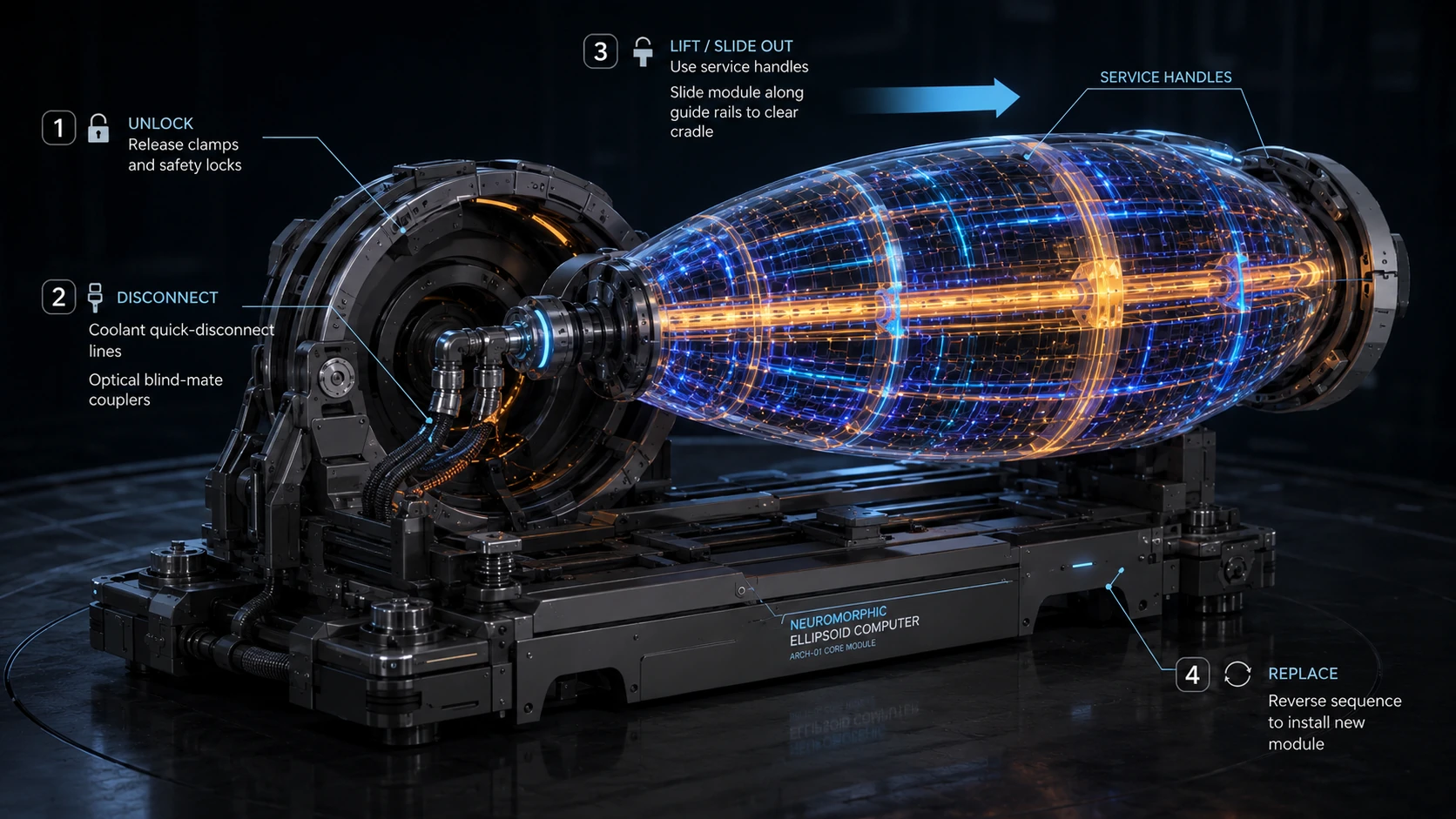
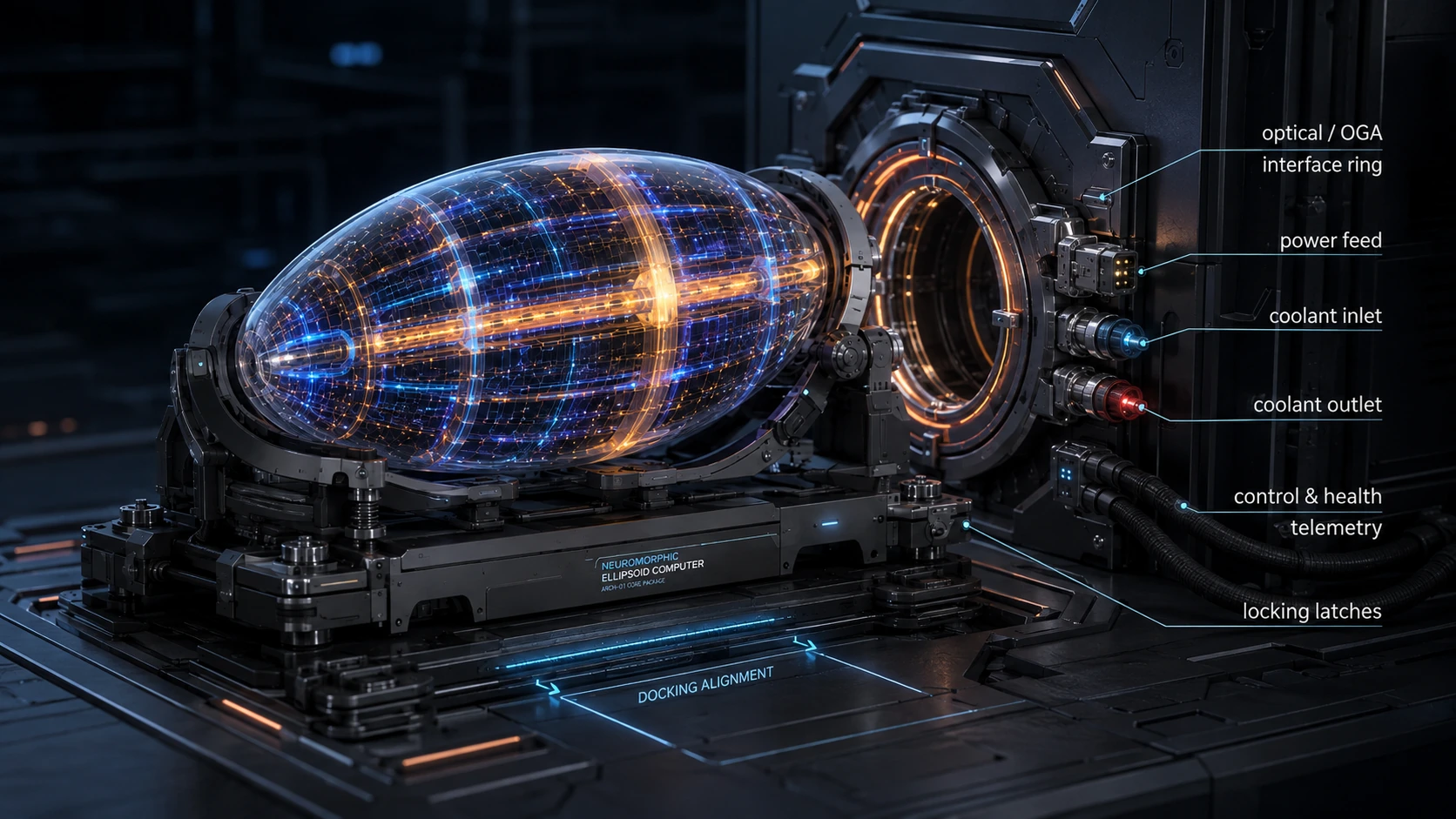
Rack architecture can move into facilities, vehicles and mission bays.
The same service-cell principles can inform laboratory, datacenter, industrial, vehicle, aerospace or spacecraft installations, but each platform must own its environmental qualification, power/cooling envelope, safety authority and verification evidence. Larger deployments are not released merely because a conceptual rack rendering exists.