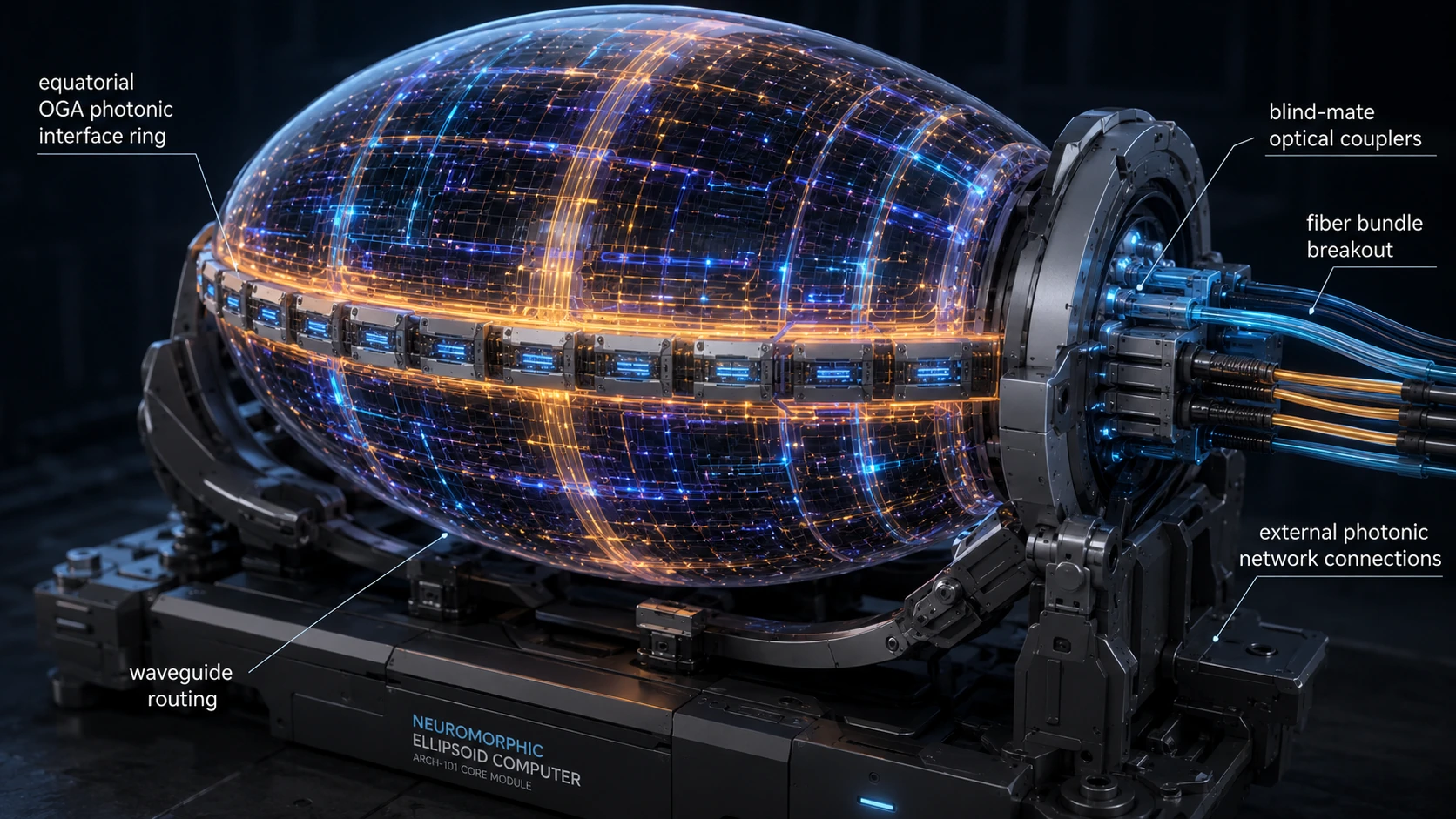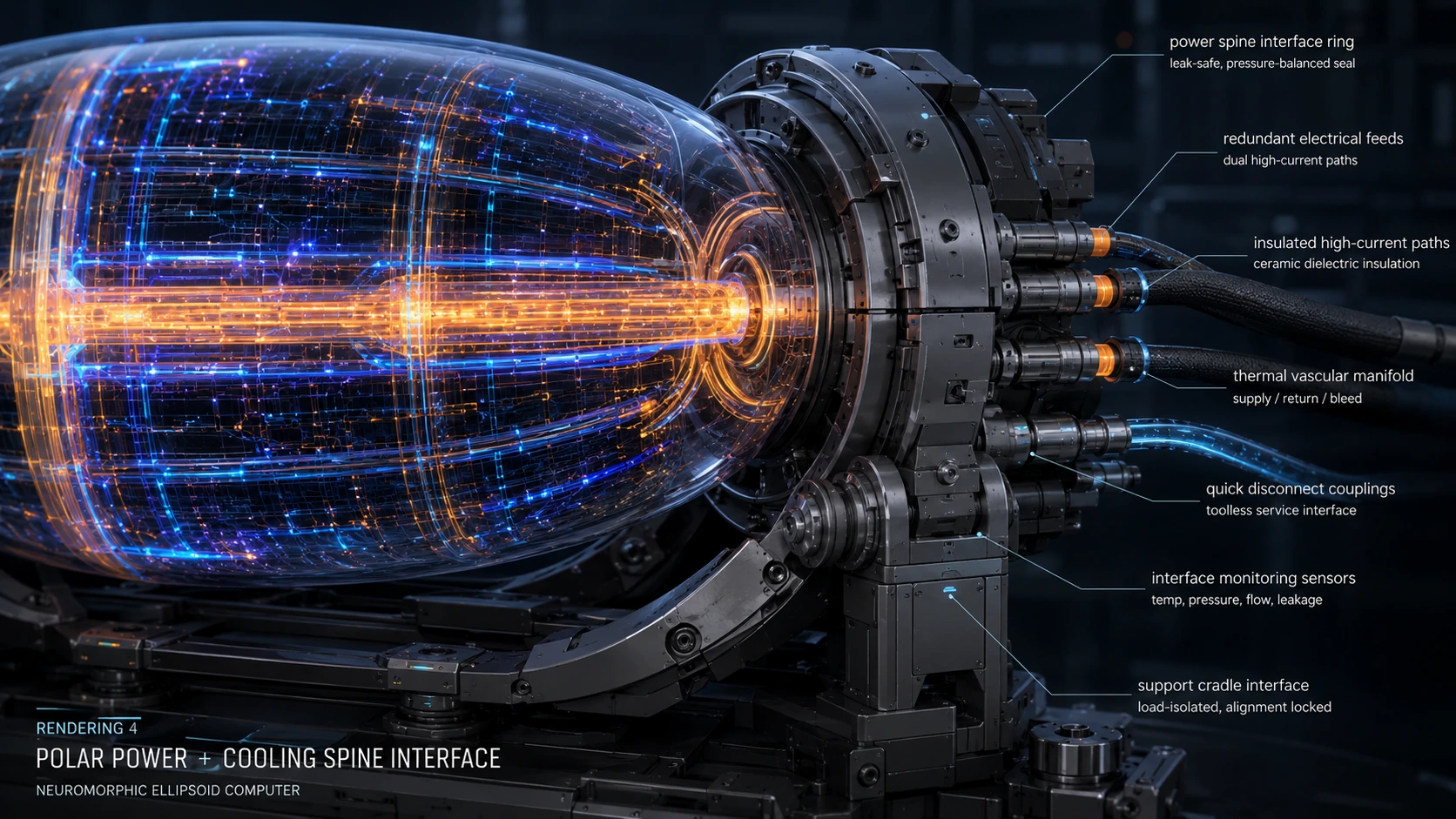
The compute body has to be maintainable, not merely impressive.
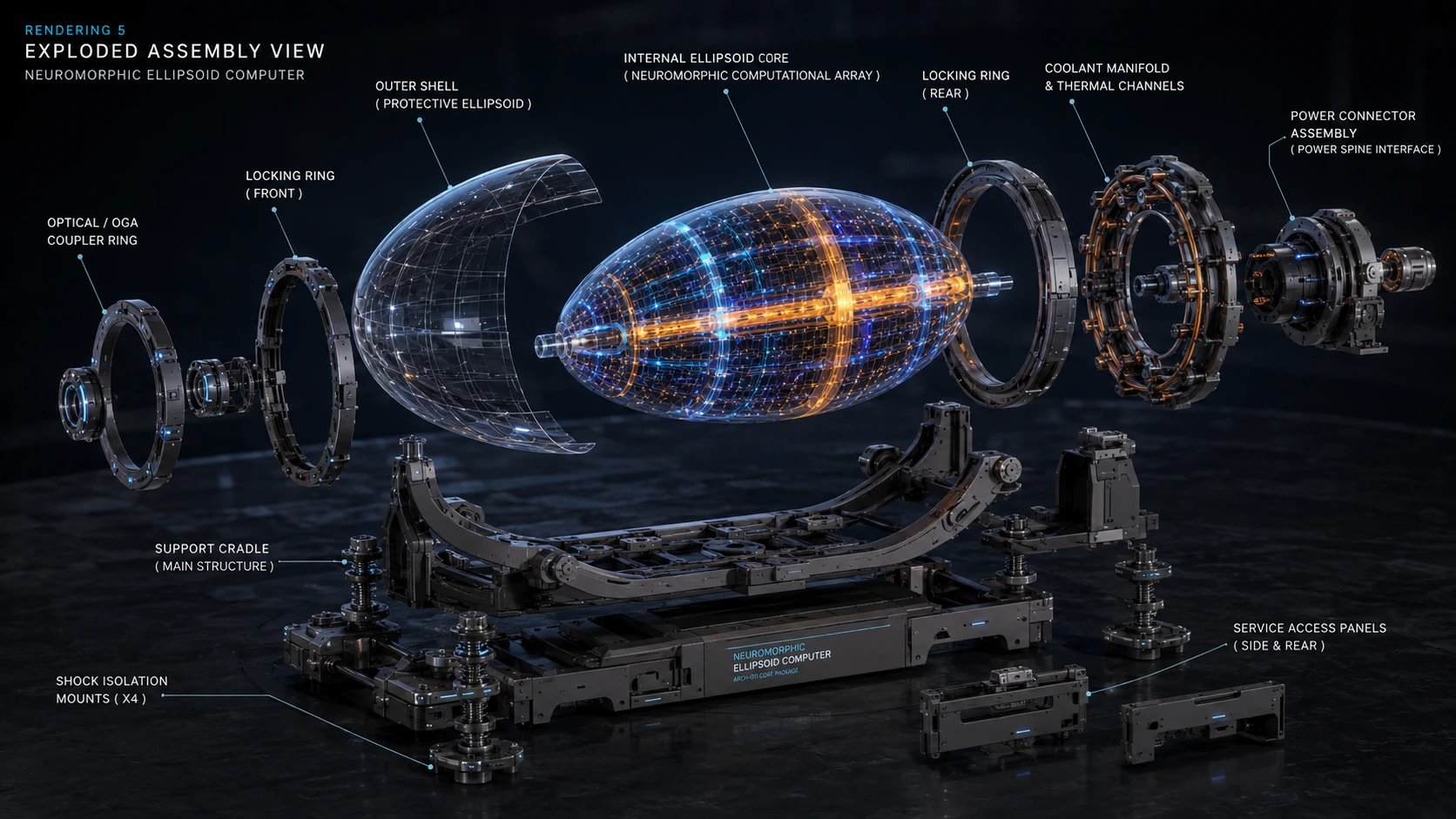
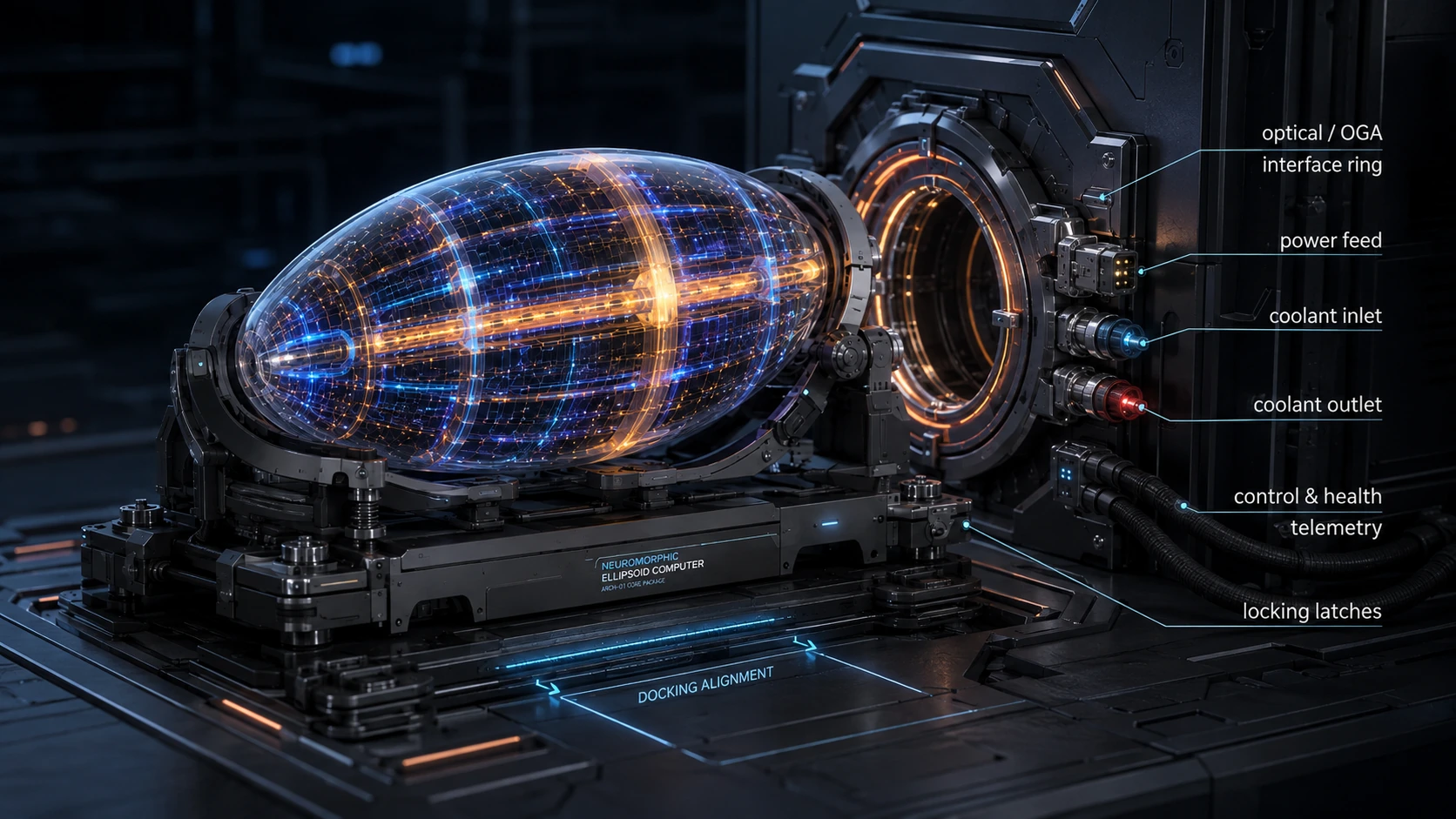
NCE serviceability separates the active ellipsoid from its support structure, docking/registration features, optical/data interface, power/cooling services and host bay. The public page focuses on replaceability, observability and fault boundaries without publishing reproduction-enabling mechanical tolerances.
Long-range signaling, lane health and service-zone access support both intra-module communication and host integration.
Power delivery, thermal transport, isolation and health monitoring scale with the selected NCE class and host environment.
Cradle, keying and docking concepts keep module identity and orientation explicit during installation and service.
Persistent module identity and observable health state support safe workload admission, maintenance and post-service verification.
Service architecture must distinguish internal module failure, interface failure and commanded degraded operation.
No learned or adaptive behavior is allowed to defeat independent deterministic protection or service isolation.
From whole-unit replacement to regional service.
Favor strong factory screening, minimal embedded service structures and whole-unit replacement when internal repair would cost more than the module.
Increase regional health, optical/thermal access, docking/registration features, spare mapping and bounded service loops while rapid characterization remains practical.
Use hierarchical health state, explicit service zones, multiple cooling paths, persistent digital-twin state and isolated degraded operation as the system becomes too large for simple whole-unit treatment.
The rack architecture treats the ellipsoid as an independently serviceable module inside a larger power, cooling, timing and data fabric.