
From Sparrow to Ostrich.
The NCE family uses bird-relative names as memorable physical-scale aliases. They are not a mathematically monotonic ordinal sequence, and they do not imply a fixed performance ranking. Released mechanical envelopes and interface keys—not the illustration alone—govern compatibility.
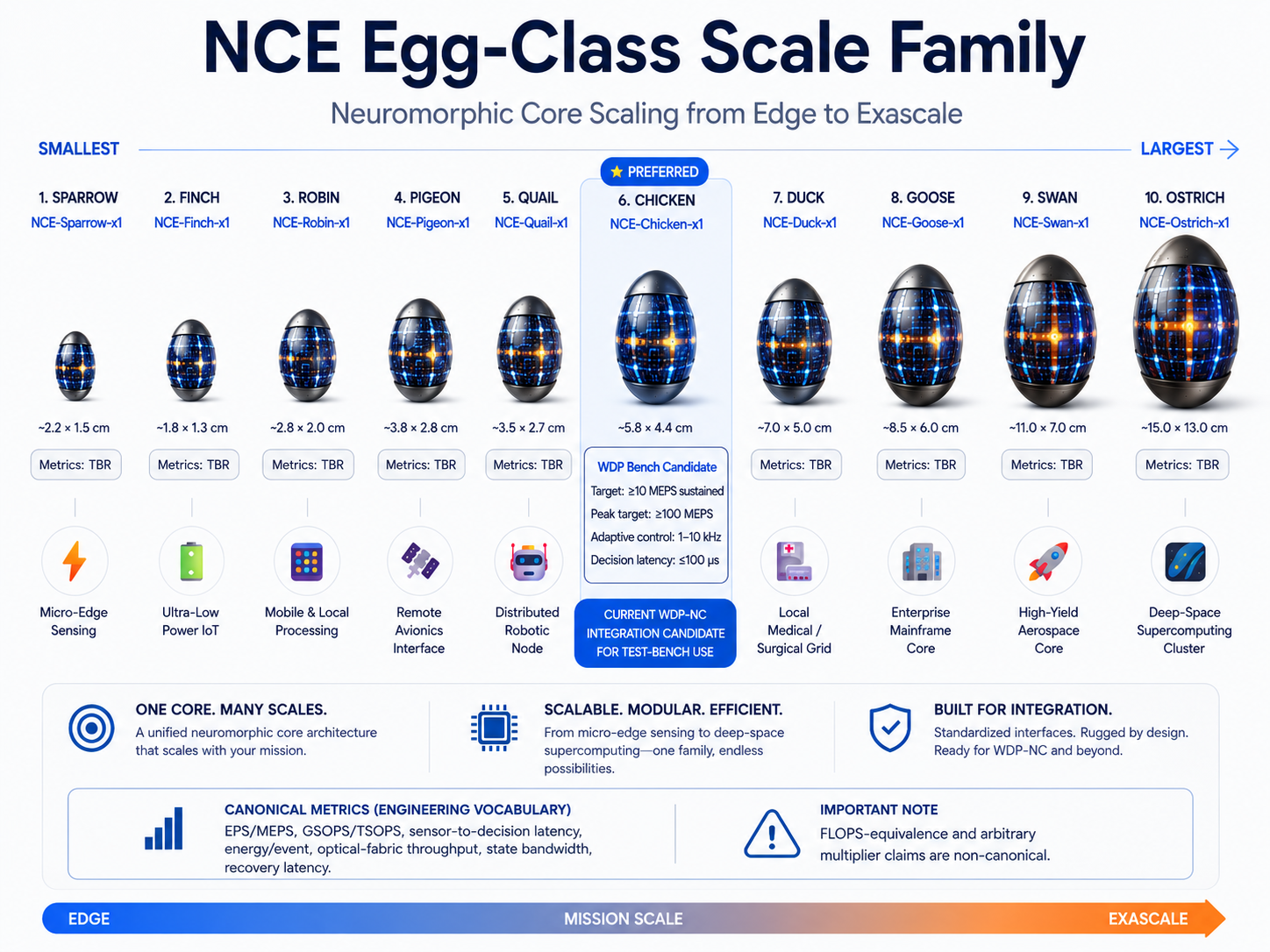
Ten names, four existing anchors, six proposed intermediates.
The current controlled anchors are Sparrow, Chicken, Goose and Ostrich. Finch, Robin, Pigeon, Quail, Duck and Swan remain proposed intermediate product-family aliases until dimensional, thermal, optical, manufacturing and verification evidence supports promotion.
Micro-edge sensing
Ultra-low-power IoT
Mobile & local processing
Remote avionics interface
Distributed robotic node
Desktop/workstation accelerator; WDP bench controller
Local medical/surgical grid
Enterprise/mainframe core
High-yield aerospace core
Deep-space / datacenter cluster core
Reference family table
| Class / Nomenclature | Approx. reference size | Role band | Status | Engineering envelope note |
|---|---|---|---|---|
| Sparrow NCE-Sparrow-x1 | ~2.2 × 1.5 cm | Micro-edge sensing | Existing NC-S anchor | 22 × 16 × 16 mm active ellipsoid baseline |
| Finch NCE-Finch-x1 | ~1.8 × 1.3 cm | Ultra-low-power IoT | Proposed intermediate | Third axis / cartridge TBD |
| Robin NCE-Robin-x1 | ~2.8 × 2.0 cm | Mobile & local processing | Proposed intermediate | Third axis / cartridge TBD |
| Pigeon NCE-Pigeon-x1 | ~3.8 × 2.8 cm | Remote avionics interface | Proposed intermediate | Third axis / cartridge TBD |
| Quail NCE-Quail-x1 | ~3.5 × 2.7 cm | Distributed robotic node | Proposed intermediate | Third axis / cartridge TBD |
| Chicken NCE-Chicken-x1 | ~5.8 × 4.4 cm | Desktop/workstation accelerator; WDP bench controller | Existing NC-C anchor | 58 × 44 × 44 mm active ellipsoid baseline |
| Duck NCE-Duck-x1 | ~7.0 × 5.0 cm | Local medical/surgical grid | Proposed intermediate | Third axis / cartridge TBD |
| Goose NCE-Goose-x1 | ~8.5 × 6.0 cm | Enterprise/mainframe core | Existing NC-G anchor | 86 × 56 × 56 mm active ellipsoid baseline |
| Swan NCE-Swan-x1 | ~11.0 × 7.0 cm | High-yield aerospace core | Proposed intermediate | Third axis / cartridge TBD |
| Ostrich NCE-Ostrich-x1 | ~15.0 × 13.0 cm | Deep-space / datacenter cluster core | Existing NC-O anchor | 154 × 129 × 129 mm active ellipsoid baseline |
Important: biological-reference dimensions are approximate communication aids. For example, Finch and Quail can be smaller than adjacent named tiers. Controlled envelopes, not bird ordering, govern real compatibility.
The suffix counts active ellipsoid modules.
One Sparrow-class ellipsoid. A physical/configuration designation, not a statement that it is always the slowest processor.
Eight Goose-class ellipsoids in a host assembly. It does not mean one physically enlarged Goose.
Four Ostrich-class ellipsoids. The name alone does not assert measured exascale performance.
The scale graphic includes initial WDP-NC performance targets, but those values remain TBR engineering targets until correlated on representative hardware.
Size changes the engineering strategy—not just the outer shell.
Micro classes can emphasize passive paths; larger classes increasingly require explicit heat spreading, active cooling, flow monitoring and hotspot certification.
As volume grows, regional health, optical/thermal inspection and persistent as-built state become more important than simple external screening.
Local spare capacity evolves into regional redundancy, rerouting, containment and graceful degraded operation.
Docking, alignment, service access, structural tolerance and interface keying become stronger architecture drivers at larger scales.
Longer paths and multi-module systems require explicit transport health, routing latency and bandwidth management.
Large systems migrate from whole-unit exhaustive test toward regional evidence, persistent digital-twin state and mission-level end-to-end verification.