Operating Concept
How it fits the response loop
A redundant multi-rotor VTOL moves standardized loads between logistics bases and prepared remote sites, using stabilized winch control and terrain-aware placement.
 AURORA DESIGN SYSTEMSEngineering Systems • Applied Research • Product Architecture
Contact
AURORA DESIGN SYSTEMSEngineering Systems • Applied Research • Product Architecture
Contact
Uncrewed heavy-lift platform for remote delivery of water bladders, pumps, hose, batteries and response modules.
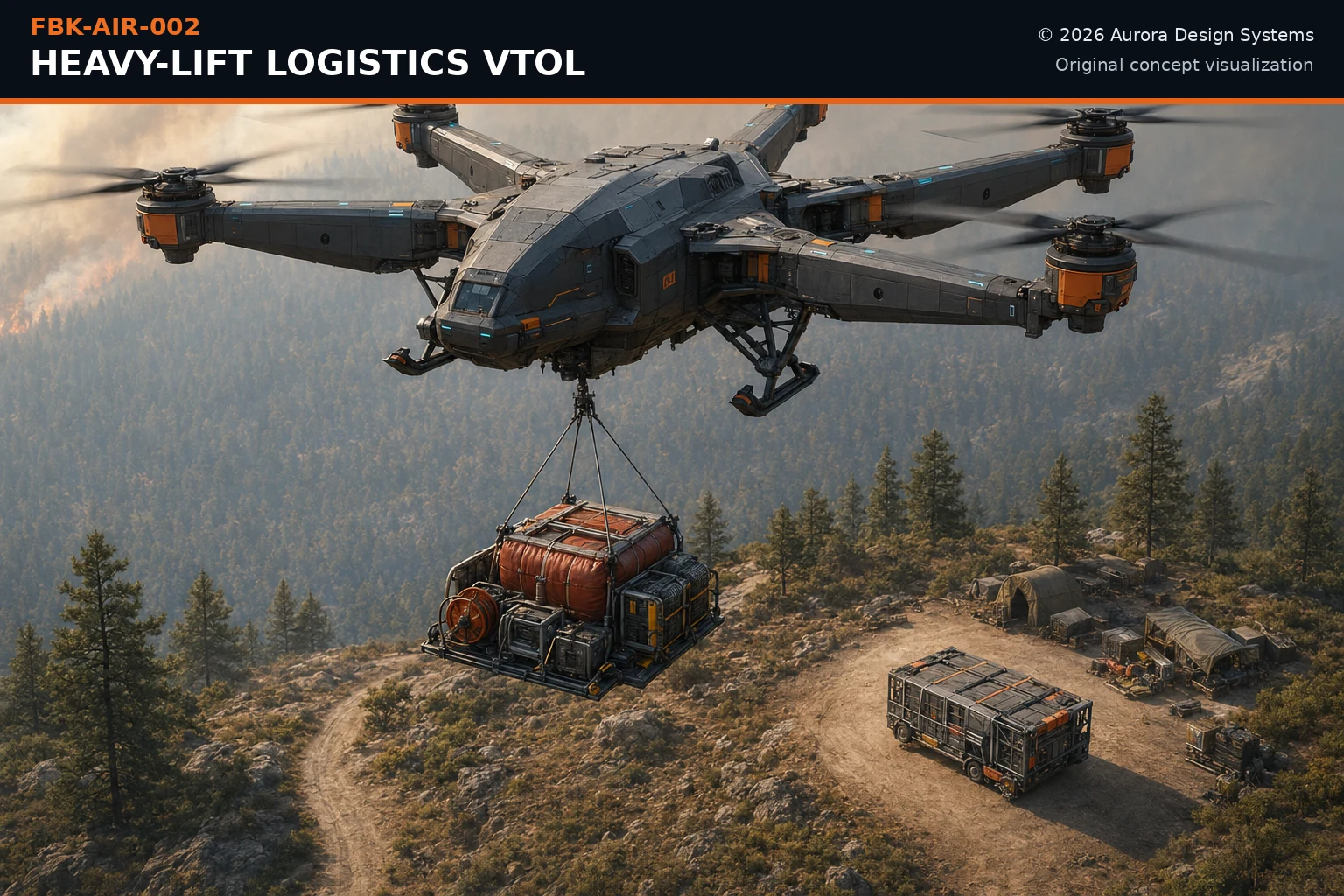
A redundant multi-rotor VTOL moves standardized loads between logistics bases and prepared remote sites, using stabilized winch control and terrain-aware placement.
This component is one element of a larger human-commanded response architecture. Its public role is bounded by verified inputs, authorized action, safe fallback, and post-event confirmation.
Open mission family →These are functional blocks—not a procurement bill of materials, manufacturing drawing, or construction specification.
Separated rotor and load paths
Fault-tolerant vertical lift
Range and hover endurance
Safe low-level placement
Controlled modular cargo delivery
Water, pump, hose and energy payload interface
This page does not publish dimensions, formulas, agent compositions, control thresholds, source code, fabrication drawings, site-specific operating procedures, or certification claims. Any future implementation requires prior-art review, engineering analysis, hazard assessment, environmental qualification, human-factors review, independent testing, and approval by the relevant authorities.