Operating Concept
How it fits the response loop
Terrain-following and infrared guidance support a segmented, low-pressure drop profile. Release remains constrained by human authorization, airspace separation and ground-personnel exclusion.
 AURORA DESIGN SYSTEMSEngineering Systems • Applied Research • Product Architecture
Contact
AURORA DESIGN SYSTEMSEngineering Systems • Applied Research • Product Architecture
Contact
Medium uncrewed airtanker intended for precisely metered water or qualified-agent delivery along verified attack lines.
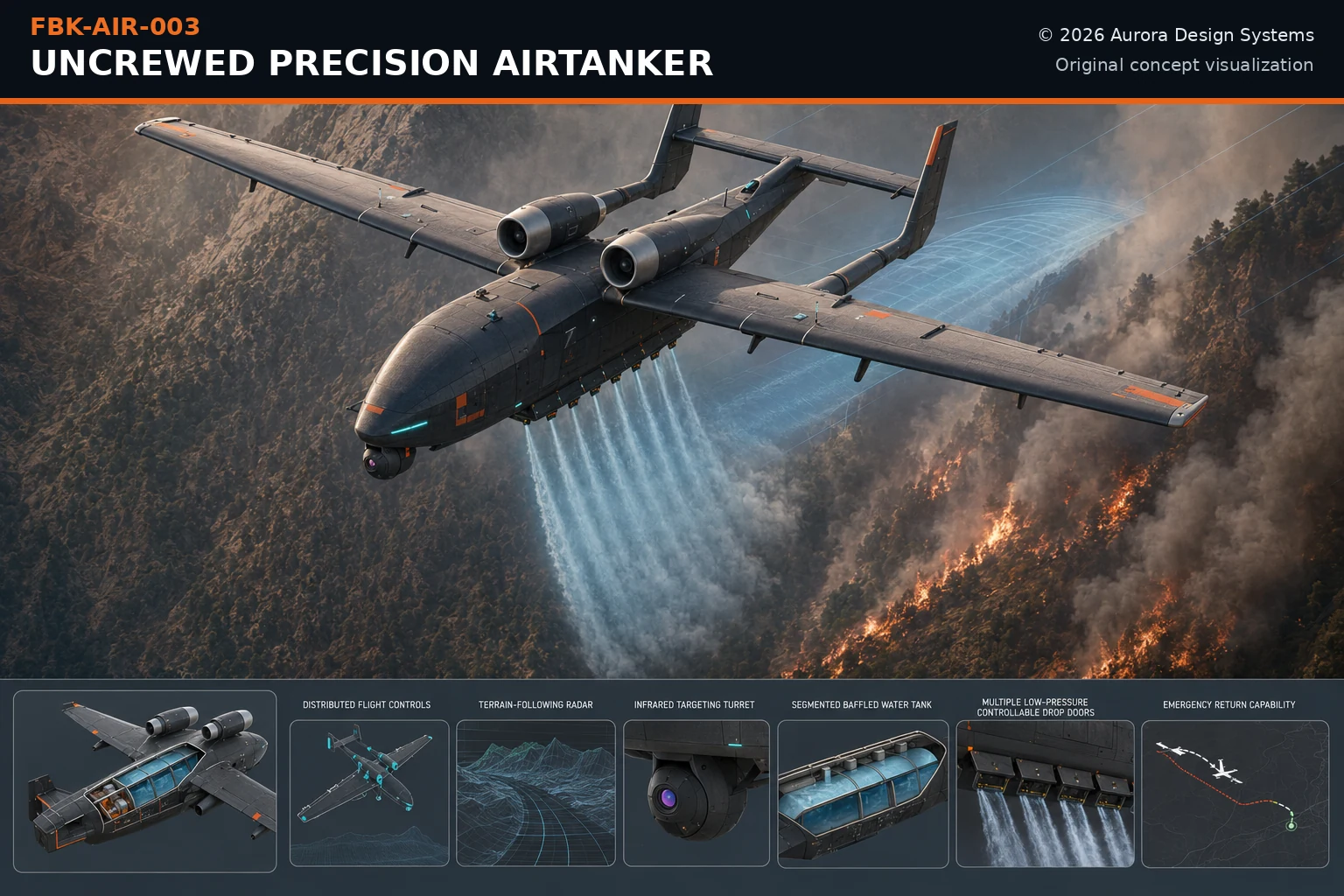
Terrain-following and infrared guidance support a segmented, low-pressure drop profile. Release remains constrained by human authorization, airspace separation and ground-personnel exclusion.
This component is one element of a larger human-commanded response architecture. Its public role is bounded by verified inputs, authorized action, safe fallback, and post-event confirmation.
Open mission family →These are functional blocks—not a procurement bill of materials, manufacturing drawing, or construction specification.
Low-speed stability and payload volume
Operational reliability
Low-level route protection
Fire-edge and drop-line localization
Center-of-gravity and surge control
Controlled coverage distribution
This page does not publish dimensions, formulas, agent compositions, control thresholds, source code, fabrication drawings, site-specific operating procedures, or certification claims. Any future implementation requires prior-art review, engineering analysis, hazard assessment, environmental qualification, human-factors review, independent testing, and approval by the relevant authorities.