Operating Concept
How it fits the response loop
The rover scans, turns debris with an insulated manipulator, samples gas and acoustic cavities, applies a local mist and records the verified cool-down state for human review.
 AURORA DESIGN SYSTEMSEngineering Systems • Applied Research • Product Architecture
Contact
AURORA DESIGN SYSTEMSEngineering Systems • Applied Research • Product Architecture
Contact
Compact robot for post-flame overhaul, debris movement, cavity inspection, hot-spot treatment and reignition patrol.
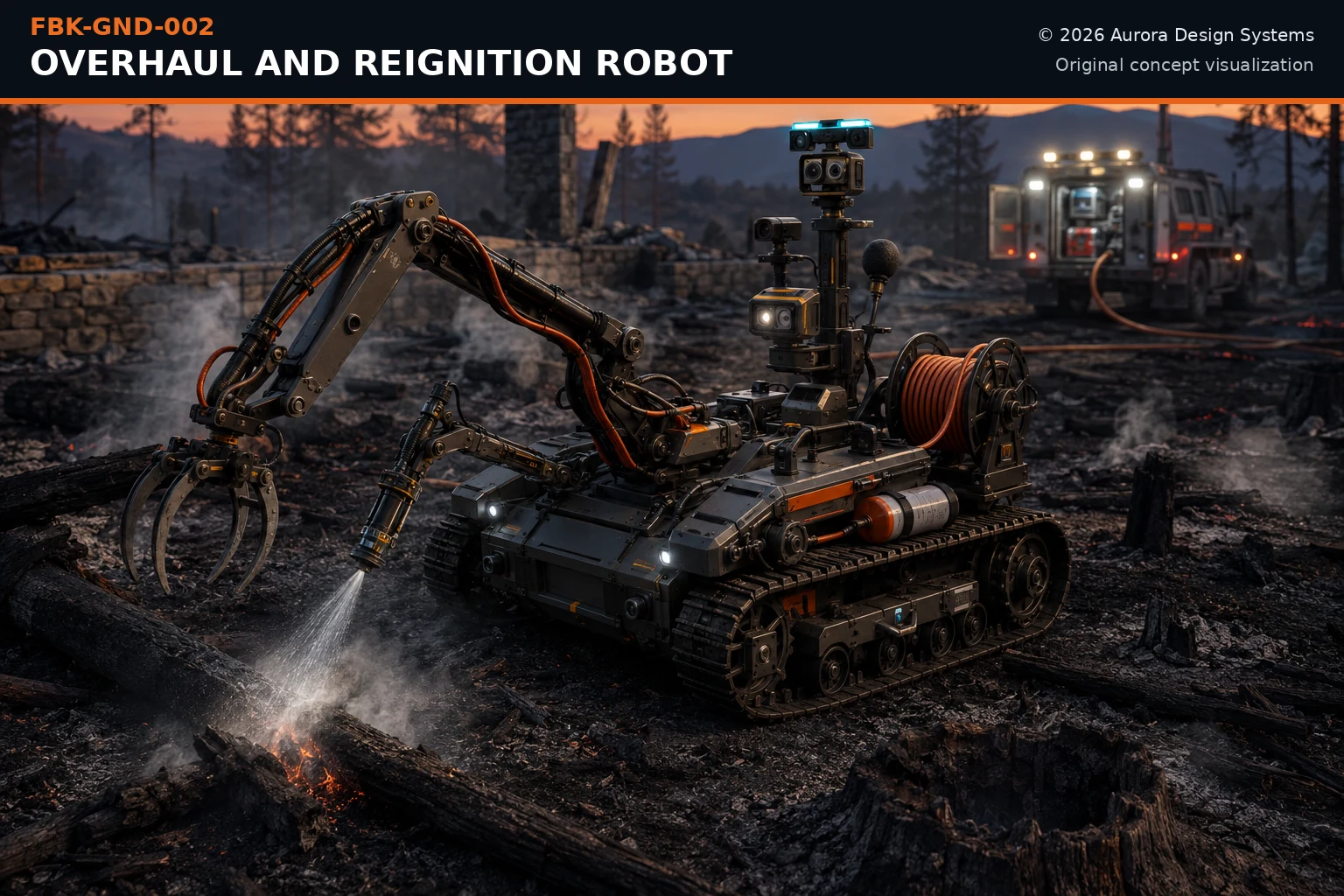
The rover scans, turns debris with an insulated manipulator, samples gas and acoustic cavities, applies a local mist and records the verified cool-down state for human review.
This component is one element of a larger human-commanded response architecture. Its public role is bounded by verified inputs, authorized action, safe fallback, and post-event confirmation.
Open mission family →These are functional blocks—not a procurement bill of materials, manufacturing drawing, or construction specification.
Access through burned terrain and structures
Debris movement and cavity access
Overhaul tool exchange
Local treatment of concealed heat
Multi-mode hot-spot verification
Flexible supply and remote operation
This page does not publish dimensions, formulas, agent compositions, control thresholds, source code, fabrication drawings, site-specific operating procedures, or certification claims. Any future implementation requires prior-art review, engineering analysis, hazard assessment, environmental qualification, human-factors review, independent testing, and approval by the relevant authorities.