← Back to Component Arsenal
FBK-WLD-001 / Component 12 of 21
Rapid Wildfire Initial-Attack Network
Distributed detection, water, aircraft, robot and command network intended to stop new ignitions before they become large incidents.
Frontier / DevelopableControlled by SUST-FIRE-WILD-007Detailed ARCH: SUST-FIRE-COMP-WLD-001
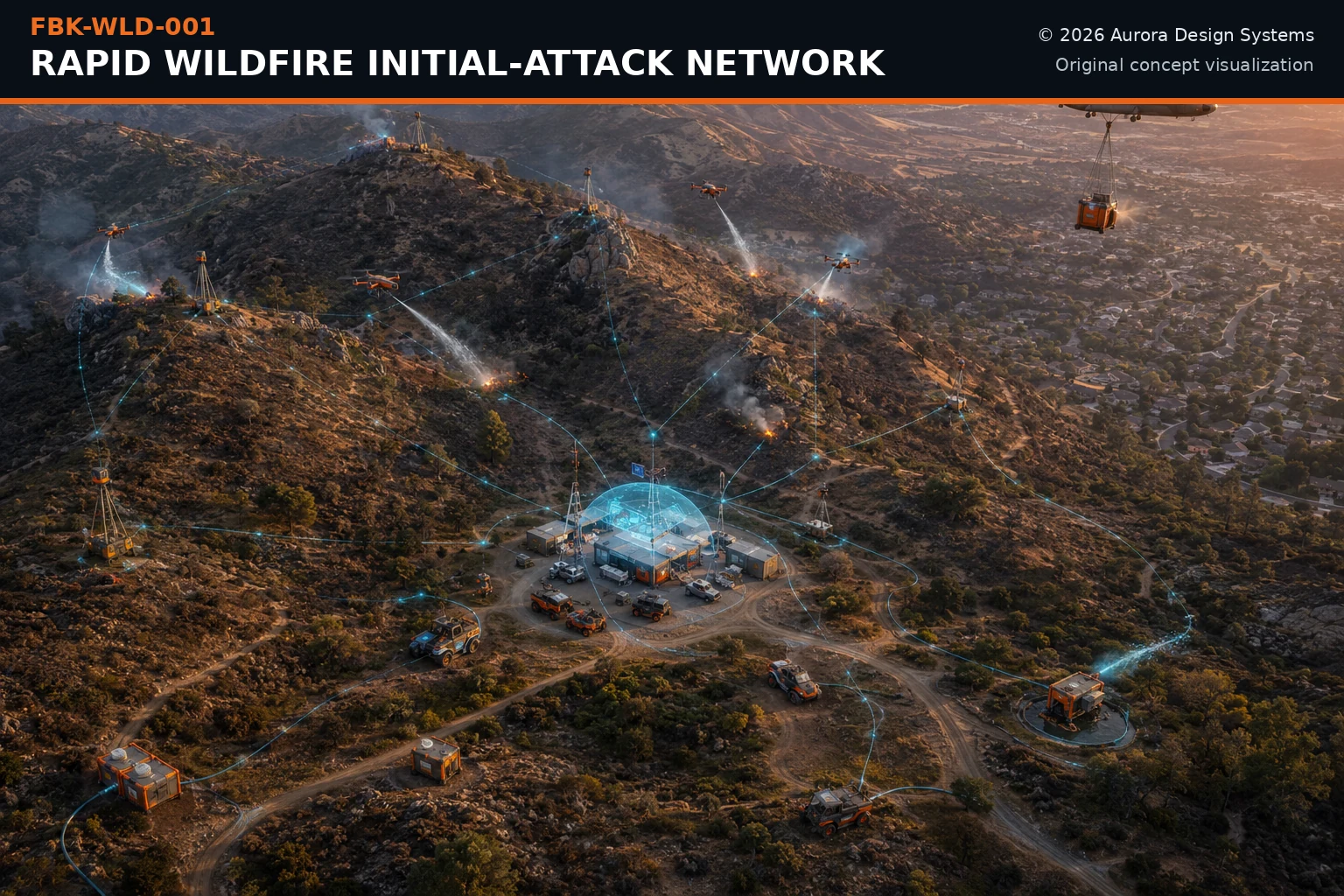
Operating Concept
How it fits the response loop
Ridge sensors verify an ignition, human command authorizes response, the nearest safe assets intercept spot fires and the network escalates to conventional agencies if containment confidence is insufficient.
Mission Family
Wildfire Initial Attack
This component is one element of a larger human-commanded response architecture. Its public role is bounded by verified inputs, authorized action, safe fallback, and post-event confirmation.
Open mission family →
Preliminary Functional Breakdown
Six public-safe architecture layers
These are functional blocks—not a procurement bill of materials, manufacturing drawing, or construction specification.
01Ridge and corridor sensor nodes
Rapid ignition detection and verification
02Sealed water/agent caches
Distributed first-attack supply
03Short-range suppression UAS
Precision response to small verified ignitions
04Ground response robots
Wet lines, access and local containment
05Communications and command node
Human-led authorization and coordination
06Microgrid and charging package
Independent emergency operation
Primary Interfaces
What it must connect to
- Operations Twin
- sensor grid
- aircraft
- robots
- water caches
- public-safety communications
- FIREBREAK Spine and local agencies.
Verification Focus
What must be proved
- Detection-to-action time, dispatch reliability, water sufficiency, airspace coordination, communications loss and false-positive containment.
Public Release Boundary
Concept visualization, not achieved performance
This page does not publish dimensions, formulas, agent compositions, control thresholds, source code, fabrication drawings, site-specific operating procedures, or certification claims. Any future implementation requires prior-art review, engineering analysis, hazard assessment, environmental qualification, human-factors review, independent testing, and approval by the relevant authorities.