
Toroidal magnetic fields. Tokamaks combine external coils with substantial plasma current; stellarators rely more heavily on three-dimensional external magnetic shaping.
← Back to Fusion Reactor Systems
Fusion System • Magnetic Confinement
Magnetic Confinement Fusion
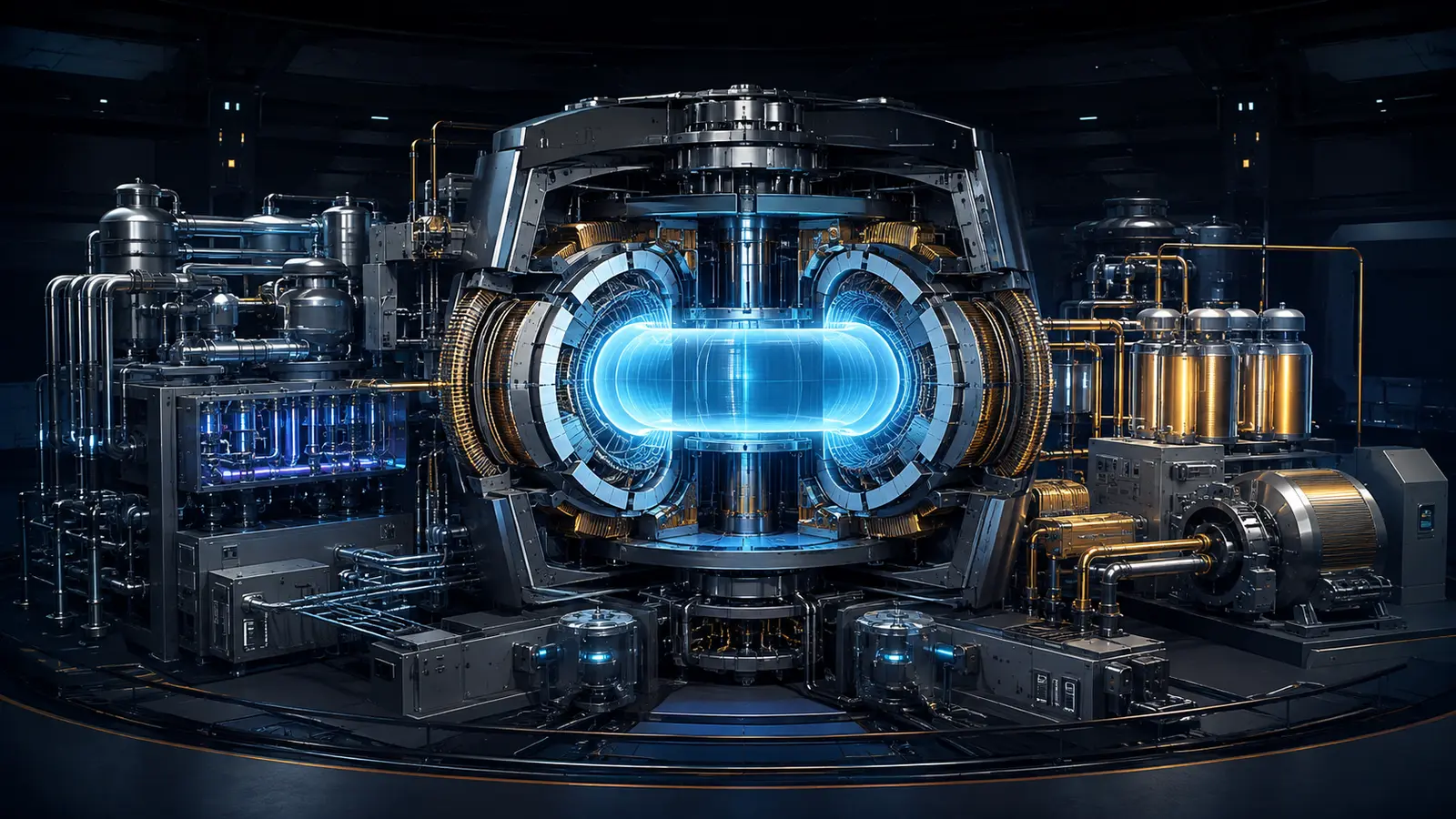
Magnetic confinement uses shaped magnetic fields to keep high-temperature plasma away from material walls. Tokamaks and stellarators are the two principal toroidal families, but their plasma-current, coil, control, maintenance, and steady-state strategies differ.
TokamakStellaratorResearch & DemonstrationNo Commercial-Readiness Claim
Phase 4 • Concise Comparison
Engineering comparison
Most near-term power-plant studies use deuterium-tritium fuel, producing energetic neutrons that drive blanket, shielding, materials, and fuel-cycle requirements.
Extensive experimental base and major demonstration facilities; no commercial fusion-electricity plant.
Plasma-science experiments, burning-plasma demonstrations, pilot-plant studies, and eventual electricity or industrial heat if full plant integration is demonstrated.
Plasma stability and exhaust, superconducting magnets, cryogenics, neutron-resistant materials, tritium systems, blankets, remote maintenance, availability, total facility efficiency, and cost.
System Breakdown
How this branch is organized
Tokamak Systems
Axisymmetric toroidal systems with a large experimental base, pulsed and steady-state research paths, and significant current-drive and disruption-control requirements.
Stellarator Systems
Three-dimensional magnetic configurations designed for steady-state operation without depending on the same large toroidal plasma current as a tokamak.
Shared Plant Boundary
Both families still require fuel cycle, vacuum, cryogenics, blankets, heat extraction, shielding, remote handling, controls, and power conversion.
Official Public Sources
Reference basis
Public boundary: Concept classification and public research context only. No device parameters, operating sequences, target or fuel preparation, magnet specifications, control logic, materials recipes, calculations, CAD, or build instructions.
10-Phase Reactor Program • Phase 2
Fusion taxonomy specification
Standardized public-safe fields support comparison across every fission and fusion family. Values are intentionally qualitative; licensing data, dimensions, operating windows, calculations, control logic, and build instructions remain offline.
Toroidal or linear magnetic confinement families
Magnetic-field strength, topology, exhaust, materials, and maintainability
D-T reference retains neutron activation and tritium obligations
Tokamak and stellarator experiments established; power plants unproven
Specification boundary: Family-level technology classification and lifecycle context—not a vendor datasheet, safety analysis, procurement specification, or construction package.
Ten-Phase Reactor Program · Phase 5
Safety and public-trust boundary
Architecture groupings and future concepts do not establish a licensing pathway or safety finding. Apply the exact reactor, material inventory, mission, site, regulator, safeguards, and emergency-planning basis before making deployment claims.
Public claim boundary: No “inherently safe,” “waste-free,” “unregulated,” “no emergency plan,” licensed, commercially ready, or guaranteed-performance claim is authorized.