
Toroidal magnetic fields. Tokamaks combine external coils with substantial plasma current; stellarators rely more heavily on three-dimensional external magnetic shaping.
← Back to Fusion Reactor Systems
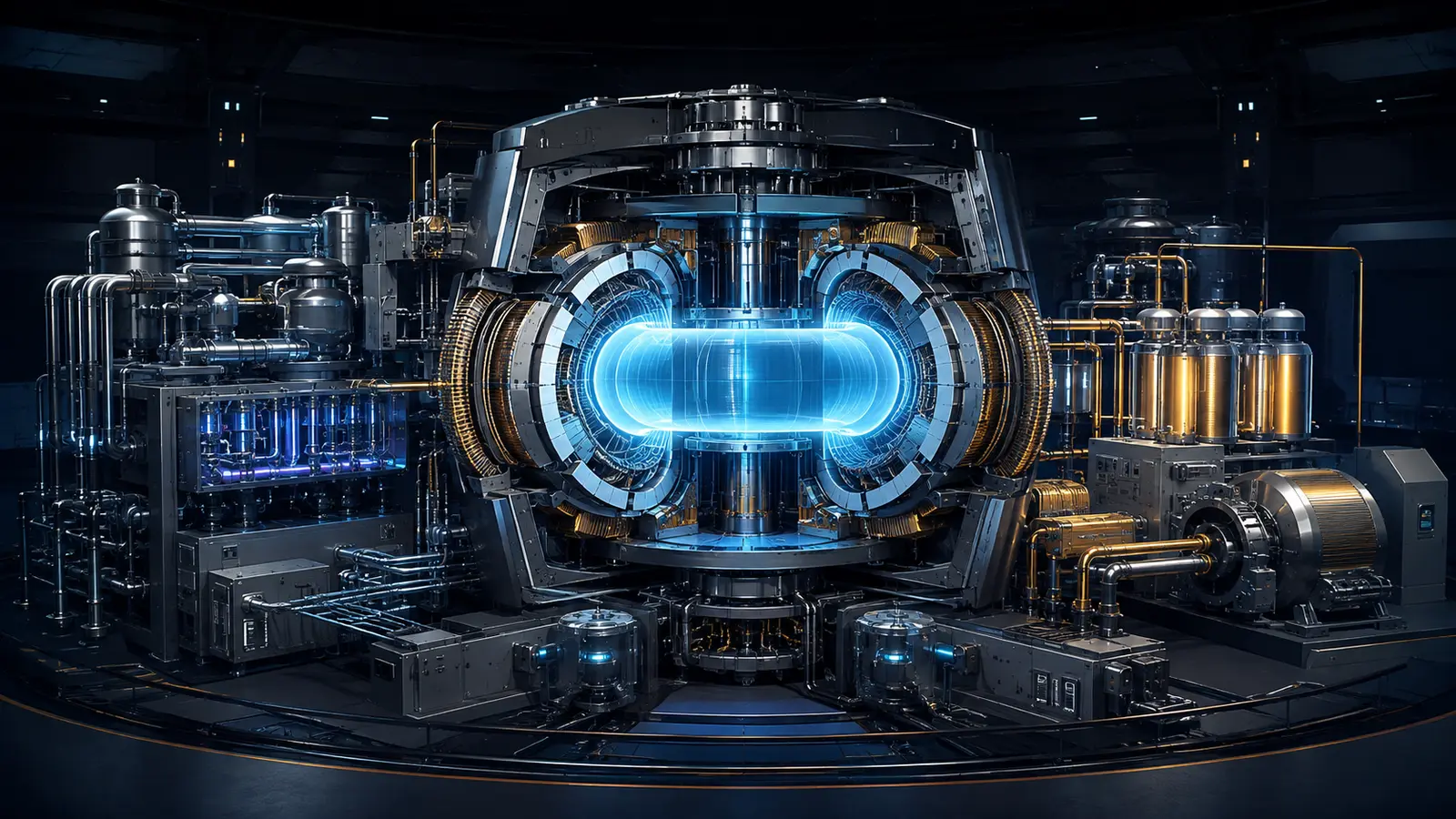
Fusion System • Magnetic Confinement
Magnetic Confinement Fusion
Magnetic confinement uses shaped magnetic fields to keep high-temperature plasma away from material walls. Tokamaks and stellarators are the two principal toroidal families, but their plasma-current, coil, control, maintenance, and steady-state strategies differ.
TokamakStellaratorResearch & DemonstrationNo Commercial-Readiness Claim
Phase 4 • Concise Comparison
Engineering comparison
Most near-term power-plant studies use deuterium-tritium fuel, producing energetic neutrons that drive blanket, shielding, materials, and fuel-cycle requirements.
Extensive experimental base and major demonstration facilities; no commercial fusion-electricity plant.
Plasma-science experiments, burning-plasma demonstrations, pilot-plant studies, and eventual electricity or industrial heat if full plant integration is demonstrated.
Plasma stability and exhaust, superconducting magnets, cryogenics, neutron-resistant materials, tritium systems, blankets, remote maintenance, availability, total facility efficiency, and cost.
Phase 4 • Technical Education + Terminology + Accuracy
Learn the System
This learning layer explains the system in public engineering language. Definitions are intentionally conceptual: they teach terminology and relationships without providing operating procedures, design set-points, construction dimensions, or protected implementation details.
Maturity checkpoint: Broad research domain with multiple device families and extensive experimental heritage.
System walkthrough
How it works — at a safe public level
- Magnetic fields guide charged plasma particles away from material walls.
- Heating systems raise the plasma to fusion-relevant temperatures.
- Control systems shape the plasma and suppress or manage instabilities.
- Diagnostics estimate temperature, density, current, impurities, and energy confinement.
- A reactor-scale system must then absorb neutron energy, manage fuel, reject heat, and convert useful heat to electricity.
Key distinction: Magnetic confinement describes a physics strategy. Tokamaks, stellarators, mirrors, FRCs, and other devices implement it differently.
Technical vocabulary
Terms worth knowing
Magnetic confinement
Use of magnetic fields to restrict the motion of charged plasma particles and keep hot plasma away from material walls.
Plasma
An ionized gas containing free electrons and ions. Fusion experiments must heat, shape, and confine plasma under extreme conditions.
Lawson criterion
A relationship among plasma density, temperature, and energy-confinement time that indicates the conditions required for net fusion-relevant performance.
Triple product
The product of plasma density, temperature, and energy-confinement time, widely used to compare fusion performance.
Superconducting magnet
A magnet using superconducting conductors to produce strong magnetic fields with low electrical resistance at cryogenic temperature.
Neutral beam injection
A plasma-heating and current-drive technique that injects high-energy neutral atoms which become ionized inside the plasma.
Radio-frequency heating
Use of electromagnetic waves at selected frequencies to transfer energy to plasma particles and, in some systems, help drive plasma current.
Fusion diagnostics
Instruments that measure plasma temperature, density, magnetic fields, radiation, impurities, instabilities, and other conditions needed for control and research.
First wall
The material surface closest to the fusion plasma and directly exposed to heat and particle loads.
Blanket
Structures surrounding a fusion plasma that absorb neutron energy, protect equipment, and in future power plants may breed tritium and transfer heat.
Divertor
A plasma-facing system in many magnetic-confinement devices that exhausts heat, helium ash, and impurities from the edge of the plasma.
Remote handling
Robotic or remotely operated maintenance used where radiation, activation, vacuum boundaries, or geometry make direct human access impractical.
System Breakdown
How this branch is organized
Tokamak Systems
Axisymmetric toroidal systems with a large experimental base, pulsed and steady-state research paths, and significant current-drive and disruption-control requirements.
Stellarator Systems
Three-dimensional magnetic configurations designed for steady-state operation without depending on the same large toroidal plasma current as a tokamak.
Shared Plant Boundary
Both families still require fuel cycle, vacuum, cryogenics, blankets, heat extraction, shielding, remote handling, controls, and power conversion.
Official Public Sources
Reference basis
Public boundary: Concept classification and public research context only. No device parameters, operating sequences, target or fuel preparation, magnet specifications, control logic, materials recipes, calculations, CAD, or build instructions.
10-Phase Reactor Program • Phase 2
Fusion taxonomy specification
Standardized public-safe fields support comparison across every fission and fusion family. Values are intentionally qualitative; licensing data, dimensions, operating windows, calculations, control logic, and build instructions remain offline.
Toroidal or linear magnetic confinement families
Magnetic-field strength, topology, exhaust, materials, and maintainability
D-T reference retains neutron activation and tritium obligations
Tokamak and stellarator experiments established; power plants unproven
Specification boundary: Family-level technology classification and lifecycle context—not a vendor datasheet, safety analysis, procurement specification, or construction package.
Ten-Phase Reactor Program · Phase 5
Safety, licensing, lifecycle & public trust
Phase 5 treats safety as a full lifecycle obligation: site and license basis, fuel/material supply, operation, environmental controls, safeguards, emergency preparedness, waste, decommissioning, and disciplined public claims.
Magnetic stored energy, cryogens, vacuum, plasma disruptions or losses, tritium inventory, neutron shielding, plasma-facing components, activated structures, heat extraction, and remote maintenance define the plant safety envelope.
U.S. fusion regulation is evolving under the byproduct-material framework. The NRC published a proposed fusion-machine rule in February 2026 and draft possession-license guidance; exact jurisdiction may involve the NRC or an Agreement State depending on location and material authority. A research milestone is not a commercial operating license.
Evaluate site electricity demand, heat rejection, tritium or other radioactive inventories, activated components, coolant and chemical systems, cryogens, magnets, pulsed-power systems, construction, waste storage, and decommissioning. Fusion avoids a fission chain reaction but is not automatically impact-free.
Fuel-cycle obligations depend on the fusion reaction and facility. D-T concepts require tritium inventory control, processing, confinement, accountability, and potentially breeding-system integration. Other fuel concepts have different materials and performance constraints.
Fusion does not create spent fission fuel from the plasma, but neutron-producing concepts can activate structural materials and generate radioactive components, tritium-bearing waste, contaminated maintenance equipment, and decommissioning waste. Waste classification and disposal remain design- and jurisdiction-specific.
Apply graded material control and accounting, physical protection, cybersecurity, transport controls, insider-risk controls, and international safeguards as applicable to the material, facility, mission, and jurisdiction. Public pages must not reproduce Safeguards Information, sensitive security layouts, response tactics, or adversary-useful detail.
Emergency planning should be based on actual radioactive inventories, credible energy releases, chemical and cryogenic hazards, activated material, and site conditions under the applicable materials/facility framework. Lower source terms cannot be translated into 'no emergency plan' without analysis and regulatory acceptance.
State the maturity actually achieved, name the applicable authority, separate family-level evidence from project approval, and distinguish demonstrated performance from projections or marketing.
May describe achieved plasma, target, magnet, driver, materials, or subsystem milestones and the emerging U.S. materials-based regulatory framework. Keep physics gain, target gain, engineering gain, net electricity, plant availability, and commercial licensing as separate claims.
Do not claim radiation-free, waste-free, self-sustaining, commercially licensed, net-electric, maintenance-free, or 'just a small sun.' A Q or ignition milestone does not prove a power plant, grid export, economic competitiveness, or licensing readiness.
Phase 5 evidence:NRC — Fusion ↗NRC — Fusion Machine Rulemaking Status ↗NRC — Draft Fusion Possession-License Guidance ↗DOE — Fusion Energy ↗
Public classification only: This is not a safety finding, licensing opinion, environmental permit, emergency plan, security plan, safeguards determination, waste-acceptance decision, or legal advice. Exact obligations belong to the applicable regulator and project authority.
Phase 7 • Release Certification & Production Integration
Release certification
This page has passed the Reactor Programs Phase 7 branch-level release review for internal routing, asset references, canonical metadata, maturity and terminology controls, source-authority links, accessibility essentials, responsive markup, and release traceability.
Production boundary: this certification covers the Reactor Programs branch package. Parent-site shared CSS, navigation, search, logo, and global assets remain controlled by the Aurora website root and must already exist in production. Live deployment is not implied until the package is uploaded and the production URLs are rechecked.