
Magnetized target or compact plasma compressed by a mechanical, electromagnetic, plasma-jet, liner, projectile, or other pulsed driver.
← Back to Fusion Reactor Systems
Fusion System • Hybrid Pulsed Confinement
Magneto-Inertial / Pulsed Fusion
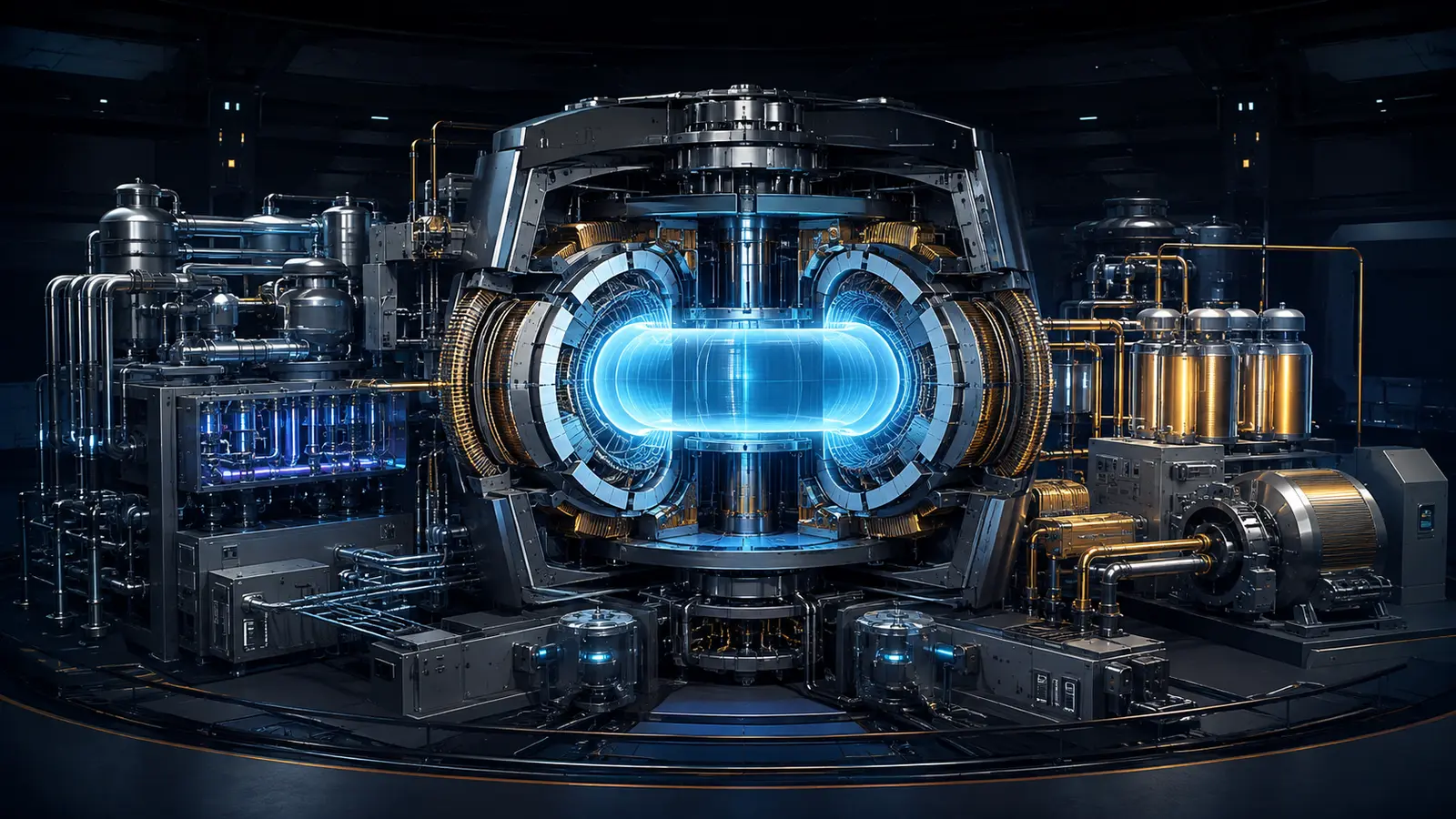
Magneto-inertial fusion occupies an intermediate regime between long-duration magnetic confinement and very rapid inertial compression. Concepts pre-magnetize plasma and then compress it with liners, projectiles, plasma jets, magnetic fields, or pulsed electrical systems.
Hybrid ConfinementRapid CompressionPublic ResearchConcept-Specific Evidence
Phase 4 • Concise Comparison
Engineering comparison
Fuel and output vary by concept; many power studies assume neutron-producing deuterium-tritium operation.
Active public and private research with component and integrated experiments; no commercially mature power plant.
Pulsed fusion experiments and potential compact energy systems if plasma, driver, chamber, fuel-cycle, and plant-performance requirements are jointly demonstrated.
Target formation, compression symmetry, driver lifetime and efficiency, pulse repetition, chamber fatigue, electrodes or liners, materials, fuel recovery, heat capture, maintenance, controls, and net plant output.
System Breakdown
How this branch is organized
Magnetized Targets
Pre-magnetized plasma can reduce required compression relative to purely inertial approaches, but target formation and stability are concept-specific.
Pulsed Drivers
Electrical, mechanical, plasma, or projectile systems must deliver repeatable pulses at useful efficiency and component life.
Integrated Facility
A credible energy claim must include chamber recovery, consumables, heat conversion, maintenance, safety, and all auxiliary loads.
Official Public Sources
Reference basis
Public boundary: Concept classification and public research context only. No device parameters, operating sequences, target or fuel preparation, magnet specifications, control logic, materials recipes, calculations, CAD, or build instructions.
10-Phase Reactor Program • Phase 2
Fusion taxonomy specification
Standardized public-safe fields support comparison across every fission and fusion family. Values are intentionally qualitative; licensing data, dimensions, operating windows, calculations, control logic, and build instructions remain offline.
Hybrid magnetized-plasma and rapid-compression families
Repeatable formation, pulsed power, chamber survival, and availability
Neutron-producing variants retain activation, tritium, and replaceable-liner waste
Frontier research
Specification boundary: Family-level technology classification and lifecycle context—not a vendor datasheet, safety analysis, procurement specification, or construction package.
Ten-Phase Reactor Program · Phase 5
Safety and public-trust boundary
Architecture groupings and future concepts do not establish a licensing pathway or safety finding. Apply the exact reactor, material inventory, mission, site, regulator, safeguards, and emergency-planning basis before making deployment claims.
Public claim boundary: No “inherently safe,” “waste-free,” “unregulated,” “no emergency plan,” licensed, commercially ready, or guaranteed-performance claim is authorized.