
Non-axisymmetric toroidal magnetic confinement produced primarily by shaped external coils.
← Back to Fusion Reactor Systems
Magnetic Confinement Fusion • Detailed Family
Stellarator Fusion
Stellarators use three-dimensional external magnetic fields to create rotational transform without relying on the same large toroidal plasma current used by a tokamak. This supports a steady-state research path, but complex coils, field accuracy, exhaust geometry, blanket access, and maintenance integration carry substantial engineering burden.
Three-Dimensional Magnetic ConfinementSteady-State Research PathLimited Large-Device BaseNo Commercial-Readiness Claim
ADS 43.9 • Stellarator Phase 2 • Rev 1.0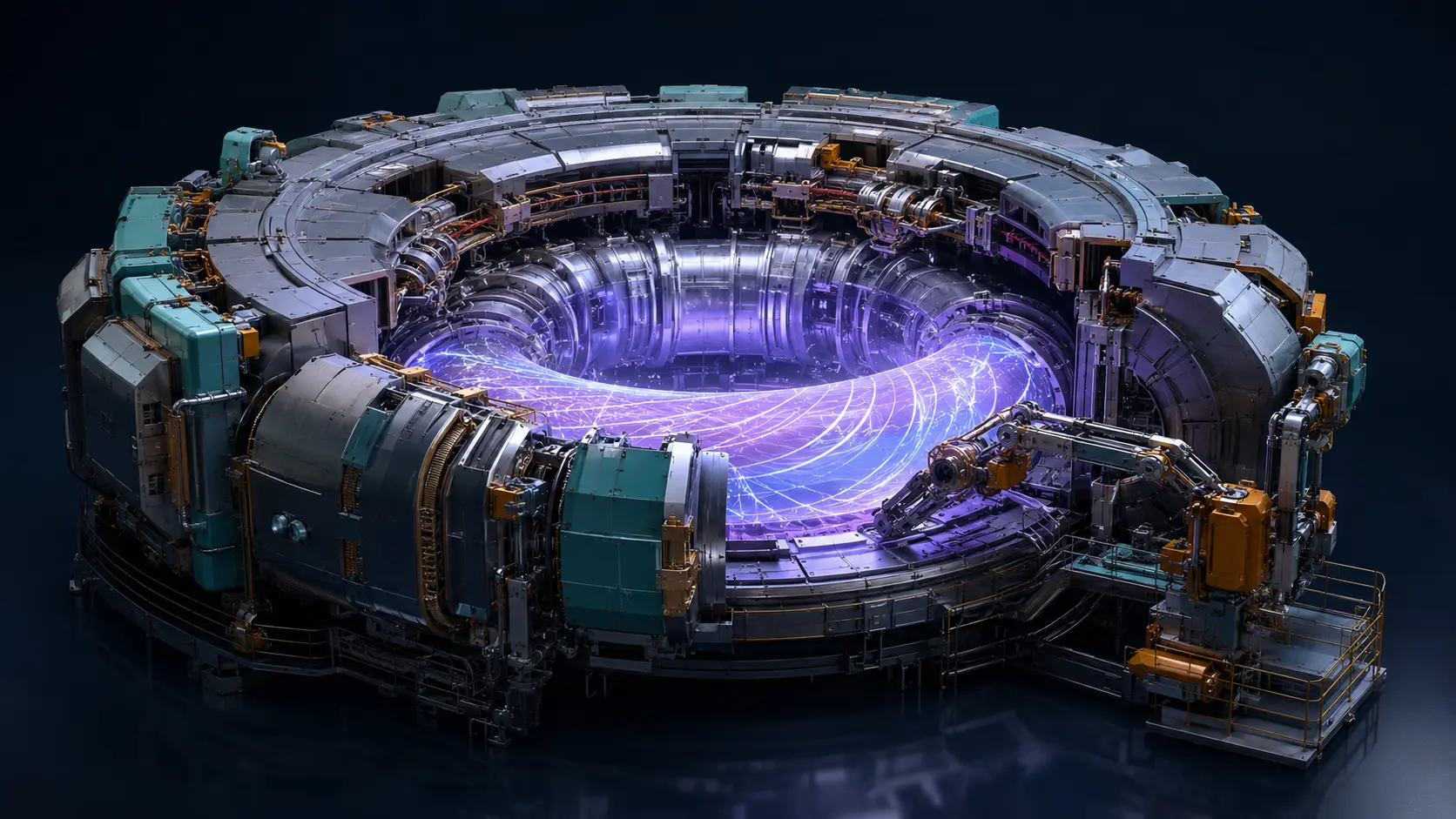
Phase 4B • Concise Comparison
Engineering comparison
Near-term plant studies generally assume deuterium-tritium operation and neutron-facing blankets.
Long-running experimental lineage with modern optimized devices; fewer reactor-scale demonstrations than tokamaks.
Steady-state plasma research, long-pulse component testing, pilot-plant studies, and possible future continuous energy production.
Complex magnet manufacture and assembly, field-error control, exhaust, plasma-facing materials, neutron shielding, tritium systems, sector access, remote maintenance, and cost.
Major-Component Plausibility Review
Public-level system callouts
These callouts describe plausible subsystem roles without publishing dimensions, operating parameters, control logic, materials recipes, or build instructions.
- Modular or continuous non-axisymmetric coils
- Three-dimensional vacuum vessel
- Plasma-heating and diagnostic ports
- Exhaust and plasma-facing component zones
- Cryostat and magnet support structure
- Blanket, shielding and maintenance-sector interfaces
Callouts were reviewed for family-level technical plausibility. Their arrangement is illustrative and does not represent a specific facility.
New • Stellarator Design Expansion Phase 2
See the plasma path—and the architecture around it
Six named high-resolution treatments explore solar-flow visual language, quasi-axisymmetric optimization, planned-outage maintenance sectors, distributed coils, compact high-field trade spaces, and long-pulse research facilities. Each treatment includes a pitch and an explicit engineering maturity boundary.
Six visual studiesSolar-inspired flow languageEngineering reality checks
 Open the Phase 2 portfolio →
Applications
Where this family fits
Steady-state research
Investigates continuous magnetic confinement without transformer-driven plasma current.
Optimization programs
Tests magnetic-field shaping, turbulence reduction, exhaust, and engineering accessibility.
Future energy systems
Potential continuous electricity or heat after integrated nuclear-island and maintenance performance are proven.
Engineering Reality Check
Maturity and claims boundary
What the artwork shows
A generalized public-facing concept intended to communicate architecture and subsystem relationships.
What it does not show
No proprietary geometry, device settings, operating windows, safety calculations, fuel-cycle recipes, procurement specifications, control logic, or construction instructions.
Public boundary: Technology classification and public research context only. Advanced fuels and direct conversion remain clearly labeled frontier research; neither is presented as commercially ready.
10-Phase Reactor Program • Phase 2
Standardized fusion technical specification
Standardized public-safe fields support comparison across every fission and fusion family. Values are intentionally qualitative; licensing data, dimensions, operating windows, calculations, control logic, and build instructions remain offline.
Three-dimensional toroidal magnetic confinement produced mainly by external coils
Field optimization, high-field magnets, simpler coil manufacture, and maintenance-aware geometry
HTS or advanced superconducting coils; precision support cases; tungsten; reduced-activation structures; blanket and tritium systems
D-T plant studies retain neutron activation, shielding, tritium, component replacement, and radioactive-material management even without fission products.
Thermal energy capture is the conservative reference
Established experimental family with active optimization; no integrated power plant
Steady-state potential does not remove coil complexity, blankets, shielding, exhaust, cryogenics, or service access.
Specification boundary: Family-level technology classification and lifecycle context—not a vendor datasheet, safety analysis, procurement specification, or construction package.
Ten-Phase Reactor Program · Phase 5
Safety, licensing and public-trust boundary
Three-dimensional magnet stored energy and quench, cryogens, plasma exhaust, vacuum, tritium confinement, activated components, constrained maintenance access, coolant boundaries, and occupational dose.
Near-term U.S. fusion systems are directed toward a Part 30 byproduct-material framework and associated regulations. Exact jurisdiction and license content depend on radioactive inventories, hazards, and facility activities.
Control and account for tritium and other radioactive materials; secure sources, targets, activated components, digital systems, and transfers. Fusion is not exempt from material control or security merely because fissile fuel is not the primary energy source.
Use a hazard- and inventory-based emergency plan under the applicable materials and facility framework. Lower accident potential cannot be translated into “no emergency plan” without an approved consequence analysis.
May say the concept is an active fusion research line with identified hazards and an emerging materials-based regulatory framework. Distinguish plasma milestones from plant safety and electricity.
Do not claim harmless, radiation-free, waste-free, maintenance-free, self-sustaining, net-electric, commercially licensed, no emergency planning, or “just a small sun.”
Classification only: This is not a safety finding, licensing opinion, emergency plan, security plan, or legal determination. Exact obligations belong to the applicable regulator and project authority.