
Design-dependent: heat pipes, pumped liquid metal, gas, or other mission-qualified heat-transport arrangements.
Fission Application • Space Power + Propulsion Research
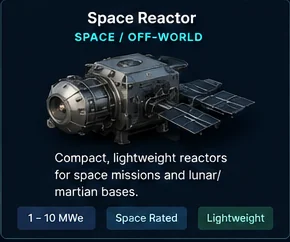
Space Reactor
Space fission includes reactor systems for surface electricity, spacecraft power, and nuclear propulsion research. Radioisotope power systems are not reactors and remain a separate technology category.
Flight HeritageSurface + Spacecraft PowerPropulsion ResearchMission-Specific Qualification
Phase 4 • Page-Specific Technical Summary
What this reactor category means
System definition
A compact fission reactor and conversion system engineered for launch, autonomous operation, radiation separation, vacuum heat rejection, and mission-specific power delivery.
A compact fission reactor and conversion system engineered for launch, autonomous operation, radiation separation, vacuum heat rejection, and mission-specific power delivery.
Intended applications
Lunar or planetary surface power, deep-space spacecraft electricity, high-power electric propulsion, and nuclear thermal propulsion research.
Lunar or planetary surface power, deep-space spacecraft electricity, high-power electric propulsion, and nuclear thermal propulsion research.
Public boundary
Technology classification, system relationships, maturity, and engineering challenges only. No design parameters, calculations, control logic, procedures, procurement data, or build instructions.
Technology classification, system relationships, maturity, and engineering challenges only. No design parameters, calculations, control logic, procedures, procurement data, or build instructions.
System Architecture • Public-Level Component Map
Major Components
A second view separates the principal system functions for Space Reactor. The rendering and callouts are conceptual and intended for public engineering orientation.

- Reactor unit
- Radiation shadow shield
- Deployment boom or separation cabling
- Power-conversion package
- Radiator panels
- Electrical transmission and control interface
Component boundaries vary by vendor, plant arrangement, coolant choice, power-conversion cycle, site constraints, and licensing basis.
Phase 4 • Concise Comparison
Engineering comparison
Fast, epithermal, or thermal depending on mass, shielding, fuel, moderator, and mission architecture.
Historical flight operation and ground-test heritage plus active modern surface-power and propulsion development.
Reliable long-duration power beyond practical solar or chemical-energy limits, and selected high-performance propulsion missions.
Launch safety, mass, radiation shielding and stand-off distance, autonomous control, long life, conversion reliability, radiator size, thermal transients, planetary protection, ground testing, safeguards, and end-of-mission disposition.
Application Context
Where the family fits
Lunar & Planetary Surface Power
Firm electricity for long nights, shadowed regions, science stations, and future surface infrastructure.
Deep-Space Electricity
Power for instruments, communications, and electric propulsion where sunlight is weak or intermittent.
Nuclear Propulsion Research
Separate thermal- and electric-propulsion pathways with distinct reactors, testing, shielding, and mission requirements.
10-Phase Reactor Program • Phase 2
Standardized fission technical specification
Standardized public-safe fields support comparison across every fission and fusion family. Values are intentionally qualitative; licensing data, dimensions, operating windows, calculations, control logic, and build instructions remain offline.
Heat pipes, liquid metal, or other mission-specific systems
Fast or moderated spectrum depending mission
High-assay or other mission-specific fuel under government controls
Kilowatt-class power through larger propulsion studies; mission-specific
Thermoelectric, dynamic conversion, or nuclear thermal propulsion interfaces
Flight heritage at small scale plus active development
Space systems still create activated hardware and spent fuel. Launch approval, re-entry safety, shielding, planetary protection, retrieval, and disposal are mission requirements.
Specification boundary: Family-level technology classification and lifecycle context—not a vendor datasheet, safety analysis, procurement specification, or construction package.
Ten-Phase Reactor Program · Phase 5
Safety, licensing and public-trust boundary
Launch, abort, re-entry, impact, inadvertent criticality, containment before intended operation, mission reliability, end-of-mission disposition, and multi-agency nuclear flight safety.
Not a routine terrestrial commercial-power pathway. U.S. missions require nuclear flight-safety analysis and launch authorization with NASA and other federal responsibilities defined for the mission.
Mission-specific material control, custody, transport, launch-site security, cybersecurity, and end-of-mission accountability apply. Details belong in protected program records.
Mission-specific launch, abort, re-entry, impact, recovery, contamination-control, public-information, and interagency response planning. Terrestrial reactor emergency zones are not a substitute.
May say the family has a defined operating or research history and can be evaluated through an applicable licensing pathway. State the exact maturity and unresolved design-specific gates.
Do not claim inherently safe, meltdown-proof, waste-free, proliferation-proof, walk-away, unguarded, zero-emergency-zone, automatically cheaper, or licensed because a related reactor operated.
Classification only: This is not a safety finding, licensing opinion, emergency plan, security plan, or legal determination. Exact obligations belong to the applicable regulator and project authority.