
Design-dependent; transportability does not determine coolant, fuel, spectrum, or conversion cycle.
Fission Application • Deployment + Logistics Category
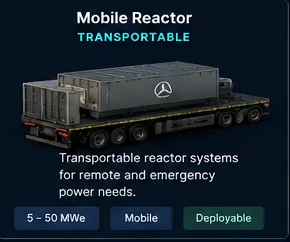
Transportable & Mobile Reactor
Transportable or mobile describes how a plant is delivered, relocated, or supported—not its neutron physics. Concepts may use heat pipes, gas, water, liquid metal, or other architectures, and must distinguish factory transport from actual operation while moving.
Deployment CategoryMultiple Reactor TypesDemonstration & LicensingRemote-Site Logistics
Phase 4 • Page-Specific Technical Summary
What this reactor category means
System definition
A compact reactor plant packaged for transport and site installation, with mobility, relocatability, and operating mode defined by the specific program.
A compact reactor plant packaged for transport and site installation, with mobility, relocatability, and operating mode defined by the specific program.
Intended applications
Remote installations, disaster recovery, temporary industrial loads, isolated communities, defense missions, mines, and other logistics-constrained sites.
Remote installations, disaster recovery, temporary industrial loads, isolated communities, defense missions, mines, and other logistics-constrained sites.
Public boundary
Technology classification, system relationships, maturity, and engineering challenges only. No design parameters, calculations, control logic, procedures, procurement data, or build instructions.
Technology classification, system relationships, maturity, and engineering challenges only. No design parameters, calculations, control logic, procedures, procurement data, or build instructions.
System Architecture • Public-Level Component Map
Major Components
A second view separates the principal system functions for Transportable Reactor. The rendering and callouts are conceptual and intended for public engineering orientation.

- Shielded reactor module
- Transport frame and seismic isolation
- Heat-transport interface
- Power-conversion module
- Site heat-rejection module
- Electrical, monitoring, and control interface
Component boundaries vary by vendor, plant arrangement, coolant choice, power-conversion cycle, site constraints, and licensing basis.
Phase 4 • Concise Comparison
Engineering comparison
Thermal or fast depending on the selected reactor architecture.
Demonstration and licensing-stage concepts with historical precedents; no broad modern commercial fleet.
Rapidly deployable firm power where conventional fuel delivery or grid construction is difficult.
Transport certification, security, safeguards, site preparation, shielding, emergency planning, heat rejection, setup and removal, maintenance access, refueling strategy, jurisdictional licensing, and economics.
Application Context
Where the family fits
Remote Installations
Firm electricity and heat where fuel convoys, transmission lines, or seasonal access create operational risk.
Temporary Critical Loads
Deployable energy studies for recovery bases, emergency logistics, and time-limited industrial work.
Factory-to-Site Delivery
Modular packaging intended to shift construction effort into controlled manufacturing environments.
10-Phase Reactor Program • Phase 2
Standardized fission technical specification
Standardized public-safe fields support comparison across every fission and fusion family. Values are intentionally qualitative; licensing data, dimensions, operating windows, calculations, control logic, and build instructions remain offline.
Underlying reactor-dependent
Underlying reactor-dependent
Underlying design and mission determine fuel and enrichment
Transportable or relocatable deployment format
Electricity and heat for isolated or temporary sites
Demonstrations and active development
Mobility is not a waste solution. Transport security, return-to-vendor strategy, spent fuel, activated modules, site restoration, and final disposal require a complete lifecycle plan.
Specification boundary: Family-level technology classification and lifecycle context—not a vendor datasheet, safety analysis, procurement specification, or construction package.
Ten-Phase Reactor Program · Phase 5
Safety, licensing and public-trust boundary
Underlying reactor hazards plus transport accidents, repeated commissioning, changing site interfaces, security in transit and at temporary sites, emergency coordination, return logistics, and site restoration.
U.S. advanced-power candidate: Parts 50 and 52 remain available, and the NRC issued Part 53 as an additional risk-informed, technology-inclusive pathway. The exact design, fuel, mission, and site control the route.
Apply nuclear-material control and accounting, physical protection, cybersecurity, transport security, insider-risk controls, and international safeguards as applicable to the exact material and jurisdiction. Do not publish Safeguards Information or adversary-useful detail.
Eligible SMR, non-light-water, and non-power facilities may use the performance-based 10 CFR 50.160 framework. Emergency-planning scope and zone are consequence-informed and design-specific—not automatically the site boundary.
May say the family has a defined operating or research history and can be evaluated through an applicable licensing pathway. State the exact maturity and unresolved design-specific gates.
Do not claim inherently safe, meltdown-proof, waste-free, proliferation-proof, walk-away, unguarded, zero-emergency-zone, automatically cheaper, or licensed because a related reactor operated.
Classification only: This is not a safety finding, licensing opinion, emergency plan, security plan, or legal determination. Exact obligations belong to the applicable regulator and project authority.