
Design-dependent: heat pipes, pumped liquid metal, gas, or other mission-qualified heat-transport arrangements.
Fission Application • Space Power + Propulsion Research
Space Reactor
Space fission includes reactor systems for surface electricity, spacecraft power, and nuclear propulsion research. Radioisotope power systems are not reactors and remain a separate technology category.
Flight HeritageSurface + Spacecraft PowerPropulsion ResearchMission-Specific Qualification
Phase 4 • Page-Specific Technical Summary
What this reactor category means
System definition
A compact fission reactor and conversion system engineered for launch, autonomous operation, radiation separation, vacuum heat rejection, and mission-specific power delivery.
A compact fission reactor and conversion system engineered for launch, autonomous operation, radiation separation, vacuum heat rejection, and mission-specific power delivery.
Intended applications
Lunar or planetary surface power, deep-space spacecraft electricity, high-power electric propulsion, and nuclear thermal propulsion research.
Lunar or planetary surface power, deep-space spacecraft electricity, high-power electric propulsion, and nuclear thermal propulsion research.
Public boundary
Technology classification, system relationships, maturity, and engineering challenges only. No design parameters, calculations, control logic, procedures, procurement data, or build instructions.
Technology classification, system relationships, maturity, and engineering challenges only. No design parameters, calculations, control logic, procedures, procurement data, or build instructions.
Phase 2 • Public-Level System Architecture
Core System Elements
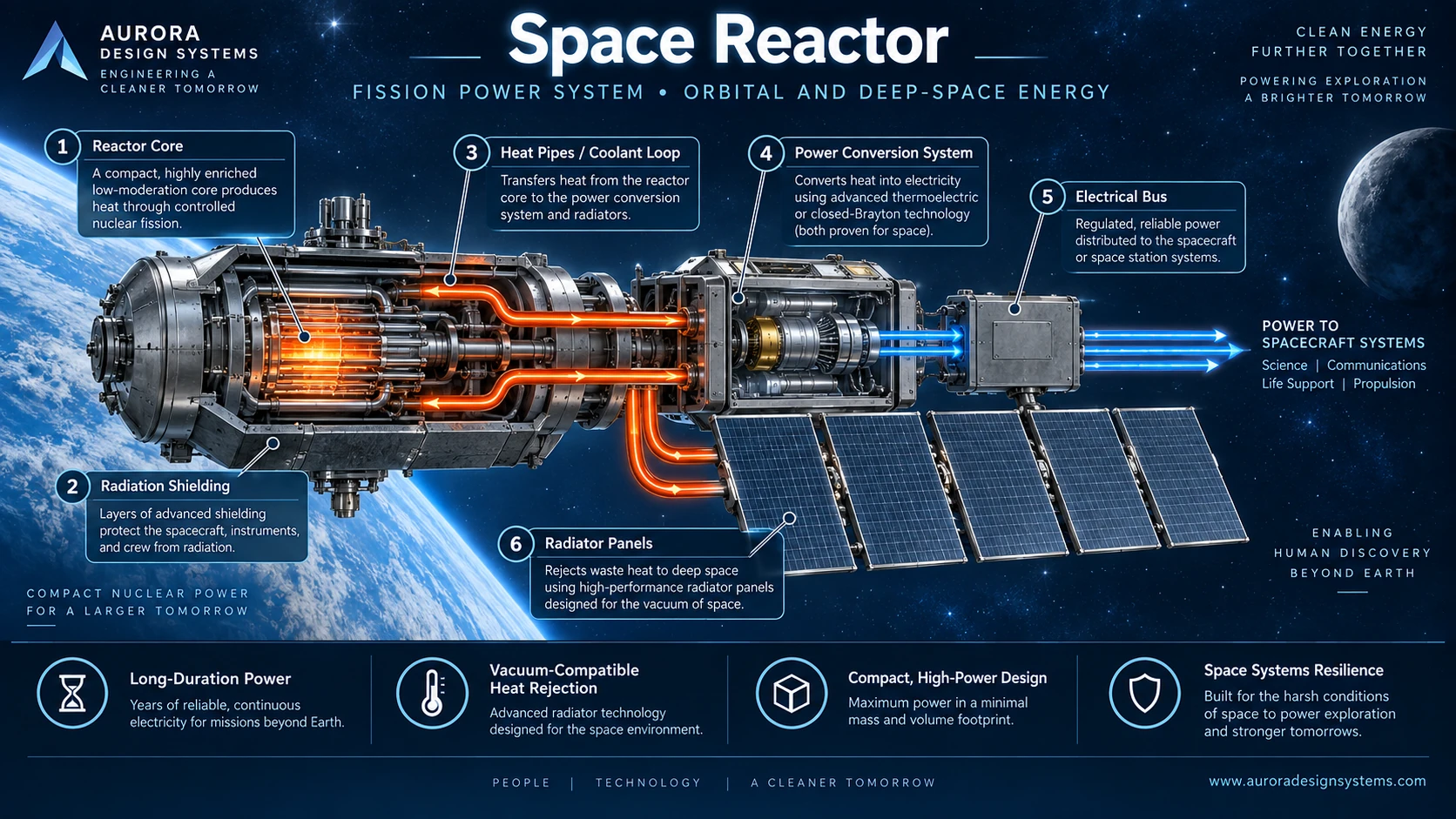
The full-width rendering above provides the visual system map. The callouts below identify the principal public-level functions without repeating the same reactor graphic a second time.
- Reactor unit
- Radiation shadow shield
- Deployment boom or separation cabling
- Power-conversion package
- Radiator panels
- Electrical transmission and control interface
System roles are family-level and intentionally qualitative. Exact geometry, operating conditions, safety classification, equipment boundaries, and licensing basis remain design-specific.
Phase 4 • Concise Comparison
Engineering comparison
Fast, epithermal, or thermal depending on mass, shielding, fuel, moderator, and mission architecture.
Historical flight operation and ground-test heritage plus active modern surface-power and propulsion development.
Reliable long-duration power beyond practical solar or chemical-energy limits, and selected high-performance propulsion missions.
Launch safety, mass, radiation shielding and stand-off distance, autonomous control, long life, conversion reliability, radiator size, thermal transients, planetary protection, ground testing, safeguards, and end-of-mission disposition.
Phase 4 • Technical Education + Terminology + Accuracy
Learn the System
This learning layer explains the system in public engineering language. Definitions are intentionally conceptual: they teach terminology and relationships without providing operating procedures, design set-points, construction dimensions, or protected implementation details.
Maturity checkpoint: Fission space power has flight heritage (SNAP-10A) and active surface-power development; NASA and DOE are pursuing a lunar surface reactor for the 2030 timeframe.
System walkthrough
How it works — at a safe public level
- A compact fission reactor produces heat independently of sunlight.
- Heat moves through heat pipes or another coolant system to a power-conversion unit.
- A converter produces electricity for surface systems, spacecraft loads, or electric propulsion.
- Large radiator surfaces reject waste heat to space by thermal radiation.
- Shielding, separation distance, launch safety, autonomous control, lifetime, and disposal strategy are mission-specific parts of the architecture.
Key distinction: Space fission power, nuclear electric propulsion, nuclear thermal propulsion, and radioisotope power systems are distinct categories. An RTG is not a reactor because it does not sustain a chain reaction.
Technical vocabulary
Terms worth knowing
Fission surface power
A compact reactor-based electrical system intended to provide long-duration power on a planetary surface such as the Moon or Mars.
Nuclear electric propulsion
A space-propulsion architecture in which a reactor generates electricity that powers an electric thruster.
Nuclear thermal propulsion
A propulsion concept in which a reactor directly heats propellant before expansion through a rocket nozzle; distinct from a space power reactor.
Radioisotope power system
A device that converts heat from natural radioactive decay into electricity. It is not a nuclear reactor because it does not sustain a fission chain reaction.
Radiator panel
A surface engineered to reject heat by thermal radiation, crucial in vacuum where there is no atmospheric convective cooling.
Shadow shield
A directional radiation shield placed so sensitive equipment or crew lie in a protected region rather than surrounding a reactor uniformly with heavy shielding.
Brayton cycle
A thermodynamic power-conversion cycle based on compression, heating, expansion through a turbine, and heat rejection; often discussed for advanced and space power systems.
Stirling conversion
Power conversion using a closed-cycle reciprocating engine driven by a temperature difference; used in some space power studies.
Specific power
Power output relative to mass or volume. It is especially important in aircraft, mobile, and space applications where mass is highly constrained.
Heat pipe
A sealed passive heat-transfer device using evaporation and condensation of an internal working fluid to move heat with no mechanical pump.
Decay heat
Heat that continues after the fission chain reaction stops because radioactive fission products continue to decay.
Kilowatt electric
A unit of electrical output equal to one thousand watts; often used for small space-power systems.
Application Context
Where the family fits
Lunar & Planetary Surface Power
Firm electricity for long nights, shadowed regions, science stations, and future surface infrastructure.
Deep-Space Electricity
Power for instruments, communications, and electric propulsion where sunlight is weak or intermittent.
Nuclear Propulsion Research
Separate thermal- and electric-propulsion pathways with distinct reactors, testing, shielding, and mission requirements.
10-Phase Reactor Program • Phase 2
Standardized fission technical specification
Standardized public-safe fields support comparison across every fission and fusion family. Values are intentionally qualitative; licensing data, dimensions, operating windows, calculations, control logic, and build instructions remain offline.
Heat pipes, liquid metal, or other mission-specific systems
Fast or moderated spectrum depending mission
High-assay or other mission-specific fuel under government controls
Kilowatt-class power through larger propulsion studies; mission-specific
Thermoelectric, dynamic conversion, or nuclear thermal propulsion interfaces
Flight heritage at small scale plus active development
Space systems still create activated hardware and spent fuel. Launch approval, re-entry safety, shielding, planetary protection, retrieval, and disposal are mission requirements.
Specification boundary: Family-level technology classification and lifecycle context—not a vendor datasheet, safety analysis, procurement specification, or construction package.
Ten-Phase Reactor Program · Phase 5
Safety, licensing, lifecycle & public trust
Phase 5 treats safety as a full lifecycle obligation: site and license basis, fuel/material supply, operation, environmental controls, safeguards, emergency preparedness, waste, decommissioning, and disciplined public claims.
Launch, abort, re-entry, impact, inadvertent criticality, containment before intended operation, mission reliability, end-of-mission disposition, and multi-agency nuclear flight safety.
Mission-specific reactors do not share one universal licensing path. Civilian, federal, military, maritime, transportable, research, launch, and off-world missions can involve different statutory authorities and regulators. Public pages should identify the category without asserting a permit path that has not been established for the exact mission.
Mission review must include terrestrial fabrication and transport, launch-site operations, launch or ascent accidents, re-entry or Earth-return potential, planetary-protection or destination constraints where applicable, orbital/deep-space end state, and disposition of nuclear material after mission completion.
Fuel, enrichment, transport form, shielding, custody, and refueling or replacement strategy are mission-specific. Compactness can increase the importance of fuel qualification, transportability, security, and end-of-mission accountability.
For space systems, 'waste' includes terrestrial manufacturing and test waste plus the fueled system's end-of-mission disposition. A credible architecture identifies whether the reactor is retrieved, stored, disposed in an approved end state, or remains in a controlled mission trajectory under applicable policy.
Apply graded material control and accounting, physical protection, cybersecurity, transport controls, insider-risk controls, and international safeguards as applicable to the material, facility, mission, and jurisdiction. Public pages must not reproduce Safeguards Information, sensitive security layouts, response tactics, or adversary-useful detail.
Emergency planning must match the mission and credible hazards. Terrestrial EP rules, maritime response, transport accidents, research-facility response, launch/re-entry contingency planning, and recovery operations are not interchangeable frameworks.
State the maturity actually achieved, name the applicable authority, separate family-level evidence from project approval, and distinguish demonstrated performance from projections or marketing.
May describe verified historical programs, research demonstrations, or active federal/industry development programs with precise maturity labels. Public architecture can compare mission constraints without implying approval for deployment.
Do not imply that military heritage creates a civilian license, that mobility removes siting obligations, that remote deployment removes security or emergency planning, or that a space/aviation concept has an established commercial pathway when it does not.
Phase 5 evidence:NRC — Advanced Reactor & Microreactor Activities ↗NRC — Nuclear Security & Safeguards ↗IAEA — Safety Standards ↗
Public classification only: This is not a safety finding, licensing opinion, environmental permit, emergency plan, security plan, safeguards determination, waste-acceptance decision, or legal advice. Exact obligations belong to the applicable regulator and project authority.
Phase 7 • Release Certification & Production Integration
Release certification
This page has passed the Reactor Programs Phase 7 branch-level release review for internal routing, asset references, canonical metadata, maturity and terminology controls, source-authority links, accessibility essentials, responsive markup, and release traceability.
Production boundary: this certification covers the Reactor Programs branch package. Parent-site shared CSS, navigation, search, logo, and global assets remain controlled by the Aurora website root and must already exist in production. Live deployment is not implied until the package is uploaded and the production URLs are rechecked.