
Most public operating heritage is pressurized-water based; other coolants remain historical or conceptual.
Fission Application • Specialized Marine Systems
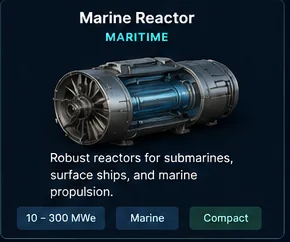
Marine Reactor
Marine nuclear propulsion has decades of specialized operational experience, primarily in naval service. Civilian nuclear ships, floating power units, and future commercial maritime concepts form a separate and much narrower deployment record.
Propulsion + Ship PowerSpecialized Operational HeritageCivilian Deployment LimitedPublic Functional View
Phase 4 • Page-Specific Technical Summary
What this reactor category means
System definition
A reactor plant integrated with a vessel or floating platform to provide propulsion, electrical power, useful heat, or a combination of those services.
A reactor plant integrated with a vessel or floating platform to provide propulsion, electrical power, useful heat, or a combination of those services.
Intended applications
Naval propulsion, icebreakers, selected civilian vessels, floating power plants, and future low-carbon maritime studies.
Naval propulsion, icebreakers, selected civilian vessels, floating power plants, and future low-carbon maritime studies.
Public boundary
Technology classification, system relationships, maturity, and engineering challenges only. No design parameters, calculations, control logic, procedures, procurement data, or build instructions.
Technology classification, system relationships, maturity, and engineering challenges only. No design parameters, calculations, control logic, procedures, procurement data, or build instructions.
System Architecture • Public-Level Component Map
Major Components
A second view separates the principal system functions for Marine Reactor. The rendering and callouts are conceptual and intended for public engineering orientation.

- Shielded reactor vessel
- Primary heat-transport system
- Steam generator or heat exchanger
- Propulsion and electrical conversion train
- Marine heat-sink interface
- Monitoring, protection, and control
Component boundaries vary by vendor, plant arrangement, coolant choice, power-conversion cycle, site constraints, and licensing basis.
Phase 4 • Concise Comparison
Engineering comparison
Typically thermal-neutron for pressurized-water marine systems; design-dependent outside that family.
Established specialized naval technology; limited civilian operation and active concept development for future maritime applications.
Long endurance, high energy density, propulsion, and shipboard electricity where specialized crews and infrastructure are justified.
Compact shielding, collision and flooding resilience, motion and shock loads, crew protection, port access, security, safeguards, maintenance, emergency response, waste, decommissioning, jurisdiction, public acceptance, and economics.
Application Context
Where the family fits
Naval Propulsion
A mature but specialized operational domain with restricted design details and dedicated support infrastructure.
Civilian Maritime
A limited historical and modern field covering icebreakers, demonstration ships, and prospective cargo concepts.
Floating Power
Mooring-based generation platforms that combine marine logistics with stationary grid service.
10-Phase Reactor Program • Phase 2
Standardized fission technical specification
Standardized public-safe fields support comparison across every fission and fusion family. Values are intentionally qualitative; licensing data, dimensions, operating windows, calculations, control logic, and build instructions remain offline.
Often pressurized water in established naval practice; alternatives are design-specific
Usually thermal spectrum in established designs
Long-life engineered fuel selected for vessel mission and national controls
Ship or floating-platform installation
Steam-electric, mechanical propulsion, or integrated electric drive
Established naval heritage; civilian deployment is limited and regulated
Marine deployment adds shipyard defueling, transport, security, port, decommissioning, and accident-response obligations to the underlying spent-fuel pathway.
Specification boundary: Family-level technology classification and lifecycle context—not a vendor datasheet, safety analysis, procurement specification, or construction package.
Ten-Phase Reactor Program · Phase 5
Safety, licensing and public-trust boundary
Underlying reactor hazards plus collision, grounding, flooding, sinking, port operations, ship motion, marine evacuation, salvage, jurisdiction, liability, and decommissioning.
Civilian U.S. maritime reactors may use Parts 50, 52, or 53, with maritime, port, Coast Guard, environmental, transport, liability, and jurisdictional interfaces. Naval programs use a separate federal framework.
Apply nuclear-material control and accounting, physical protection, cybersecurity, transport security, insider-risk controls, and international safeguards as applicable to the exact material and jurisdiction. Do not publish Safeguards Information or adversary-useful detail.
Shipboard, port, route, collision, grounding, sinking, salvage, evacuation, contamination-control, and multi-jurisdiction response planning must be integrated before deployment.
May say the family has a defined operating or research history and can be evaluated through an applicable licensing pathway. State the exact maturity and unresolved design-specific gates.
Do not claim inherently safe, meltdown-proof, waste-free, proliferation-proof, walk-away, unguarded, zero-emergency-zone, automatically cheaper, or licensed because a related reactor operated.
Classification only: This is not a safety finding, licensing opinion, emergency plan, security plan, or legal determination. Exact obligations belong to the applicable regulator and project authority.