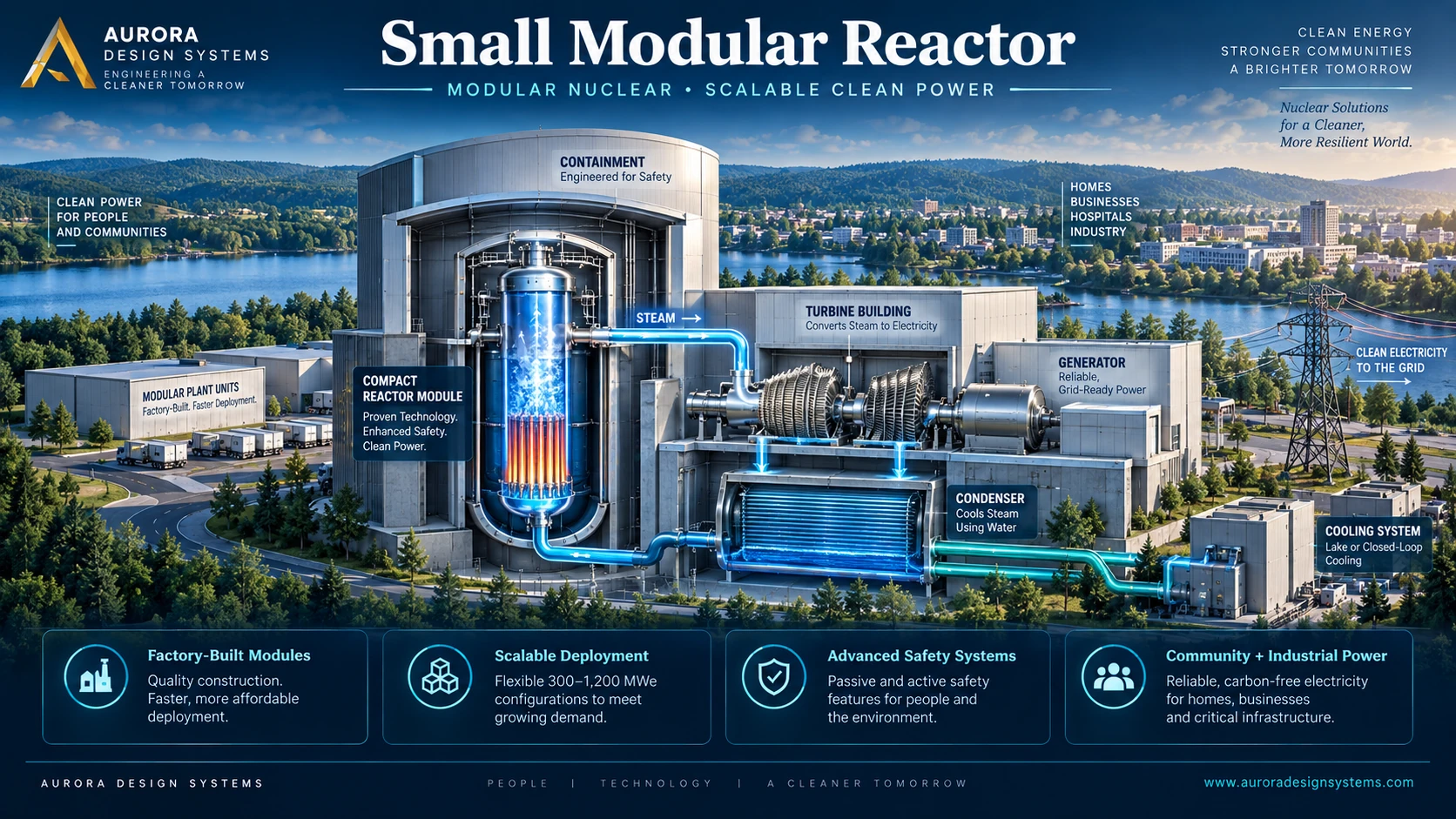
Concept rendering for public orientation. Page text below controls technical, maturity, safety, and licensing claims; visual labels are illustrative rather than design or licensing statements.
Fission System • Size + Deployment Category
Small Modular Reactor
Small modular reactor, or SMR, is a size and deployment category rather than one reactor-physics family. Designs span light-water, gas-cooled, liquid-metal, and salt-based systems, with different fuels, spectra, conversion cycles, and licensing positions.
Up to 300 MWe per ModuleMultiple Reactor FamiliesEarly DeploymentFactory-Oriented Delivery
Technical Overview
What this reactor category means
System definition A reactor module within the IAEA small-reactor range, intended to gain schedule, quality, or scaling advantages through modular manufacture and deployment.
Intended applications Grid generation, cogeneration, district energy, industrial heat, desalination, replacement of retiring thermal plants, and isolated-grid support.
Public boundary Technology classification, system relationships, maturity, and engineering challenges only. No design parameters, calculations, control logic, procedures, procurement data, or build instructions.
Featured Industry Reference · Boiling-Water SMR
GE Vernova Hitachi BWRX-300
Mechanical Nuclear Island systems, functional interfaces, and engineering documentation
The BWRX-300 is a light-water boiling-water reactor (BWR) with a direct steam cycle and natural circulation in the reactor pressure vessel. It is a particular reactor design within the broader small modular reactor (SMR) category—not a variant of the NuScale integral pressurized-water reactor presented separately on this page.
Nominal reference figures and architecture are from GE Vernova Hitachi public materials. Design and site-specific licensing data govern actual implementation.
Mechanical Nuclear Island · Systems overview
Three systems central to the mechanical engineering scope
Public-level component boundaries and integration questions—not detailed plant drawings, functional setpoints, or fabrication instructions.
01 / Nuclear Boiler System
Reactor vessel and steam-generation boundaries
The nuclear boiler encompasses the reactor pressure vessel and associated interfaces that support steam production, internal circulation, main steam, feedwater, and nuclear instrumentation functions.
Mechanical-system focus: pressure-boundary interfaces, component envelopes, structural support, equipment access, installation coordination, and consistent system documentation.
02 / Isolation Condenser System
Passive decay-heat removal and heat-rejection interfaces
Isolation condensers transfer energy from reactor steam to heat exchangers submerged in dedicated water pools. The overall arrangement supports passive decay-heat removal under specified plant conditions.
Mechanical-system focus: heat-exchanger integration, equipment and piping interfaces, structural supports, access for inspection, and interface records across thermal, civil, and instrumentation disciplines.
03 / Control Rod Drive System
Reactivity-control equipment integration
The control rod drive system provides the means to position control rods and supports reactor shutdown functions within the design's qualified safety architecture.
Mechanical-system focus: mechanical actuation equipment, vessel interfaces, installation clearances, maintenance accessibility, interfaces with controls, and configuration management.
Engineering delivery · Configuration control
Deliverables that connect systems to design, procurement, and construction
The topics below describe the engineering work products and coordination disciplines involved in a plant project, rather than completed deliverables claimed for Aurora.
Process flow diagrams and calculations
Establish system boundaries, operating-state assumptions, heat and mass-flow accounting, interface responsibilities, independent checks, and revision traceability.
Piping & Instrumentation Diagrams (P&IDs)
Coordinate functional equipment relationships, instrument identification, system interfaces, drawing conventions, and the design-change process across mechanical, process, and I&C teams.
Equipment and piping lists
Support controlled lists of equipment, connections, system identifiers, drawing references, installation boundaries, procurement requirements, and change impacts.
Interfaces, procurement & construction
Coordinate design handoffs, supplier submittal reviews, mechanical layout constraints, installation access, field clarifications, nonconformance resolution, and as-built document reconciliation.
Relevant multidisciplinary engineering background
Aurora Design Systems' founder, Evan Coffield, has supported DOE Y-12 Uranium Processing Facility glovebox and hazardous-containment equipment integration, including structural frameworks, pressure/vacuum equipment interfaces, instrumentation and cable routing, equipment layout, and manufacturing-release documentation. Related work includes high-vacuum semiconductor equipment, mechanical packaging, aerospace tooling, GD&T, and configuration-controlled CAD/PLM engineering.
Experience boundary: those assignments are relevant mechanical and systems-integration experience; they are not represented as prior BWRX-300 reactor design, reactor licensing authority, or completed BWRX-specific P&IDs or flow calculations.
Independent educational engineering reference, reviewed October 2026. Not affiliated with or endorsed by GE Vernova Hitachi or NuScale. The information is not a licensed design, safety analysis, P&ID, procurement specification, fabrication package, or construction instruction. Vendor documents and governing project requirements take precedence.
Industry Example • Integral PWR SMR
NuScale Power Module
This is the NuScale reactor in our list: Small Modular Reactor is the deployment category; integral pressurized-water reactor is the underlying technology.
Reactor typeIntegral PWRPer module250 MWt / 77 MWe grossCoolant and fuelLight water / UO₂Fuel enrichmentBelow 4.95%Core37 assemblies • 17 × 17Operating cycle18–21 monthsSteam generatorsTwo once-through helical bundlesPlant objective60 years
Vendor-published, nonproprietary February 2026 data. Values describe the NuScale Power Module—not every SMR.
The full-width rendering above provides the visual system map. The callouts below identify the principal public-level functions without repeating the same reactor graphic a second time.
Reactor module
Containment or confinement structure
Primary heat-transport system
Heat exchanger or steam-generation system
Power or useful-heat conversion
Electrical, cooling, and control interfaces
System roles are family-level and intentionally qualitative. Exact geometry, operating conditions, safety classification, equipment boundaries, and licensing basis remain design-specific.
Engineering Comparison
Engineering comparison
Coolant / heat transport
Varies by design: light water, gas, liquid metal, molten salt, or other qualified heat-transport media.
Neutron spectrum
May be thermal, epithermal, or fast; SMR does not determine the neutron spectrum.
Maturity
Development, licensing, construction, and limited early deployment coexist across different designs and countries.
Intended application
Incremental capacity additions, smaller grids, modular expansion, and power-and-heat applications.
Key engineering challenges
First-of-a-kind cost, licensing, supply-chain repeatability, module transport, construction learning, staffing, safeguards, waste, and demonstrating fleet economics.
This learning layer explains the system in public engineering language. Definitions are intentionally conceptual: they teach terminology and relationships without providing operating procedures, design set-points, construction dimensions, or protected implementation details.
Maturity checkpoint: Multiple SMR designs are in licensing, construction, demonstration, or operation worldwide; maturity must be stated by exact design.
System walkthrough
How it works — at a safe public level
A reactor design is divided into modules that can be fabricated or assembled to a greater extent before site installation.
Each module contains a complete or semi-integrated nuclear steam supply system, depending on design.
One or more modules connect to shared or dedicated power-conversion and balance-of-plant systems.
Plants may add modules in phases to match demand, financing, or grid size.
Licensing, emergency planning, staffing, and economics remain design- and site-specific.
Key distinction: SMR describes scale and modular deployment strategy, not one coolant, fuel, neutron spectrum, or power cycle.
Technical vocabulary
Terms worth knowing
SMR
Small modular reactor: generally an advanced reactor designed for modular fabrication and an electrical output up to roughly 300 MWe per module in IAEA usage.
FOAK
First-of-a-kind: the first implementation of a new design or major design configuration, typically carrying higher execution and learning risk.
NOAK
Nth-of-a-kind: later deployments expected to benefit from standardization, experience, and repeated manufacturing or construction.
Natural circulation
Fluid motion driven by density differences rather than by a mechanical pump.
Passive safety
A safety function that relies strongly on physical effects such as gravity, stored energy, natural circulation, or thermal expansion rather than continuous powered actuation.
MWe
Megawatts electric: the electrical power output delivered by a generating system.
MWth
Megawatts thermal: the rate of heat production before conversion to electricity or useful process heat.
Factory fabrication
Manufacturing major plant modules in a controlled factory environment before transport and site installation.
Module
A standardized reactor or plant section intended to be manufactured, transported, installed, or replicated as a defined unit.
Multi-module plant
A site containing multiple reactor modules that may share selected balance-of-plant or infrastructure systems.
Integral reactor
A reactor architecture that places major primary-system components such as steam generators or pressurizers inside or very close to the reactor vessel to reduce large external primary piping.
Capacity factor
Actual electricity produced over a period divided by what the plant could have produced if it operated at full rated output continuously.
Add capacity in modules rather than committing to one very large generating unit.
Power + Process Heat
Support electricity, district energy, desalination, hydrogen, or industrial-heat studies where the selected design is suitable.
Brownfield Energy Transition
Evaluate reuse of transmission, cooling, and skilled-workforce assets at retiring generation sites.
Technology Classification
Standardized fission technical specification
Standardized public-safe fields support comparison across every fission and fusion family. Values are intentionally qualitative; licensing data, dimensions, operating windows, calculations, control logic, and build instructions remain offline.
Coolant / moderator
Technology-dependent: water, gas, liquid metal, or salt
Neutron spectrum
Technology-dependent
Fuel form
Technology-dependent; SMR describes size and construction format, not one fuel
Scale / deployment
Single or multi-module small-reactor plant
Energy conversion
Technology-dependent electricity, heat, or cogeneration system
Maturity
First deployments, licensing, demonstrations, and active development
Fuel resource & waste
Modularity does not automatically reduce waste per unit energy. Waste form, enrichment, burnup, decommissioning, and repository needs depend on the underlying reactor and fuel cycle.
Specification boundary: Family-level technology classification and lifecycle context—not a vendor datasheet, safety analysis, procurement specification, or construction package.
Phase 5 treats safety as a full lifecycle obligation: site and license basis, fuel/material supply, operation, environmental controls, safeguards, emergency preparedness, waste, decommissioning, and disciplined public claims.
Safety case
Underlying reactor hazards plus multi-module interactions, shared systems, staffing and human factors, source-term evidence, passive-feature validation, underground or compact siting, and module replacement.
Licensing & jurisdiction
In the United States, Parts 50 and 52 remain available, and Part 53 became available in 2026 as a risk-informed, performance-based, technology-inclusive pathway for eligible class 103 commercial plants. For microreactors, the NRC has also proposed Part 57; it is not yet an available licensing route. Exact applicability depends on design, mission, fuel, and site.
Environmental boundary
SMR is a size/deployment category, so environmental impacts follow the underlying reactor technology and site. Multi-module campuses can accumulate land, water, transmission, construction, waste, and emergency-planning effects; do not scale a single-module footprint linearly without project evidence.
Fuel / material lifecycle
Fuel form and enrichment are design-specific. Many advanced-reactor concepts depend on fuels or supply chains that differ from today's light-water fleet, including some designs that require HALEU. Fuel qualification, fabrication capacity, transport packages, and secure material availability can be deployment gates.
Waste & decommissioning
Advanced fuel forms can change waste streams but do not eliminate them. Account for spent or used fuel, activated structures, coolant or salt cleanup where applicable, contaminated maintenance hardware, storage, transportation, decommissioning, and disposal pathways.
Safeguards & information security
Apply graded material control and accounting, physical protection, cybersecurity, transport controls, insider-risk controls, and international safeguards as applicable to the material, facility, mission, and jurisdiction. Public pages must not reproduce Safeguards Information, sensitive security layouts, response tactics, or adversary-useful detail.
Emergency preparedness
Eligible SMRs, non-light-water reactors, and non-power facilities may use the performance-based 10 CFR 50.160 emergency-preparedness framework. EP scope and any plume-exposure planning zone are consequence- and site-informed; neither reactor size nor passive features automatically reduce the requirement to zero.
Claims discipline
State the maturity actually achieved, name the applicable authority, separate family-level evidence from project approval, and distinguish demonstrated performance from projections or marketing.
Defensible public claim
May describe a design family as research, demonstration, early deployment, or commercially operating only where the cited design actually supports that maturity. May say U.S. licensing pathways exist without claiming that a particular design is licensed.
Blocked public claim
Do not convert passive features into 'walk-away safe,' fuel robustness into 'meltdown-proof,' smaller size into 'no emergency planning,' or advanced fuel into 'waste-free' or 'proliferation-proof.' Do not treat concept maturity as project approval.
Public classification only: This is not a safety finding, licensing opinion, environmental permit, emergency plan, security plan, safeguards determination, waste-acceptance decision, or legal advice. Exact obligations belong to the applicable regulator and project authority.
Phase 6 • Publication Authority & Final Integration
Publication authority
Mixed / Design-Dependent Maturity
This page has passed the Reactor Programs Phase 6 publication review for source hierarchy, terminology, maturity labeling, metadata, cross-linking, and public-claims consistency. Page text controls over illustrative artwork.
Production boundary: this certification covers the Reactor Programs branch package. Parent-site shared CSS, navigation, search, logo, and global assets remain controlled by the Aurora website root and must already exist in production. Live deployment is not implied until the package is uploaded and the production URLs are rechecked.