
Facility-specific; pool water, air, gas, or other arrangements may be used depending on reactor type and experiment mission.
Fission Research Facility • Controlled Transients
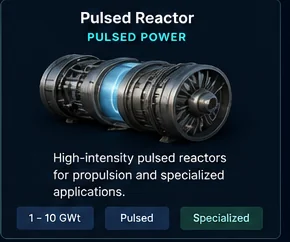
Pulsed Reactor
Pulsed and transient research reactors create short, controlled changes in reactor power to expose experiments, materials, electronics, or fuel specimens to defined neutron and radiation environments. They are research facilities, not grid-power reactor families.
Transient TestingResearch FacilitySpecialized Operating HeritageNot Grid Generation
Phase 4 • Page-Specific Technical Summary
What this reactor category means
System definition
A research reactor configured to produce repeatable short-duration neutron and radiation pulses or controlled power transients.
A research reactor configured to produce repeatable short-duration neutron and radiation pulses or controlled power transients.
Intended applications
Radiation-effects testing, detector calibration, materials research, fuel-safety experiments, neutron science, and validation of transient models.
Radiation-effects testing, detector calibration, materials research, fuel-safety experiments, neutron science, and validation of transient models.
Public boundary
Technology classification, system relationships, maturity, and engineering challenges only. No design parameters, calculations, control logic, procedures, procurement data, or build instructions.
Technology classification, system relationships, maturity, and engineering challenges only. No design parameters, calculations, control logic, procedures, procurement data, or build instructions.
System Architecture • Public-Level Component Map
Major Components
A second view separates the principal system functions for Pulsed Reactor Research. The rendering and callouts are conceptual and intended for public engineering orientation.

- Transient reactor and test vessel
- Shielding and experiment containment
- Experiment channel
- Rapid-reactivity and shutdown systems
- High-speed instrumentation
- Remote monitoring and control
Component boundaries vary by vendor, plant arrangement, coolant choice, power-conversion cycle, site constraints, and licensing basis.
Phase 4 • Concise Comparison
Engineering comparison
Thermal, epithermal, fast, or mixed depending on core, moderator, reflector, and experiment location.
Specialized operating and historical research capability with a limited number of dedicated facilities.
Controlled experimental irradiation and transient-response research rather than continuous energy production.
Repeatable transient control, rapid instrumentation, fuel and structural stress, experiment containment, shielding, remote handling, calibration, aging facilities, safety analysis, security, and specialized workforce retention.
Application Context
Where the family fits
Radiation Effects
Controlled environments for electronics, sensors, materials, and systems exposed to intense neutron or gamma fields.
Fuel Safety Research
Transient experiments supporting models of fuel and component behavior under tightly bounded test conditions.
Neutron Science
Pulse timing and specialized experiment channels for diagnostics, detector work, and nuclear-data studies.
10-Phase Reactor Program • Phase 2
Standardized fission technical specification
Standardized public-safe fields support comparison across every fission and fusion family. Values are intentionally qualitative; licensing data, dimensions, operating windows, calculations, control logic, and build instructions remain offline.
Research-device-specific coolant and heat removal
Thermal or fast transient spectrum depending facility
Specialized research fuel and core design
Short transient or pulse research facility, not steady grid generation
Measurement and experimental heat management rather than continuous power conversion
Established specialized research role
Pulse reactors consume and activate research fuel and hardware; facility decommissioning, fuel return, storage, and disposal remain regulated lifecycle work.
Specification boundary: Family-level technology classification and lifecycle context—not a vendor datasheet, safety analysis, procurement specification, or construction package.
Ten-Phase Reactor Program · Phase 5
Safety, licensing and public-trust boundary
Rapid reactivity insertion, pulse limits, experiment interfaces, confinement, radiation protection, cooling between pulses, instrumentation independence, operator qualification, and emergency shutdown.
U.S. non-power research or test reactors are licensed as non-power production or utilization facilities under Part 50; facility purpose and hazard determine the application and review basis.
Apply nuclear-material control and accounting, physical protection, cybersecurity, transport security, insider-risk controls, and international safeguards as applicable to the exact material and jurisdiction. Do not publish Safeguards Information or adversary-useful detail.
Eligible SMR, non-light-water, and non-power facilities may use the performance-based 10 CFR 50.160 framework. Emergency-planning scope and zone are consequence-informed and design-specific—not automatically the site boundary.
May say the family has a defined operating or research history and can be evaluated through an applicable licensing pathway. State the exact maturity and unresolved design-specific gates.
Do not claim inherently safe, meltdown-proof, waste-free, proliferation-proof, walk-away, unguarded, zero-emergency-zone, automatically cheaper, or licensed because a related reactor operated.
Classification only: This is not a safety finding, licensing opinion, emergency plan, security plan, or legal determination. Exact obligations belong to the applicable regulator and project authority.