Operating Concept
How it fits the response loop
The machine mulches, separates roots, trenches, rakes, compacts and installs a buried wet line under human supervision, with spark and hot-surface controls for operation near fire.
 AURORA DESIGN SYSTEMSEngineering Systems • Applied Research • Product Architecture
Contact
AURORA DESIGN SYSTEMSEngineering Systems • Applied Research • Product Architecture
Contact
Uncrewed heavy ground platform for vegetation reduction, mineral-line construction and protected wet-line installation.
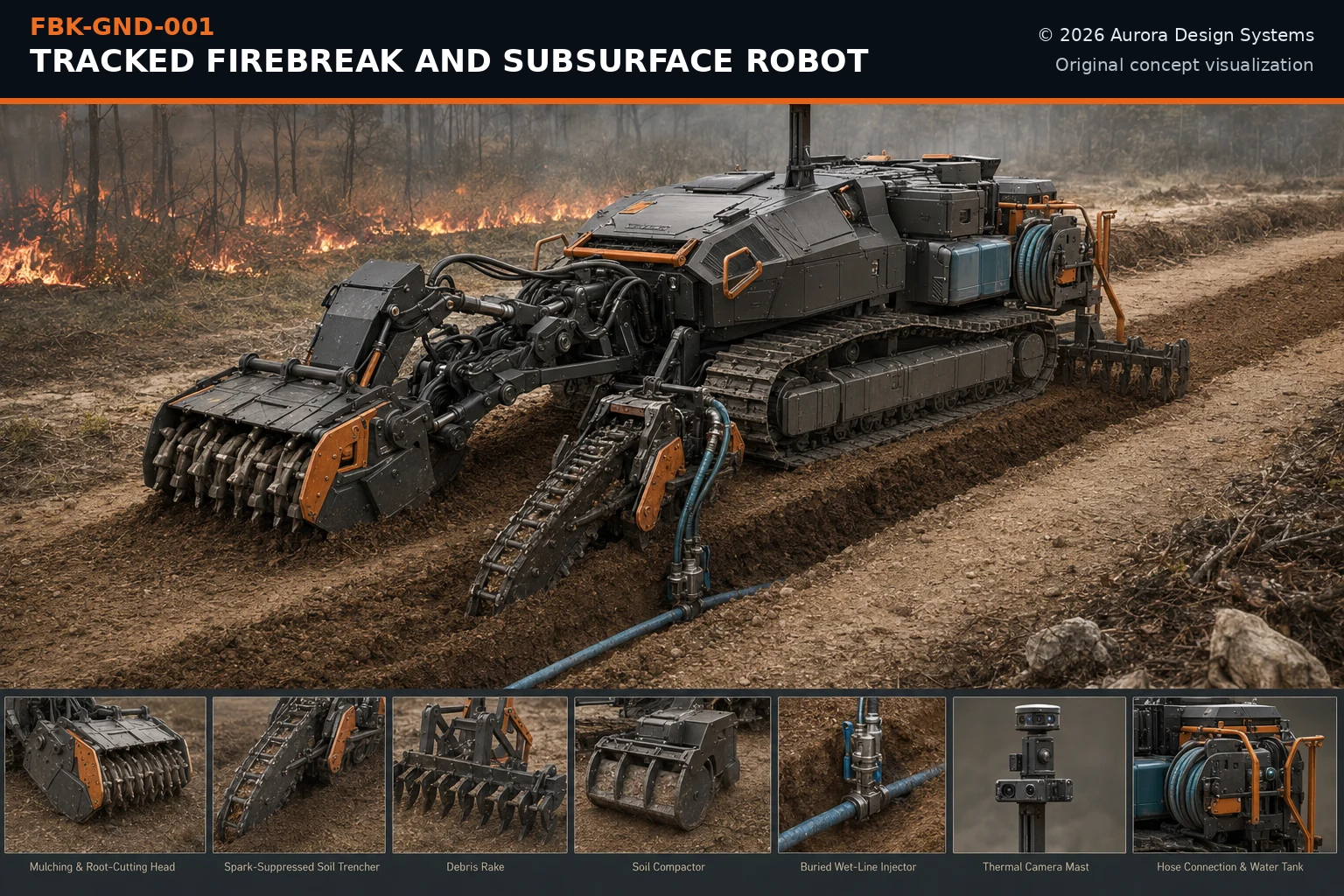
The machine mulches, separates roots, trenches, rakes, compacts and installs a buried wet line under human supervision, with spark and hot-surface controls for operation near fire.
This component is one element of a larger human-commanded response architecture. Its public role is bounded by verified inputs, authorized action, safe fallback, and post-event confirmation.
Open mission family →These are functional blocks—not a procurement bill of materials, manufacturing drawing, or construction specification.
Stability and protected mobility
High torque with controlled hot surfaces
Fuel and root separation
Mineral line and utility channel
Clean, stable corridor finish
Protected subsurface suppression supply
This page does not publish dimensions, formulas, agent compositions, control thresholds, source code, fabrication drawings, site-specific operating procedures, or certification claims. Any future implementation requires prior-art review, engineering analysis, hazard assessment, environmental qualification, human-factors review, independent testing, and approval by the relevant authorities.