← Back to Component Arsenal
FBK-INF-001 / Component 21 of 21
Smart Firebreak Infrastructure Spine
Permanent, maintainable ridge and corridor infrastructure combining water, power, communications, response bases and ecological crossings.
Frontier / DevelopableControlled by SUST-FIRE-WILD-007Detailed ARCH: SUST-FIRE-COMP-INF-001
Operating Concept
How it fits the response loop
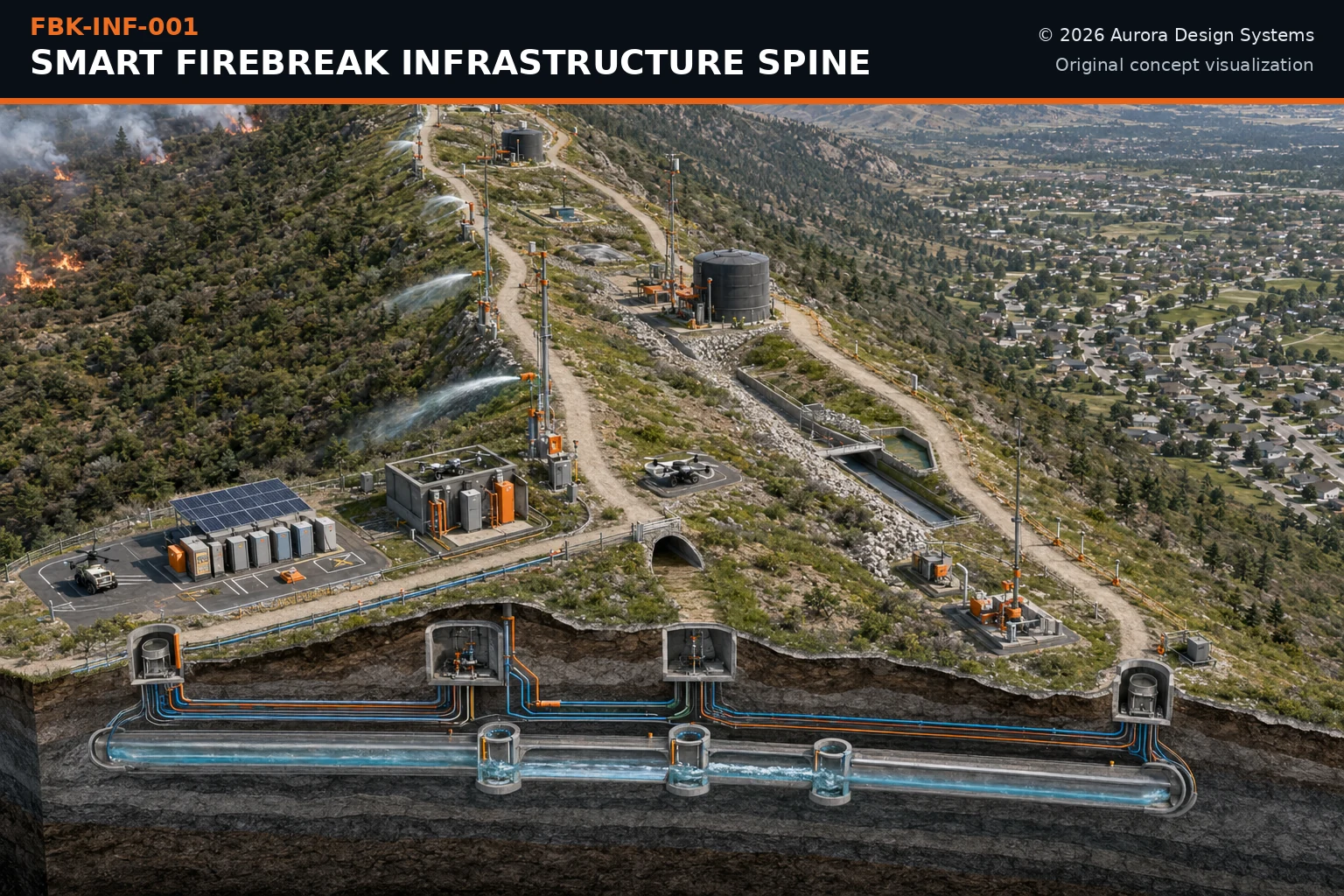
A narrow multi-use corridor provides distributed water, power, sensing, access and service points while avoiding a continuous ecological clear-cut. It is sectionalized for maintenance and local failure.
Mission Family
Weather & Permanent Infrastructure
This component is one element of a larger human-commanded response architecture. Its public role is bounded by verified inputs, authorized action, safe fallback, and post-event confirmation.
Open mission family →
Preliminary Functional Breakdown
Six public-safe architecture layers
These are functional blocks—not a procurement bill of materials, manufacturing drawing, or construction specification.
01Buried high-capacity water main
Sectionalized suppression supply
02Protected power and fiber conduits
Energy and communications backbone
03Isolation and service vaults
Repairable corridor segmentation
04Ridge tanks, pumps and hydrants
Local pressure and responder access
05Sensor masts and response bases
Detection, charging and robot/UAS service
06Microgrid, access and ecological crossings
Resilience with controlled environmental impact
Primary Interfaces
What it must connect to
- STORMVAULT water reserves
- Strata Energy
- LIFELINE utilities
- initial-attack network
- local roads
- wildlife and watershed plans.
Verification Focus
What must be proved
- Hydraulics, pump power, freezing, seismic/flood exposure, access, cyber/physical security, ecological fragmentation and lifecycle cost.
Public Release Boundary
Concept visualization, not achieved performance
This page does not publish dimensions, formulas, agent compositions, control thresholds, source code, fabrication drawings, site-specific operating procedures, or certification claims. Any future implementation requires prior-art review, engineering analysis, hazard assessment, environmental qualification, human-factors review, independent testing, and approval by the relevant authorities.