← Back to Component Arsenal
FBK-MAT-002 / Component 04 of 21
Cooling-to-Mineralizing Barrier
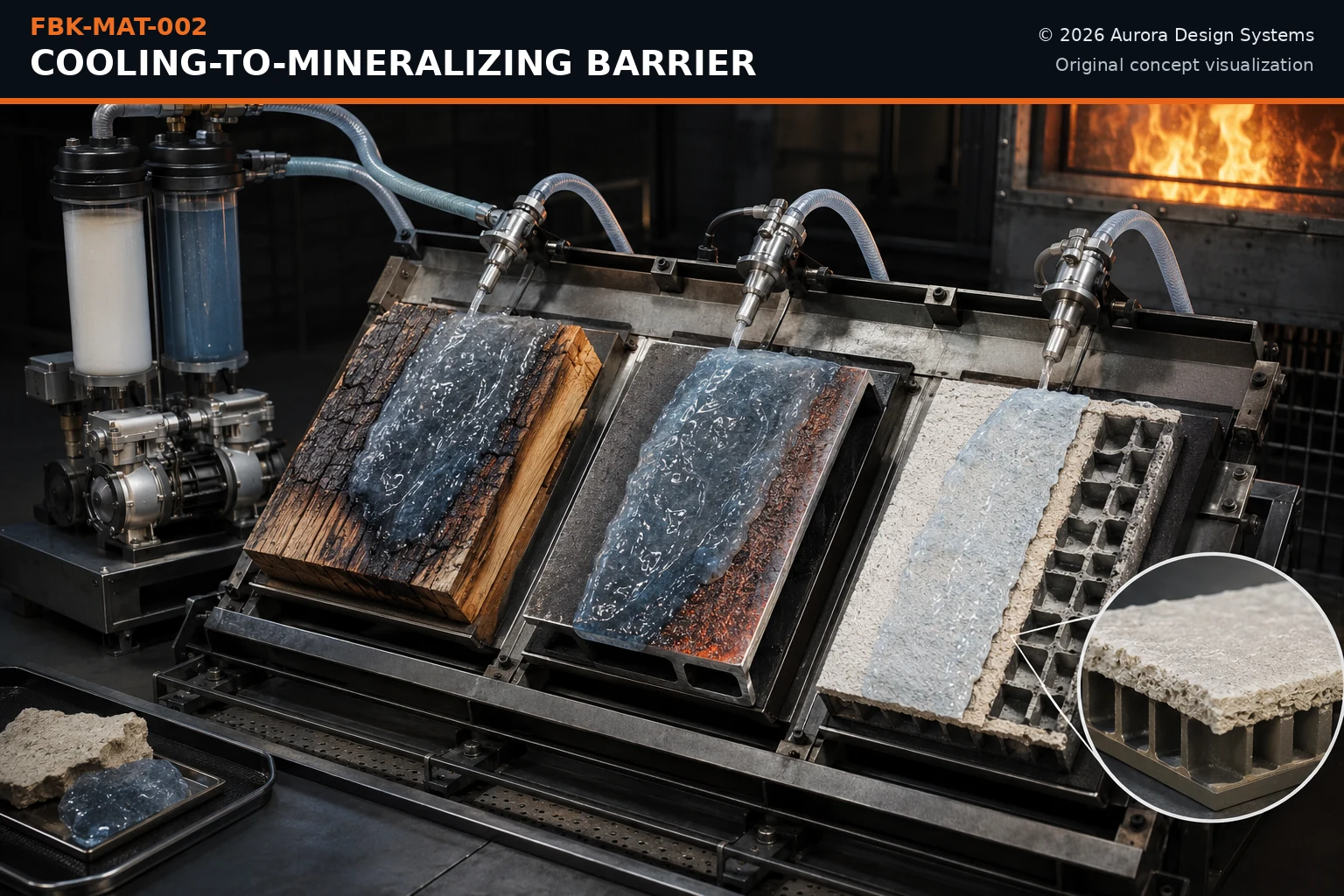
Research material intended to cool during application and leave a protective mineralized surface after water loss.
Speculative / ResearchControlled by SUST-FIRE-MAT-003Detailed ARCH: SUST-FIRE-COMP-MAT-002
Operating Concept
How it fits the response loop
A dual-stage aqueous system would first absorb heat and then form a stable, removable or repairable mineral barrier. No performance claim is authorized until coupons and full assemblies are independently tested.
Mission Family
Materials & Matched Suppression
This component is one element of a larger human-commanded response architecture. Its public role is bounded by verified inputs, authorized action, safe fallback, and post-event confirmation.
Open mission family →
Preliminary Functional Breakdown
Six public-safe architecture layers
These are functional blocks—not a procurement bill of materials, manufacturing drawing, or construction specification.
01Aqueous cooling precursor
Initial heat absorption and surface wetting
02Mineralizing precursor
Post-drying protective residue
03Isolated dual-cartridge supply
Prevents premature reaction
04Controlled mixing head
Sets ratio and application timing
05Cure and temperature monitor
Confirms safe reaction window
06Containment/removal package
Captures residue and protects receiving waters
Primary Interfaces
What it must connect to
- Material qualification
- adaptive dosing
- structural coatings
- environmental cleanup
- inspection and removal procedures.
Verification Focus
What must be proved
- Exotherm, cure chemistry, adhesion, cracking, thermal cycling, smoke/toxicity, water quality, removal and substrate compatibility.
Public Release Boundary
Concept visualization, not achieved performance
This page does not publish dimensions, formulas, agent compositions, control thresholds, source code, fabrication drawings, site-specific operating procedures, or certification claims. Any future implementation requires prior-art review, engineering analysis, hazard assessment, environmental qualification, human-factors review, independent testing, and approval by the relevant authorities.