Operating Concept
How it fits the response loop
Each layer performs a bounded task rather than relying on a single miracle material. The stack is selected by substrate, weather exposure, repair method and expected fire scenario.
 AURORA DESIGN SYSTEMSEngineering Systems • Applied Research • Product Architecture
Contact
AURORA DESIGN SYSTEMSEngineering Systems • Applied Research • Product Architecture
Contact
Layered coating family combining weather protection, heat reflection, expansion, moisture management and embedded condition sensing.
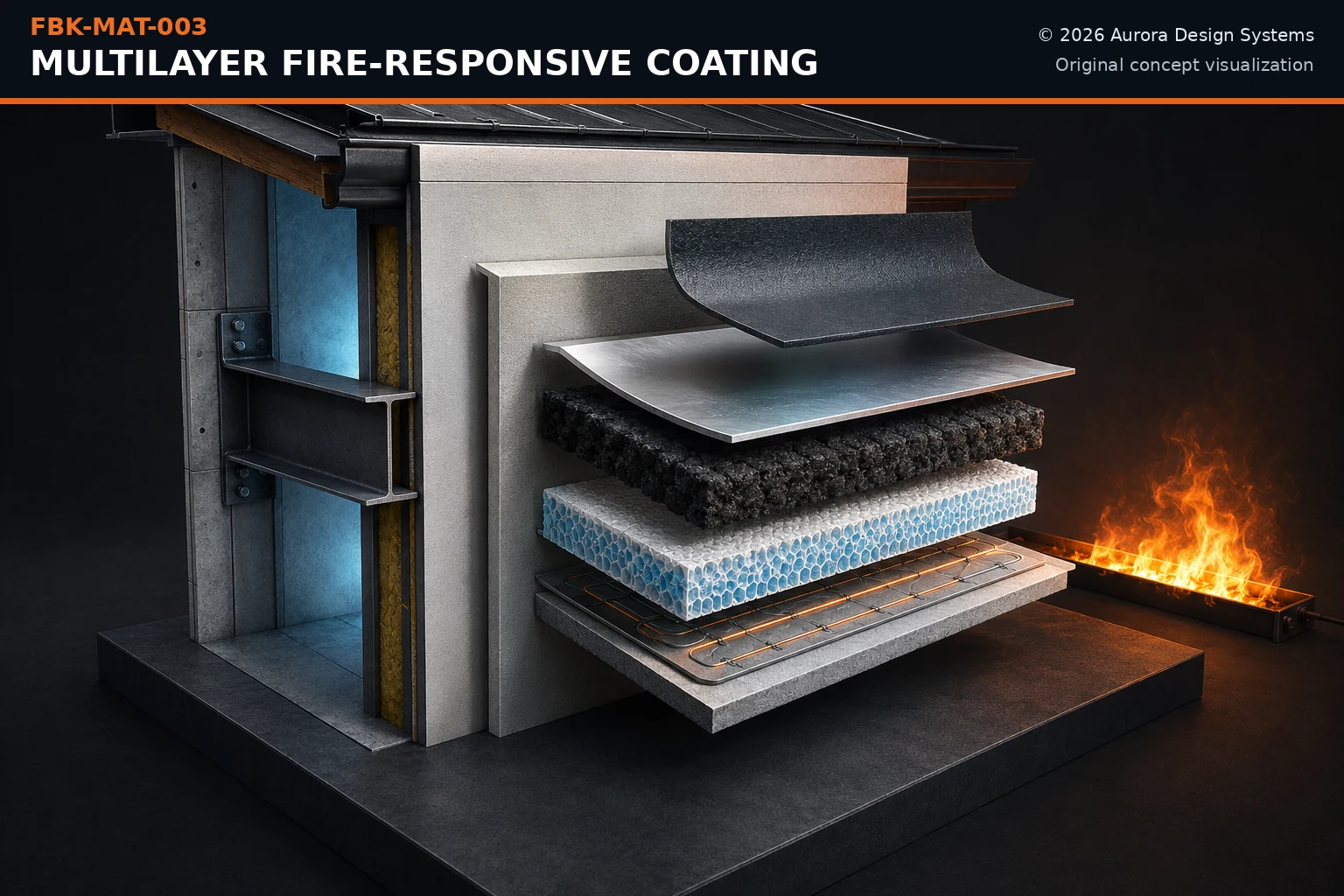
Each layer performs a bounded task rather than relying on a single miracle material. The stack is selected by substrate, weather exposure, repair method and expected fire scenario.
This component is one element of a larger human-commanded response architecture. Its public role is bounded by verified inputs, authorized action, safe fallback, and post-event confirmation.
Open mission family →These are functional blocks—not a procurement bill of materials, manufacturing drawing, or construction specification.
Adhesion and corrosion compatibility
Local temperature and coating-health monitoring
Short-duration evaporative cooling
Thermal insulation under rated exposure
Weather and radiant-heat protection
Maintains edges, joints and penetrations
This page does not publish dimensions, formulas, agent compositions, control thresholds, source code, fabrication drawings, site-specific operating procedures, or certification claims. Any future implementation requires prior-art review, engineering analysis, hazard assessment, environmental qualification, human-factors review, independent testing, and approval by the relevant authorities.