Operating Concept
How it fits the response loop
Thermal and gas sensing informs a bounded library of water, mist and qualified additive modes. Mechanical interlocks prevent incompatible agents, unsafe pressure and unintended discharge.
 AURORA DESIGN SYSTEMSEngineering Systems • Applied Research • Product Architecture
Contact
AURORA DESIGN SYSTEMSEngineering Systems • Applied Research • Product Architecture
Contact
Sensor-informed nozzle architecture that selects stream geometry and meters only qualified agents for the identified fire condition.
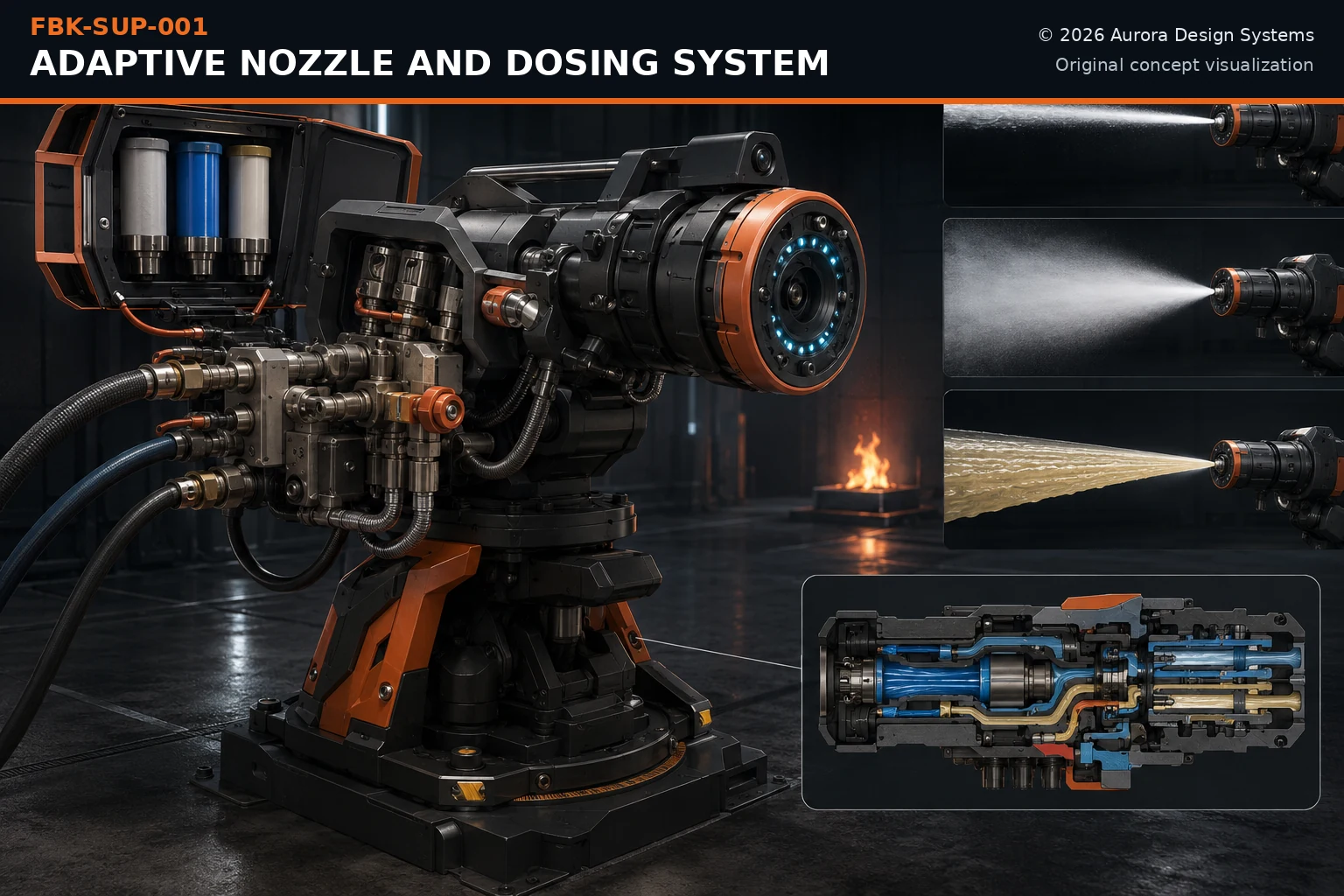
Thermal and gas sensing informs a bounded library of water, mist and qualified additive modes. Mechanical interlocks prevent incompatible agents, unsafe pressure and unintended discharge.
This component is one element of a larger human-commanded response architecture. Its public role is bounded by verified inputs, authorized action, safe fallback, and post-event confirmation.
Open mission family →These are functional blocks—not a procurement bill of materials, manufacturing drawing, or construction specification.
Straight stream, fog and controlled film delivery
Repeatable stream geometry
Local condition assessment
Prevents incompatible mixing
Bounded additive concentration
Safe hydraulic isolation
This page does not publish dimensions, formulas, agent compositions, control thresholds, source code, fabrication drawings, site-specific operating procedures, or certification claims. Any future implementation requires prior-art review, engineering analysis, hazard assessment, environmental qualification, human-factors review, independent testing, and approval by the relevant authorities.