Operating Concept
How it fits the response loop
A passive or independently powered trigger opens a directional discharge path into a small protected volume. Capsules are application-specific and are not broadcast into forests.
 AURORA DESIGN SYSTEMSEngineering Systems • Applied Research • Product Architecture
Contact
AURORA DESIGN SYSTEMSEngineering Systems • Applied Research • Product Architecture
Contact
Local replaceable capsule family for tightly bounded heat-triggered discharge at eaves, cabinets and equipment compartments.
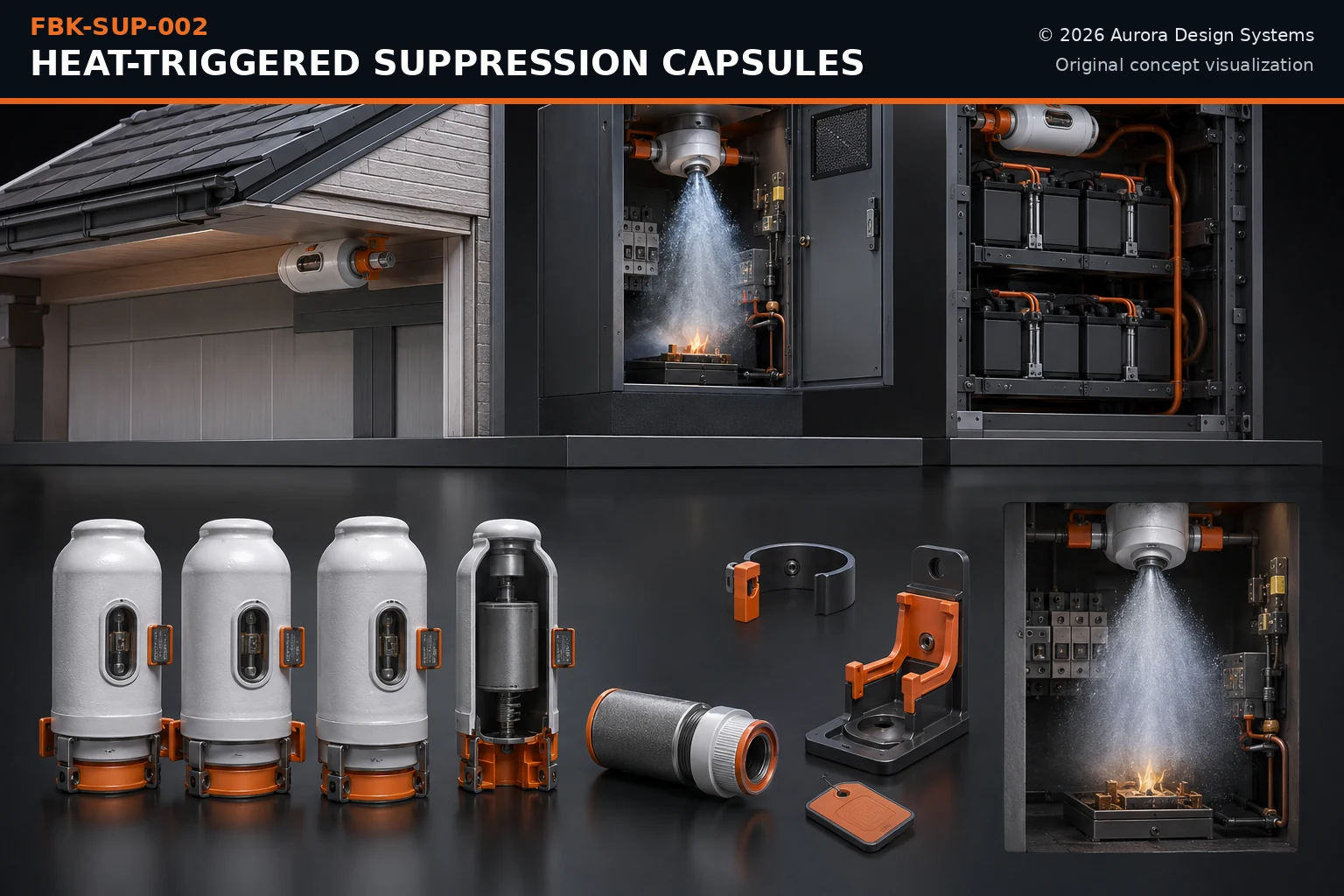
A passive or independently powered trigger opens a directional discharge path into a small protected volume. Capsules are application-specific and are not broadcast into forests.
This component is one element of a larger human-commanded response architecture. Its public role is bounded by verified inputs, authorized action, safe fallback, and post-event confirmation.
Open mission family →These are functional blocks—not a procurement bill of materials, manufacturing drawing, or construction specification.
Safe agent storage
Local suppression or cooling
Independent bounded activation
Controls release into the hazard volume
Inspection and replacement
Condition, age and traceability
This page does not publish dimensions, formulas, agent compositions, control thresholds, source code, fabrication drawings, site-specific operating procedures, or certification claims. Any future implementation requires prior-art review, engineering analysis, hazard assessment, environmental qualification, human-factors review, independent testing, and approval by the relevant authorities.