
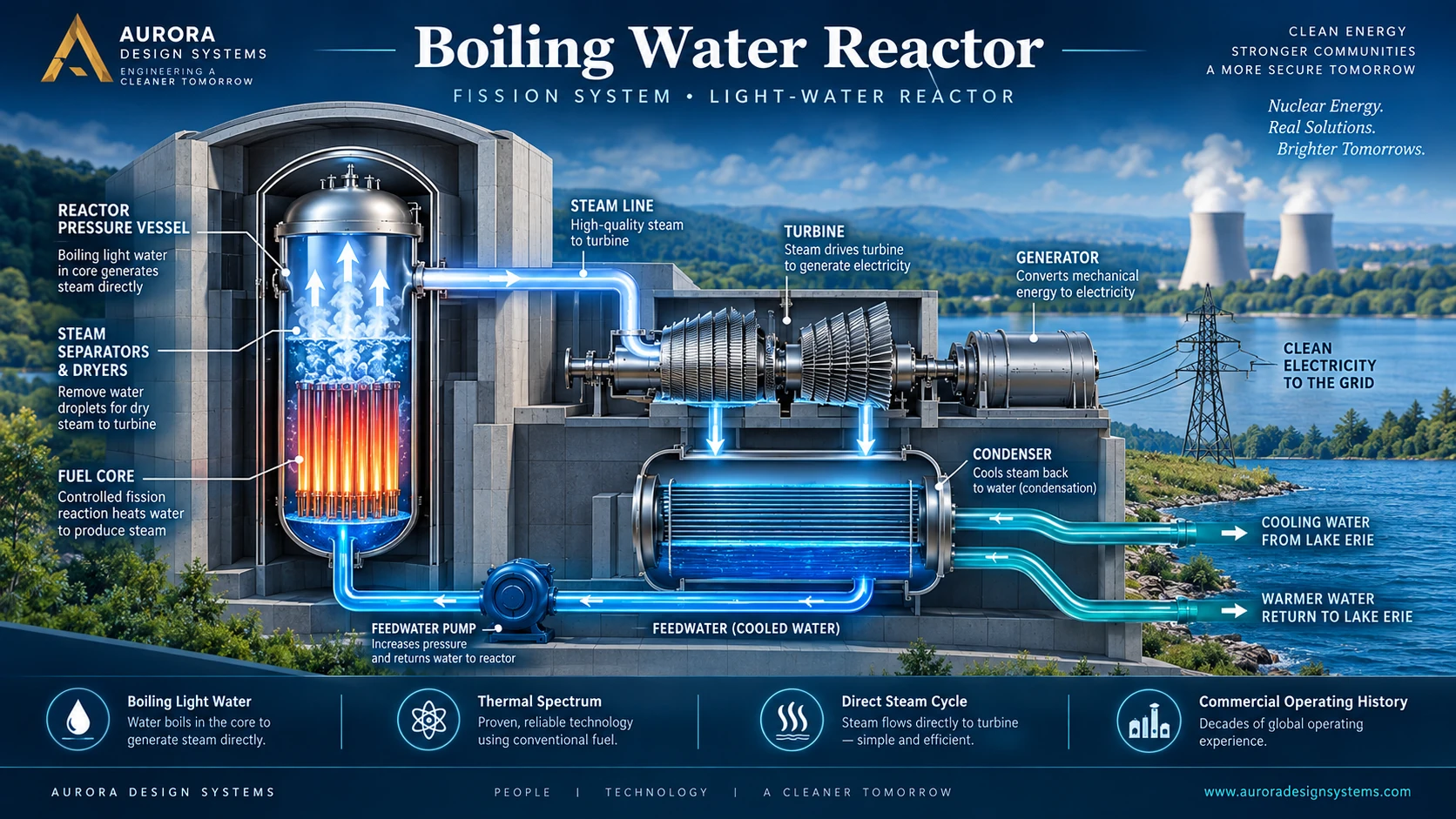
Very pure light water flows upward through the fuel assemblies, absorbs fission heat, and partially boils inside the reactor vessel.
Fission System • Light-Water Reactor
Boiling Water Reactor
A boiling water reactor (BWR) generates steam inside the reactor pressure vessel itself. After moisture separation and drying, that steam travels directly to the turbine-generator, making the BWR a direct-cycle light-water reactor rather than the two-loop arrangement used by a typical PWR.
Boiling Light Water
Thermal Spectrum
Direct Steam Cycle
Commercial Operating History
Public interpretation boundary: this page explains family-level architecture, operating logic, maturity, and licensing context only. It does not provide design dimensions, control logic, procurement specifications, or construction instructions.
Phase 4 • Page-Specific Technical Summary
What this reactor category means
System definition
A thermal-spectrum light-water reactor in which core heat boils coolant in-vessel and the resulting steam supplies the turbine plant after moisture separation.
A thermal-spectrum light-water reactor in which core heat boils coolant in-vessel and the resulting steam supplies the turbine plant after moisture separation.
Intended applications
Firm utility-scale electricity, fleet life extension, uprates, digital modernization, replacement studies, and evaluation of advanced BWR descendants.
Firm utility-scale electricity, fleet life extension, uprates, digital modernization, replacement studies, and evaluation of advanced BWR descendants.
Why it matters
The BWR family is one of the world’s foundational commercial nuclear architectures and remains important when comparing conventional fleets with newer ABWR, ESBWR, and BWRX-300 pathways.
The BWR family is one of the world’s foundational commercial nuclear architectures and remains important when comparing conventional fleets with newer ABWR, ESBWR, and BWRX-300 pathways.
Public boundary
Technology classification, family relationships, maturity, engineering challenges, and policy context only. No operating procedures, emergency actions, or adversary-useful detail.
Technology classification, family relationships, maturity, engineering challenges, and policy context only. No operating procedures, emergency actions, or adversary-useful detail.
Expanded Visual References
BWR systems and technical overview
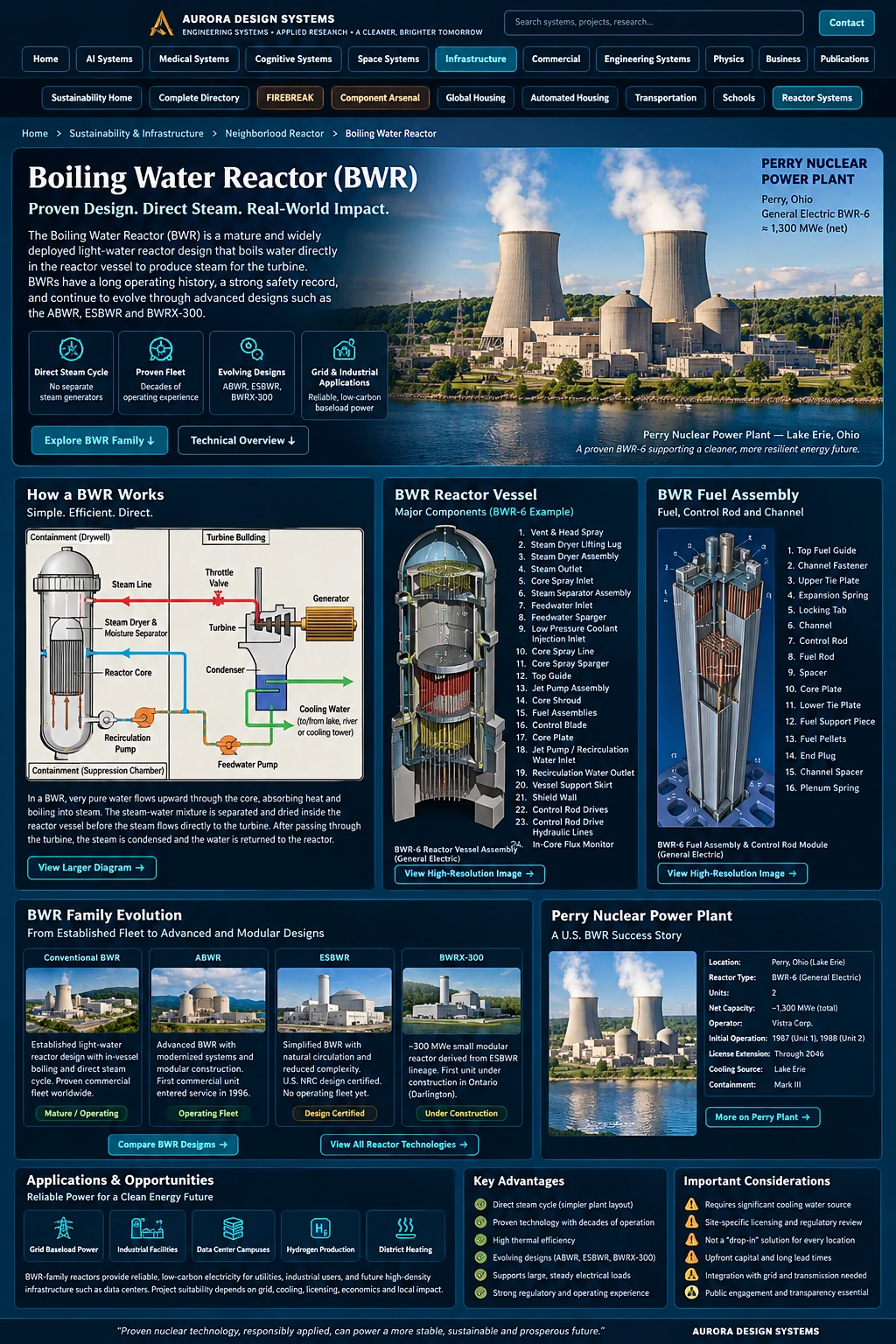
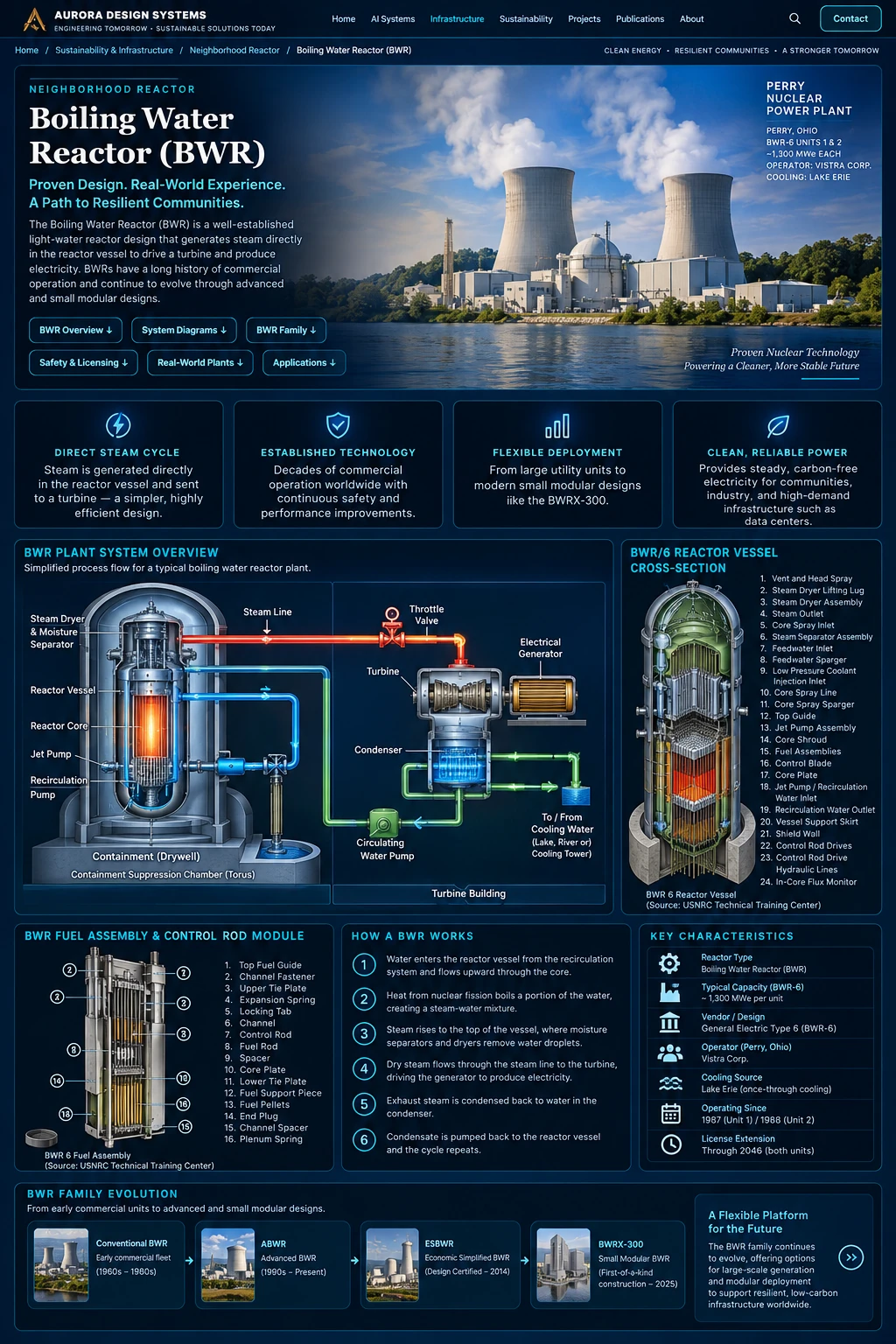
Two additional supplied renderings are retained for readers who want a vertically organized system summary and a denser technical reference layout.
Phase 2 • Public-Level System Architecture
Core System Elements
The full-width rendering above provides the visual system map. The callouts below identify the principal public-level functions without repeating the same reactor graphic a second time.
- Reactor pressure vessel
- Steam separators and dryers
- Primary containment
- Main steam and feedwater paths
- Turbine-generator
- Condenser and heat rejection
System roles are family-level and intentionally qualitative. Exact geometry, operating conditions, safety classification, equipment boundaries, and licensing basis remain design-specific.
System Logic
How the direct BWR cycle works
The steam-water mixture rises into separators and dryers that reduce entrained moisture before the steam leaves the vessel.
Unlike a PWR, the BWR sends reactor-produced steam directly to the turbine, so the turbine-side steam boundary requires radiological controls.
After driving the turbine-generator, exhaust steam is condensed back to water using an external heat sink such as a lake, river, cooling tower, or coastal source.
Pumps return conditioned feedwater to the vessel so the direct power cycle can repeat under tightly managed chemistry and thermal-hydraulic limits.
Public-safe summary adapted to the reactor family level. Actual plant layouts can include recirculation systems, jet pumps, suppression pools, and multiple auxiliary systems that vary by design generation.
Phase 4 • Technical Education + Terminology + Accuracy
Learn the System
This learning layer explains the system in public engineering language. Definitions are intentionally conceptual: they teach terminology and relationships without providing operating procedures, design set-points, construction dimensions, or protected implementation details.
Maturity checkpoint: Established commercial reactor family; advanced BWR descendants have design-specific licensing and deployment status.
System walkthrough
How it works — at a safe public level
- Fission heats very pure water as it flows upward through the core.
- A steam-water mixture forms inside the reactor vessel.
- Separators and dryers remove entrained liquid from the steam.
- Dry steam travels through the main steam line to the turbine-generator.
- The condenser returns turbine exhaust to liquid water, and feedwater is returned to the reactor vessel.
Key distinction: A BWR is defined by in-vessel boiling and a direct steam cycle. The turbine-side steam path therefore belongs to the reactor steam boundary rather than a separate secondary steam system.
Technical vocabulary
Terms worth knowing
Direct steam cycle
A power cycle in which steam produced in the reactor system is sent directly to the turbine.
Void fraction
The fraction of a coolant volume occupied by vapor rather than liquid. It is an important thermal-hydraulic variable in boiling systems.
Steam separator
Equipment that removes liquid water from a steam-water mixture before steam is sent onward.
Steam dryer
Equipment that removes additional moisture from separated steam before it enters the main steam line.
Suppression pool
A large water inventory used in certain BWR containment designs to condense steam and support pressure suppression.
Fuel assembly
An engineered grouping of nuclear fuel elements arranged to support cooling, structural integrity, neutron control, and refueling.
Reactor pressure vessel
The heavy engineered vessel that contains the reactor core and, in many reactor families, the primary coolant under operating pressure.
Condenser
A heat exchanger that turns turbine exhaust steam back into liquid water so the working fluid can be reused.
Decay heat
Heat that continues after the fission chain reaction stops because radioactive fission products continue to decay.
Capacity factor
Actual electricity produced over a period divided by what the plant could have produced if it operated at full rated output continuously.
MWe
Megawatts electric: the electrical power output delivered by a generating system.
MWth
Megawatts thermal: the rate of heat production before conversion to electricity or useful process heat.
Authoritative learning referencesU.S. NRC — Boiling Water Reactors ↗
Engineering Comparison
Core engineering characteristics
Ordinary light water serves as coolant and neutron moderator while also becoming the steam working fluid used for power conversion.
Commercial BWRs operate in the thermal-neutron spectrum using low-enriched uranium fuel in engineered fuel assemblies.
The defining feature is the direct steam cycle: steam is produced inside the vessel instead of a separate steam generator loop.
Water chemistry, materials aging, steam-boundary radiological control, boiling stability, construction economics, waste handling, and life-cycle decommissioning remain central issues.
Application Context
Where the family fits
Utility generation
Large-scale firm electricity using a comparatively direct nuclear steam cycle with decades of operating experience.
Existing-site modernization
Life extension, component replacement, uprates, control-system modernization, and replacement studies at licensed or legacy nuclear sites.
Advanced BWR branches
The family now includes conventional BWR fleets plus the ABWR, ESBWR, and BWRX-300 design lineages with different maturity levels.
High-density infrastructure
BWR-family plants may be considered in broader clean-power discussions for industrial campuses or future computing infrastructure, but siting, transmission, cooling, licensing, and economics determine suitability.
Design Lineage
BWR family evolution
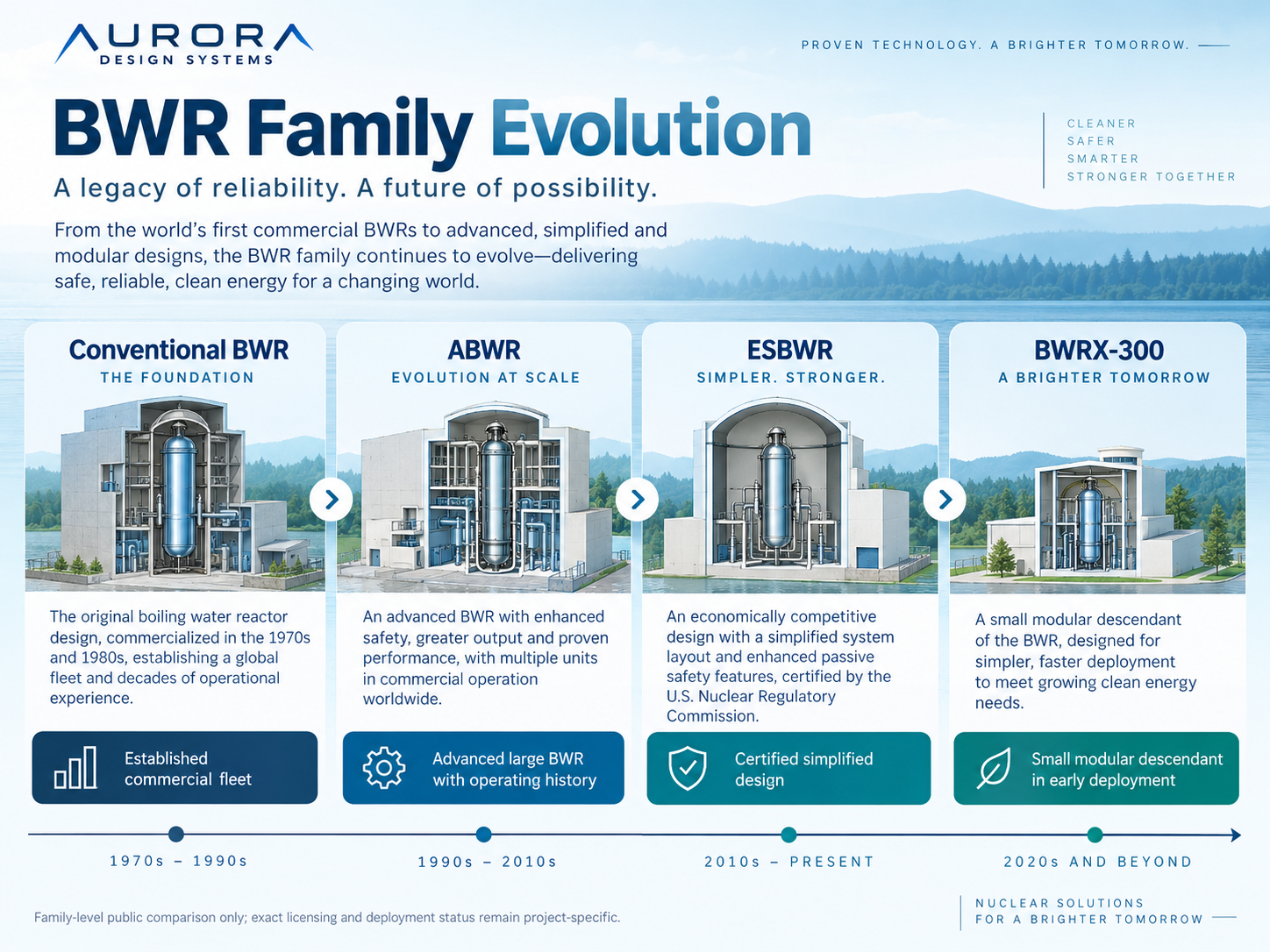
The term “BWR” covers more than one generation of plant thinking. Conventional fleet units established the architecture. Later branches pursued larger advanced stations, simplified passive concepts, and finally smaller modular descendants. Family comparison is useful, but exact deployment status must always be design-specific.
The established foundation
The original commercial BWR fleet created the baseline direct-cycle architecture and accumulated decades of operating experience.
Advanced large BWR
An advanced commercial branch that evolved the BWR at utility scale with improved systems integration and an operating history of deployed units.
Simplified passive pathway
A simplified large-BWR concept emphasizing natural circulation and passive safety features. Public discussion should distinguish design certification from operating-fleet status.
Small modular descendant
A modern SMR descendant of the BWR line intended for simpler deployment. Its maturity should be described as project-specific early deployment rather than conflated with legacy fleet experience.
Representative Public Reference
Perry Nuclear Power Plant context
For Ohio-oriented public explanation, the Perry Nuclear Power Plant is a useful familiar reference. Perry Unit 1 is a General Electric BWR-6 using a Mark III containment configuration and draws cooling water from Lake Erie. On this page it serves only as a recognizable public example of a commercial BWR installation—not as a surrogate design package for any new project.
Boiling water reactor (BWR), specifically a GE BWR-6 family unit.
Mark III containment, often cited in public summaries of the site.
Lake Erie is the dominant public-facing heat-sink reference for the plant site.
A real-world example helps visitors connect abstract reactor diagrams to an actual commercial fleet installation.
Why use a reference plant?
Public audiences often grasp reactor architecture faster when the family is tied to a known plant. A reference example improves context while keeping the page at a safe, non-procedural level.
What should not be implied?
A reference plant does not mean every BWR shares the same layout, output, equipment arrangement, licensing basis, or upgrade path. Vendor generation, site boundaries, and operating history still matter.
10-Phase Reactor Program • Phase 2
Standardized fission technical specification
Standardized public-safe fields support comparison across every fission and fusion family. Values are intentionally qualitative; licensing data, dimensions, operating windows, calculations, control logic, and build instructions remain offline.
Light water boiling in the reactor vessel
Thermal spectrum
Low-enriched uranium ceramic fuel in engineered fuel assemblies
Conventional fleet units are large commercial plants; advanced descendants can range from large utility stations to smaller modular concepts.
Direct steam cycle with radioactive-steam boundary controls
Conventional BWRs have an established operating fleet; newer descendants must be described by their own certification and deployment status.
Once-through operation produces spent fuel requiring cooling, storage, and disposal. Fuel recycling is a policy and facility choice, not an intrinsic BWR feature.
Specification boundary: Family-level technology classification and lifecycle context—not a vendor datasheet, safety analysis, procurement specification, or construction package.
Ten-Phase Reactor Program · Phase 5
Safety, licensing, lifecycle & public trust
Phase 5 treats safety as a full lifecycle obligation: site and license basis, fuel/material supply, operation, environmental controls, safeguards, emergency preparedness, waste, decommissioning, and disciplined public claims.
Reactivity control, boiling stability, vessel and pressure-boundary integrity, decay-heat removal, containment response, severe-accident mitigation, station power, spent-fuel interfaces, and steam-boundary radiological control.
For U.S. commercial power, Parts 50 and 52 remain established licensing routes. Part 53 is also available as a risk-informed, performance-based, technology-inclusive alternative for eligible class 103 commercial plants. The actual route is design- and application-specific.
Water use and thermal discharge depend on the site's condenser and heat-rejection system. Evaluate withdrawal, consumption, blowdown, receiving-water temperature, aquatic impacts, water chemistry, land disturbance, and transmission. Direct-cycle architecture also means turbine-side radiological controls are part of plant operations.
Conventional light-water fleets typically use low-enriched uranium fuel. Fuel procurement, fabrication, transport, outage handling, pool or dry storage, and long-term disposition are part of the plant lifecycle; fuel availability is not a substitute for licensing or safety findings.
Plan for operational radioactive waste, activated components, spent nuclear fuel, outage waste, and eventual decommissioning. Decommissioning funding, dismantlement, waste packaging, site release, and long-term spent-fuel disposition remain lifecycle obligations.
Apply graded material control and accounting, physical protection, cybersecurity, transport controls, insider-risk controls, and international safeguards as applicable to the material, facility, mission, and jurisdiction. Public pages must not reproduce Safeguards Information, sensitive security layouts, response tactics, or adversary-useful detail.
Large commercial light-water reactors use the established emergency-preparedness framework, including 10 CFR 50.47 and Appendix E as applicable. Emergency plans, zones, drills, offsite coordination, and protective actions are regulator- and site-specific.
State the maturity actually achieved, name the applicable authority, separate family-level evidence from project approval, and distinguish demonstrated performance from projections or marketing.
May describe the family as commercially established and supported by extensive operating and regulatory experience. Maturity of a family does not automatically establish the safety, cost, schedule, or licensing outcome of a specific plant.
Do not claim inherently safe, meltdown-proof, zero-waste, zero-impact, proliferation-proof, unguarded, maintenance-free, zero-emergency-planning, or automatically cheaper. Do not imply that one plant's license or operating record transfers to another design or site.
Phase 5 evidence:NRC — Power Reactor Licensing ↗NRC — Emergency Preparedness ↗NRC — Nuclear Security & Safeguards ↗NRC — New Reactor Environmental Review ↗
Public classification only: This is not a safety finding, licensing opinion, environmental permit, emergency plan, security plan, safeguards determination, waste-acceptance decision, or legal advice. Exact obligations belong to the applicable regulator and project authority.
Phase 7 • Release Certification & Production Integration
Release certification
This page has passed the Reactor Programs Phase 7 branch-level release review for internal routing, asset references, canonical metadata, maturity and terminology controls, source-authority links, accessibility essentials, responsive markup, and release traceability.
Production boundary: this certification covers the Reactor Programs branch package. Parent-site shared CSS, navigation, search, logo, and global assets remain controlled by the Aurora website root and must already exist in production. Live deployment is not implied until the package is uploaded and the production URLs are rechecked.