
Liquid lead or lead-bismuth eutectic, each requiring its own chemistry, materials, and freeze-protection strategy.
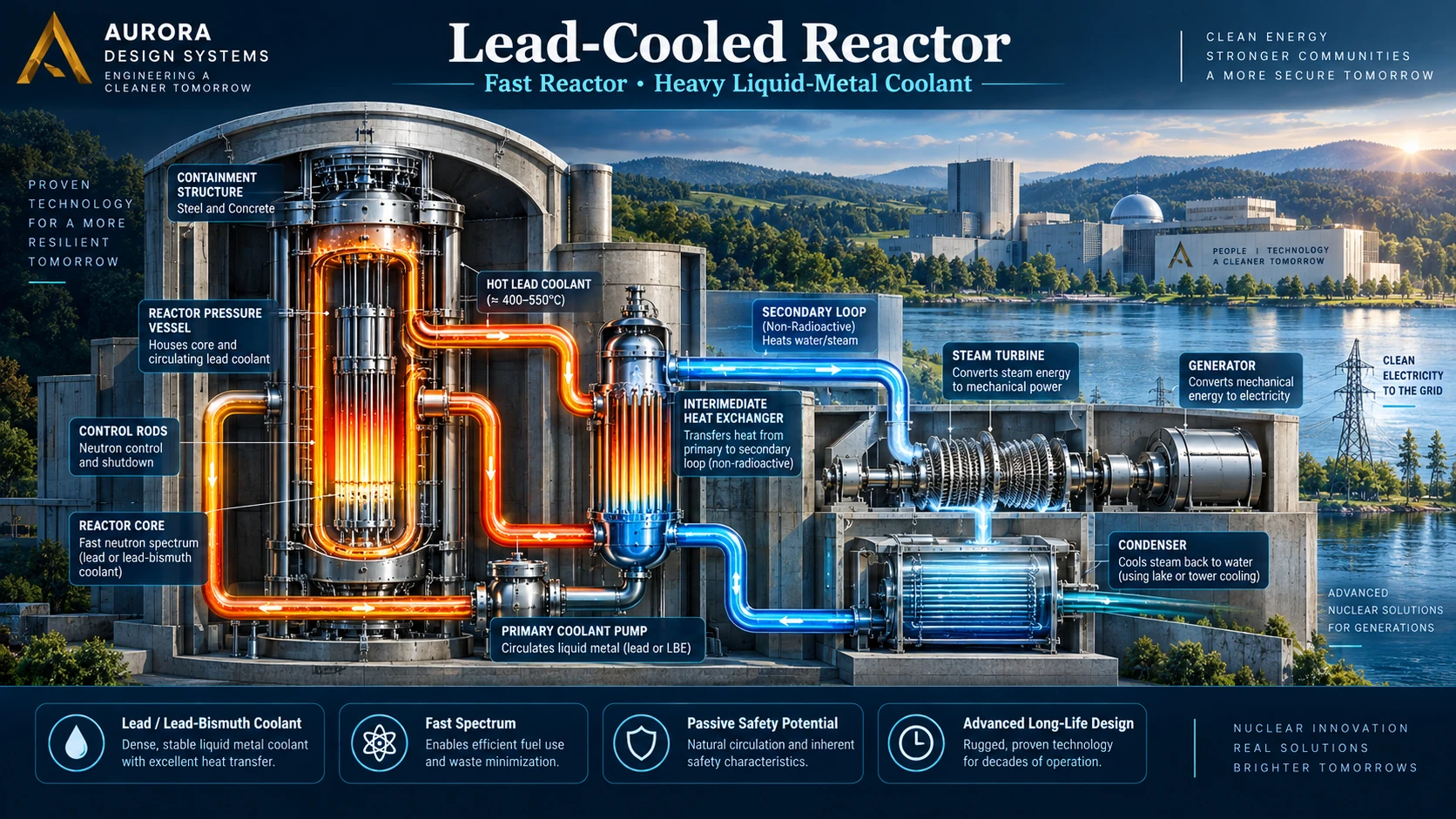
Fission System • Heavy Liquid-Metal Fast Reactor
Lead-Cooled Reactor
Lead-cooled fast reactors use liquid lead or lead-bismuth eutectic as coolant. Those fluids are related but not interchangeable: they differ in melting behavior, chemistry, activation products, materials effects, and operating history.
Lead or Lead-BismuthFast SpectrumResearch & DemonstrationHigh-Temperature Systems
Phase 4 • Page-Specific Technical Summary
What this reactor category means
System definition
A fast-neutron reactor family using a heavy liquid metal for primary heat transport, generally without a moderator.
A fast-neutron reactor family using a heavy liquid metal for primary heat transport, generally without a moderator.
Intended applications
Electricity, compact or modular fast-reactor studies, research facilities, and selected fuel-cycle or remote-power concepts.
Electricity, compact or modular fast-reactor studies, research facilities, and selected fuel-cycle or remote-power concepts.
Public boundary
Technology classification, system relationships, maturity, and engineering challenges only. No design parameters, calculations, control logic, procedures, procurement data, or build instructions.
Technology classification, system relationships, maturity, and engineering challenges only. No design parameters, calculations, control logic, procedures, procurement data, or build instructions.
Phase 2 • Public-Level System Architecture
Core System Elements
The full-width rendering above provides the visual system map. The callouts below identify the principal public-level functions without repeating the same reactor graphic a second time.
- Core region
- Heavy-liquid-metal pool and vessel
- Immersed heat exchangers
- Natural or forced circulation path
- Passive decay-heat path
- Power-conversion module
System roles are family-level and intentionally qualitative. Exact geometry, operating conditions, safety classification, equipment boundaries, and licensing basis remain design-specific.
Phase 4 • Concise Comparison
Engineering comparison
Fast-neutron spectrum.
Historical specialized lead-bismuth experience plus current research and demonstration programs; limited civilian deployment.
Fast-spectrum power with low coolant pressure, strong heat capacity, and configuration-specific passive-circulation potential.
Corrosion and erosion, oxygen and chemistry control, coolant mass, high melting temperature, freeze prevention, inspection in opaque coolant, polonium management for lead-bismuth systems, component qualification, licensing, and cost.
Phase 4 • Technical Education + Terminology + Accuracy
Learn the System
This learning layer explains the system in public engineering language. Definitions are intentionally conceptual: they teach terminology and relationships without providing operating procedures, design set-points, construction dimensions, or protected implementation details.
Maturity checkpoint: Generation-IV development family with historical specialized experience and modern research/demonstration programs; no broad commercial fleet.
System walkthrough
How it works — at a safe public level
- A fast-spectrum core heats liquid lead or a lead-bismuth alloy.
- The dense liquid-metal coolant carries heat while operating far below its boiling point.
- Heat is transferred through an intermediate exchanger or directly to a power-conversion system depending on design.
- Natural circulation may contribute to normal or decay-heat transport in some concepts.
- Materials compatibility, corrosion, coolant freezing, pumping, and inspection are dominant engineering challenges.
Key distinction: Lead and lead-bismuth provide different melting points and materials behavior. LFR designs therefore require design-specific coolant chemistry and structural-material strategies.
Technical vocabulary
Terms worth knowing
Fast spectrum
A neutron-energy environment dominated by fast neutrons rather than strongly moderated thermal neutrons.
Lead coolant
Liquid lead used as a dense, high-boiling-point coolant in some fast-reactor concepts.
Lead-bismuth eutectic
A lead-bismuth alloy that melts at a lower temperature than pure lead and has historical use in specialized reactor programs.
Liquid metal coolant
A liquid metal used to carry reactor heat. Sodium, lead, and lead-bismuth are examples used in fast-reactor concepts.
Natural circulation
Fluid motion driven by density differences rather than by a mechanical pump.
Corrosion allowance
A materials-engineering margin or design strategy that accounts for expected interaction between coolant chemistry and structural materials.
Heat exchanger
Equipment that transfers heat between fluid systems without mixing the fluids.
Decay heat
Heat that continues after the fission chain reaction stops because radioactive fission products continue to decay.
Fuel cycle
The sequence of activities involving nuclear fuel resources, enrichment or fabrication where applicable, reactor use, storage, recycling options, and waste management.
Coolant freezing
Solidification of a coolant if temperature falls below its melting point, an engineering concern for some liquid-metal or salt systems.
MWe
Megawatts electric: the electrical power output delivered by a generating system.
MWth
Megawatts thermal: the rate of heat production before conversion to electricity or useful process heat.
Application Context
Where the family fits
Fast-Reactor Development
Demonstration programs assessing heavy-liquid-metal heat transport and fast-spectrum performance.
Compact Power Concepts
Modular and remote-power studies where long refueling intervals and low primary pressure are valued.
Research & Irradiation
Potential fast-neutron test environments for fuels and materials under carefully controlled programs.
10-Phase Reactor Program • Phase 2
Standardized fission technical specification
Standardized public-safe fields support comparison across every fission and fusion family. Values are intentionally qualitative; licensing data, dimensions, operating windows, calculations, control logic, and build instructions remain offline.
Lead or lead-bismuth eutectic
Fast spectrum
Metallic, nitride, or oxide fuels proposed by program
Pool or loop advanced-reactor concept; modular variants studied
Intermediate heat transport to steam, gas, or other cycle
Operational heritage in special applications; civilian power development remains limited
Fast-spectrum missions may support recycling and actinide management. Coolant activation, polonium for LBE, corrosion products, spent fuel, and final disposal remain.
Specification boundary: Family-level technology classification and lifecycle context—not a vendor datasheet, safety analysis, procurement specification, or construction package.
Ten-Phase Reactor Program · Phase 5
Safety, licensing, lifecycle & public trust
Phase 5 treats safety as a full lifecycle obligation: site and license basis, fuel/material supply, operation, environmental controls, safeguards, emergency preparedness, waste, decommissioning, and disciplined public claims.
Coolant chemistry, corrosion and erosion, freezing and remelting, heavy-component loads, inspection and repair, activation products, decay heat, leakage, and fuel handling.
In the United States, Parts 50 and 52 remain available, and Part 53 became available in 2026 as a risk-informed, performance-based, technology-inclusive pathway for eligible class 103 commercial plants. For microreactors, the NRC has also proposed Part 57; it is not yet an available licensing route. Exact applicability depends on design, mission, fuel, and site.
Account for heavy-liquid-metal handling, corrosion and erosion control, coolant purification, worker exposure controls, heat rejection, spills, contaminated equipment, construction, and end-of-life coolant disposition. Lead toxicity and radiological hazards are separate issues and both require management.
Fuel form and enrichment are design-specific. Many advanced-reactor concepts depend on fuels or supply chains that differ from today's light-water fleet, including some designs that require HALEU. Fuel qualification, fabrication capacity, transport packages, and secure material availability can be deployment gates.
Advanced fuel forms can change waste streams but do not eliminate them. Account for spent or used fuel, activated structures, coolant or salt cleanup where applicable, contaminated maintenance hardware, storage, transportation, decommissioning, and disposal pathways.
Apply graded material control and accounting, physical protection, cybersecurity, transport controls, insider-risk controls, and international safeguards as applicable to the material, facility, mission, and jurisdiction. Public pages must not reproduce Safeguards Information, sensitive security layouts, response tactics, or adversary-useful detail.
Eligible SMRs, non-light-water reactors, and non-power facilities may use the performance-based 10 CFR 50.160 emergency-preparedness framework. EP scope and any plume-exposure planning zone are consequence- and site-informed; neither reactor size nor passive features automatically reduce the requirement to zero.
State the maturity actually achieved, name the applicable authority, separate family-level evidence from project approval, and distinguish demonstrated performance from projections or marketing.
May describe a design family as research, demonstration, early deployment, or commercially operating only where the cited design actually supports that maturity. May say U.S. licensing pathways exist without claiming that a particular design is licensed.
Do not convert passive features into 'walk-away safe,' fuel robustness into 'meltdown-proof,' smaller size into 'no emergency planning,' or advanced fuel into 'waste-free' or 'proliferation-proof.' Do not treat concept maturity as project approval.
Phase 5 evidence:NRC — Advanced Reactor Licensing ↗NRC — Part 53 / Advanced Reactor Rulemaking ↗NRC — Performance-Based Emergency Preparedness ↗DOE — HALEU Availability Program ↗
Public classification only: This is not a safety finding, licensing opinion, environmental permit, emergency plan, security plan, safeguards determination, waste-acceptance decision, or legal advice. Exact obligations belong to the applicable regulator and project authority.
Phase 7 • Release Certification & Production Integration
Release certification
This page has passed the Reactor Programs Phase 7 branch-level release review for internal routing, asset references, canonical metadata, maturity and terminology controls, source-authority links, accessibility essentials, responsive markup, and release traceability.
Production boundary: this certification covers the Reactor Programs branch package. Parent-site shared CSS, navigation, search, logo, and global assets remain controlled by the Aurora website root and must already exist in production. Live deployment is not implied until the package is uploaded and the production URLs are rechecked.