
Helium is the principal modern coolant; graphite provides moderation and structural functions within the core.
Fission System • HTGR Architecture Subtype
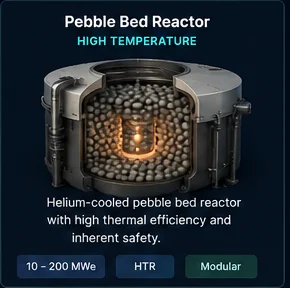
Pebble Bed Reactor
A pebble-bed reactor is a high-temperature gas-cooled reactor configuration using spherical fuel elements that typically contain TRISO particles in a graphite matrix. It is an architecture subtype within the wider gas-cooled family, not a separate coolant class.
TRISO Fuel PebblesHelium CoolingThermal SpectrumLimited Deployment
Phase 4 • Page-Specific Technical Summary
What this reactor category means
System definition
A graphite-moderated, gas-cooled reactor whose core contains many spherical coated-particle fuel elements.
A graphite-moderated, gas-cooled reactor whose core contains many spherical coated-particle fuel elements.
Intended applications
Electricity, cogeneration, industrial heat, hydrogen-production studies, and modular high-temperature reactor deployment.
Electricity, cogeneration, industrial heat, hydrogen-production studies, and modular high-temperature reactor deployment.
Public boundary
Technology classification, system relationships, maturity, and engineering challenges only. No design parameters, calculations, control logic, procedures, procurement data, or build instructions.
Technology classification, system relationships, maturity, and engineering challenges only. No design parameters, calculations, control logic, procedures, procurement data, or build instructions.
System Architecture • Public-Level Component Map
Major Components
A second view separates the principal system functions for Pebble Bed Reactor. The rendering and callouts are conceptual and intended for public engineering orientation.

- Pebble fuel bed
- Reactor pressure vessel
- Helium circulation path
- Intermediate heat exchanger or direct-cycle interface
- Power-conversion train
- Heat-rejection module
Component boundaries vary by vendor, plant arrangement, coolant choice, power-conversion cycle, site constraints, and licensing basis.
Phase 4 • Concise Comparison
Engineering comparison
Primarily thermal-neutron in current pebble-bed power-reactor concepts.
Experimental and demonstration history with limited modern deployment; broader commercial replication remains unproven.
High-temperature electricity and process heat with strong fuel retention and passive heat-removal objectives.
Fuel handling and accounting, graphite behavior, dust generation, helium leakage and purification, high-temperature materials, inspection, waste, licensing, and economic scale-up.
Application Context
Where the family fits
High-Temperature Electricity
Power conversion studies that use elevated coolant temperature while respecting material and component limits.
Industrial Process Heat
Potential heat supply for hydrogen, chemicals, refining, and other processes after application-specific qualification.
Modular HTGR Plants
Multi-module deployment concepts intended to combine factory repetition with incremental capacity growth.
10-Phase Reactor Program • Phase 2
Standardized fission technical specification
Standardized public-safe fields support comparison across every fission and fusion family. Values are intentionally qualitative; licensing data, dimensions, operating windows, calculations, control logic, and build instructions remain offline.
High-temperature gas, commonly helium; graphite moderator
Thermal spectrum
TRISO fuel particles inside graphite pebbles
Modular high-temperature reactor family
Steam or gas-cycle electricity and industrial heat
Limited deployment plus continuing development
Spent pebbles contain radioactive fuel and a large graphite matrix. Fuel handling, graphite activation, storage, and disposal must be addressed.
Specification boundary: Family-level technology classification and lifecycle context—not a vendor datasheet, safety analysis, procurement specification, or construction package.
Ten-Phase Reactor Program · Phase 5
Safety, licensing and public-trust boundary
Coated-particle fuel quality, graphite temperature and oxidation, dust and contamination control, coolant ingress, fuel handling, online-refuelling interfaces, decay heat, and confinement.
U.S. advanced-power candidate: Parts 50 and 52 remain available, and the NRC issued Part 53 as an additional risk-informed, technology-inclusive pathway. The exact design, fuel, mission, and site control the route.
Apply nuclear-material control and accounting, physical protection, cybersecurity, transport security, insider-risk controls, and international safeguards as applicable to the exact material and jurisdiction. Do not publish Safeguards Information or adversary-useful detail.
Eligible SMR, non-light-water, and non-power facilities may use the performance-based 10 CFR 50.160 framework. Emergency-planning scope and zone are consequence-informed and design-specific—not automatically the site boundary.
May say the family has a defined operating or research history and can be evaluated through an applicable licensing pathway. State the exact maturity and unresolved design-specific gates.
Do not claim inherently safe, meltdown-proof, waste-free, proliferation-proof, walk-away, unguarded, zero-emergency-zone, automatically cheaper, or licensed because a related reactor operated.
Classification only: This is not a safety finding, licensing opinion, emergency plan, security plan, or legal determination. Exact obligations belong to the applicable regulator and project authority.