← Back to Component Arsenal
FBK-MAT-004 / Component 06 of 21
Suppressant and Recovery Firebreak Medium
Deployable firebreak medium intended to provide temporary suppression support, erosion control and structured post-fire recovery.
Speculative / ResearchControlled by SUST-FIRE-ECO-010Detailed ARCH: SUST-FIRE-COMP-MAT-004
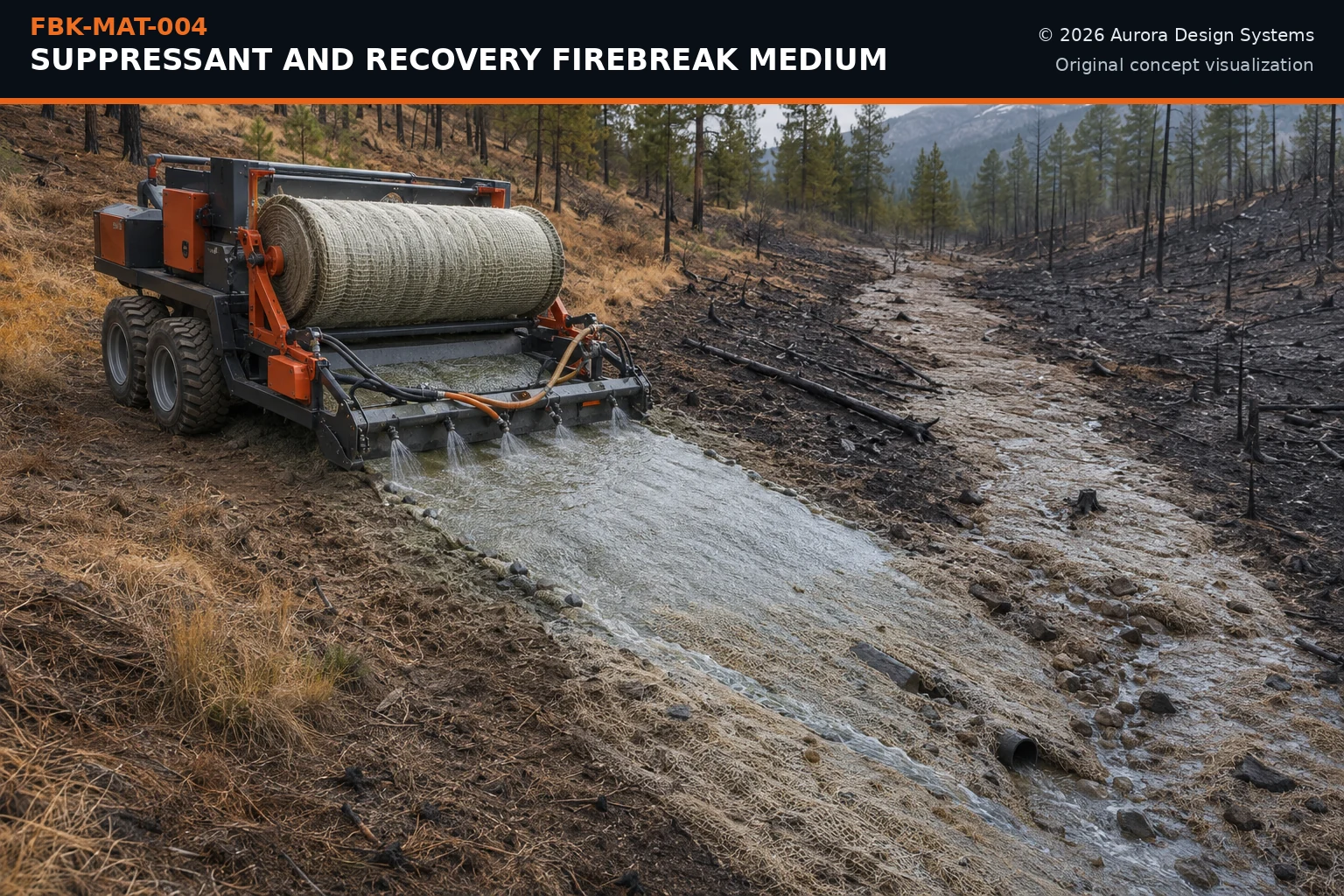
Operating Concept
How it fits the response loop
A biodegradable carrier is laid as a controlled wet barrier, preserves drainage openings and later serves as temporary soil stabilization. It must never introduce invasive species or persistent contamination.
Mission Family
Materials & Matched Suppression
This component is one element of a larger human-commanded response architecture. Its public role is bounded by verified inputs, authorized action, safe fallback, and post-event confirmation.
Open mission family →
Preliminary Functional Breakdown
Six public-safe architecture layers
These are functional blocks—not a procurement bill of materials, manufacturing drawing, or construction specification.
01Biodegradable carrier mesh
Temporary placement and soil anchoring
02Qualified hydrated medium
Short-duration wet barrier
03Erosion-control aggregate
Captures ash and reduces rilling
04Drainage openings and filters
Preserves environmental flow paths
05Roll-fed deployment module
Controlled placement by vehicle or robot
06Anchors and recovery spool
Secures, inspects and removes remaining material
Primary Interfaces
What it must connect to
- Ground robots
- water-retaining gel
- watershed protection
- ecological recovery
- prescribed-fire and land-management plans.
Verification Focus
What must be proved
- Ignition resistance, runoff, erosion, wildlife interaction, decomposition, native revegetation compatibility and retrieval.
Public Release Boundary
Concept visualization, not achieved performance
This page does not publish dimensions, formulas, agent compositions, control thresholds, source code, fabrication drawings, site-specific operating procedures, or certification claims. Any future implementation requires prior-art review, engineering analysis, hazard assessment, environmental qualification, human-factors review, independent testing, and approval by the relevant authorities.