
Water maintained above its critical point through the core and primary heat-transport path.
Fission System • Generation IV Research Concept
Supercritical Water Reactor
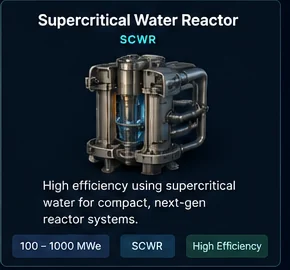
A supercritical water reactor is a research concept using water above its thermodynamic critical point. It seeks a simpler, high-efficiency power cycle, but it is not an operating extension of today’s PWR or BWR fleet.
Supercritical WaterThermal or Fast ConceptsResearch ConceptHigh-Efficiency Objective
Phase 4 • Page-Specific Technical Summary
What this reactor category means
System definition
A high-pressure water-cooled reactor concept intended to deliver reactor heat directly or indirectly to a supercritical-water power cycle.
A high-pressure water-cooled reactor concept intended to deliver reactor heat directly or indirectly to a supercritical-water power cycle.
Intended applications
Future grid electricity and research into higher-temperature water-cooled nuclear systems.
Future grid electricity and research into higher-temperature water-cooled nuclear systems.
Public boundary
Technology classification, system relationships, maturity, and engineering challenges only. No design parameters, calculations, control logic, procedures, procurement data, or build instructions.
Technology classification, system relationships, maturity, and engineering challenges only. No design parameters, calculations, control logic, procedures, procurement data, or build instructions.
System Architecture • Public-Level Component Map
Major Components
A second view separates the principal system functions for Supercritical Water Reactor. The rendering and callouts are conceptual and intended for public engineering orientation.

- Reactor pressure vessel
- High-pressure coolant path
- Turbine train
- Generator
- Feedwater and heat-recovery equipment
- Heat-rejection system
Component boundaries vary by vendor, plant arrangement, coolant choice, power-conversion cycle, site constraints, and licensing basis.
Phase 4 • Concise Comparison
Engineering comparison
Both thermal-spectrum and fast-spectrum variants have been studied.
Research and technology-development stage; no commercial SCWR fleet.
Higher thermal efficiency and plant simplification relative to conventional light-water steam cycles.
Materials and corrosion, radiolysis and water chemistry, heat-transfer behavior near the pseudo-critical region, fuel qualification, high-pressure components, startup and shutdown transients, safety analysis, licensing, and test infrastructure.
Application Context
Where the family fits
Generation IV Research
International programs study materials, thermal hydraulics, chemistry, fuel, and safety methods.
High-Efficiency Electricity
The long-term objective is a more efficient water-cooled power cycle if research gaps can be closed.
Water-Cooled Knowledge Bridge
The concept draws on light-water and fossil supercritical-steam experience without being equivalent to either.
10-Phase Reactor Program • Phase 2
Standardized fission technical specification
Standardized public-safe fields support comparison across every fission and fusion family. Values are intentionally qualitative; licensing data, dimensions, operating windows, calculations, control logic, and build instructions remain offline.
Water above the critical point
Thermal or fast-spectrum variants
Advanced water-reactor fuel and cladding concepts
Generation-IV research concept, generally grid-scale
High-efficiency direct or indirect steam-cycle concepts
Research and conceptual development
Fuel-cycle and waste characteristics broadly follow the chosen uranium or recycled-fuel system; the coolant state does not eliminate spent fuel or decommissioning waste.
Specification boundary: Family-level technology classification and lifecycle context—not a vendor datasheet, safety analysis, procurement specification, or construction package.
Ten-Phase Reactor Program · Phase 5
Safety, licensing and public-trust boundary
Very-high-pressure and high-temperature boundary integrity, water chemistry, cladding and materials behavior, cooling transients, flow stability, isolation, and decay-heat removal.
U.S. advanced-power candidate: Parts 50 and 52 remain available, and the NRC issued Part 53 as an additional risk-informed, technology-inclusive pathway. The exact design, fuel, mission, and site control the route.
Apply nuclear-material control and accounting, physical protection, cybersecurity, transport security, insider-risk controls, and international safeguards as applicable to the exact material and jurisdiction. Do not publish Safeguards Information or adversary-useful detail.
Eligible SMR, non-light-water, and non-power facilities may use the performance-based 10 CFR 50.160 framework. Emergency-planning scope and zone are consequence-informed and design-specific—not automatically the site boundary.
May say the family has a defined operating or research history and can be evaluated through an applicable licensing pathway. State the exact maturity and unresolved design-specific gates.
Do not claim inherently safe, meltdown-proof, waste-free, proliferation-proof, walk-away, unguarded, zero-emergency-zone, automatically cheaper, or licensed because a related reactor operated.
Classification only: This is not a safety finding, licensing opinion, emergency plan, security plan, or legal determination. Exact obligations belong to the applicable regulator and project authority.