
Program-dependent historical concepts included direct air heating and indirect liquid-metal or other heat-transfer arrangements.
Historical Fission Research • Aircraft Propulsion
Aviation Reactor
Nuclear-powered aircraft were investigated during the mid-twentieth century through reactor, materials, shielding, and propulsion ground programs. No nuclear-powered aircraft entered operational service, and this page does not present an active deployment program.
Historical ProgramsGround TestingNo Operational AircraftClassification Only
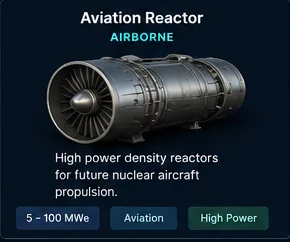
Phase 4 • Page-Specific Technical Summary
What this reactor category means
System definition
Historical research into coupling a compact reactor to aircraft propulsion, either through direct-cycle concepts or an indirect heat-transfer system.
Historical research into coupling a compact reactor to aircraft propulsion, either through direct-cycle concepts or an indirect heat-transfer system.
Intended applications
Past studies emphasized very-long-endurance military aircraft; modern relevance is mainly historical, materials, shielding, controls, and test-facility lessons.
Past studies emphasized very-long-endurance military aircraft; modern relevance is mainly historical, materials, shielding, controls, and test-facility lessons.
Public boundary
Technology classification, system relationships, maturity, and engineering challenges only. No design parameters, calculations, control logic, procedures, procurement data, or build instructions.
Technology classification, system relationships, maturity, and engineering challenges only. No design parameters, calculations, control logic, procedures, procurement data, or build instructions.
System Architecture • Public-Level Component Map
Major Components
A second view separates the principal system functions for Aviation Reactor Research. The rendering and callouts are conceptual and intended for public engineering orientation.

- Shielded reactor test cell
- Primary heat-transfer system
- Intermediate heat exchanger, concept-dependent
- Propulsion test article
- Remote instrumentation and protection
- Facility heat-rejection equipment
Component boundaries vary by vendor, plant arrangement, coolant choice, power-conversion cycle, site constraints, and licensing basis.
Phase 4 • Concise Comparison
Engineering comparison
Varied by experimental reactor and propulsion concept.
Historical research and ground-test programs only; no operational nuclear aircraft.
Historical endurance and propulsion research, not a current Aurora deployment claim.
Shielding mass, crash consequences, airborne containment, crew and public dose, compact heat rejection, materials at temperature, propulsion integration, ground testing, maintenance, security, cost, and public acceptance.
Application Context
Where the family fits
Historical Test Facilities
Ground reactors and propulsion test stands used to investigate materials, shielding, heat transfer, and controls.
Systems-Engineering Lessons
A bounded reference for integration problems created by extreme mass, safety, reliability, and thermal constraints.
No Deployment Claim
The category remains historical; it is not represented as a licensable or operational aircraft program.
10-Phase Reactor Program • Phase 2
Standardized fission technical specification
Standardized public-safe fields support comparison across every fission and fusion family. Values are intentionally qualitative; licensing data, dimensions, operating windows, calculations, control logic, and build instructions remain offline.
Historical concepts used air, liquid metal, or other heat-transport schemes
Concept-dependent
Historical military research fuels; no public commercial aviation standard
Aircraft propulsion or onboard-power concept
Direct nuclear heat or indirect turbine-cycle studies
Historical research; no operational civilian reactor aircraft
Mass shielding, crash consequence, ground handling, fuel security, maintenance, and end-of-life waste make this an unsuitable near-term civil deployment class.
Specification boundary: Family-level technology classification and lifecycle context—not a vendor datasheet, safety analysis, procurement specification, or construction package.
Ten-Phase Reactor Program · Phase 5
Safety, licensing and public-trust boundary
Crash, fire, impact, dispersion, shielding mass, airborne maintenance, emergency landing, wreck recovery, and public exposure; no credible civilian deployment baseline is established.
Historical research category with no established civilian licensing pathway. Any revival would require a new multi-agency legal, safety, environmental, airworthiness, security, and accident-response basis.
Any credible program would require nuclear-material accountancy, physical protection, transport control, aircraft and site security, cybersecurity, and protected information handling; no public design details are appropriate.
No established civilian basis. Crash, fire, dispersed contamination, evacuation, exclusion, wreck recovery, medical response, and cross-jurisdiction command would require a new validated framework.
May say the family has a defined operating or research history and can be evaluated through an applicable licensing pathway. State the exact maturity and unresolved design-specific gates.
Do not claim inherently safe, meltdown-proof, waste-free, proliferation-proof, walk-away, unguarded, zero-emergency-zone, automatically cheaper, or licensed because a related reactor operated.
Classification only: This is not a safety finding, licensing opinion, emergency plan, security plan, or legal determination. Exact obligations belong to the applicable regulator and project authority.