
Ordinary light water serves as both primary coolant and neutron moderator.
Fission System • Light-Water Reactor
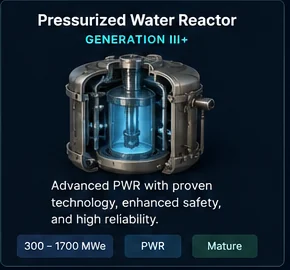
Pressurized Water Reactor
A pressurized water reactor keeps the primary water loop at high pressure so bulk boiling does not occur in the core. Steam generators transfer heat to a separate secondary loop that supplies the turbine plant.
Pressurized Light WaterThermal SpectrumIndirect Steam CycleEstablished Commercial Fleet
Phase 4 • Page-Specific Technical Summary
What this reactor category means
System definition
A thermal-spectrum light-water reactor with a pressurized radioactive primary circuit and a separate steam-producing secondary circuit.
A thermal-spectrum light-water reactor with a pressurized radioactive primary circuit and a separate steam-producing secondary circuit.
Intended applications
Utility electricity, naval propulsion in specialized designs, and selected cogeneration, district-energy, hydrogen, or desalination studies.
Utility electricity, naval propulsion in specialized designs, and selected cogeneration, district-energy, hydrogen, or desalination studies.
Public boundary
Technology classification, system relationships, maturity, and engineering challenges only. No design parameters, calculations, control logic, procedures, procurement data, or build instructions.
Technology classification, system relationships, maturity, and engineering challenges only. No design parameters, calculations, control logic, procedures, procurement data, or build instructions.
System Architecture • Public-Level Component Map
Major Components
A second view separates the principal system functions for Pressurized Water Reactor. The rendering and callouts are conceptual and intended for public engineering orientation.

- Reactor pressure vessel
- Pressurizer
- Steam generators
- Primary coolant pumps
- Containment and safety systems
- Turbine, condenser, and heat rejection
Component boundaries vary by vendor, plant arrangement, coolant choice, power-conversion cycle, site constraints, and licensing basis.
Phase 4 • Concise Comparison
Engineering comparison
Thermal-neutron spectrum in conventional commercial PWRs.
Established commercial technology with a large global operating fleet and extensive licensing experience.
Large-scale firm electricity; smaller integral PWR variants are also used in the SMR category.
High-pressure primary systems, construction cost and schedule, aging management, severe-accident prevention and mitigation, fuel and waste stewardship, and long-term decommissioning.
Application Context
Where the family fits
Utility Generation
Firm grid electricity from large commercial units with mature operating and regulatory experience.
Integral SMR Variants
Compact layouts that place major primary components within or near the reactor vessel.
Cogeneration Studies
Potential delivery of electricity and useful heat where plant design, temperature, siting, and regulation allow.
10-Phase Reactor Program • Phase 2
Standardized fission technical specification
Standardized public-safe fields support comparison across every fission and fusion family. Values are intentionally qualitative; licensing data, dimensions, operating windows, calculations, control logic, and build instructions remain offline.
Light water under pressure; separate steam system
Thermal spectrum
Low-enriched uranium ceramic fuel; design-specific cladding and assemblies
Large commercial plant; integral and modular derivatives are separate designs
Steam Rankine cycle through steam generators
Established commercial fleet
Spent fuel remains high-level radioactive material. Reprocessing can recover selected materials under national policy, but it does not eliminate fission products or disposal obligations.
Specification boundary: Family-level technology classification and lifecycle context—not a vendor datasheet, safety analysis, procurement specification, or construction package.
Ten-Phase Reactor Program · Phase 5
Safety, licensing and public-trust boundary
Reactivity control, high-pressure primary boundary, cooling and decay-heat removal, containment, severe-accident prevention and mitigation, station power, aging management, and spent-fuel interfaces.
U.S. commercial-power reference: established 10 CFR Parts 50 and 52 licensing routes, with project-specific safety, environmental, security, emergency-planning, and operating-license findings.
Apply nuclear-material control and accounting, physical protection, cybersecurity, transport security, insider-risk controls, and international safeguards as applicable to the exact material and jurisdiction. Do not publish Safeguards Information or adversary-useful detail.
Established U.S. commercial-reactor emergency-planning framework under 10 CFR 50.47 and Appendix E, coordinated with state, local, tribal, federal, and site organizations as applicable.
May say the family has a defined operating or research history and can be evaluated through an applicable licensing pathway. State the exact maturity and unresolved design-specific gates.
Do not claim inherently safe, meltdown-proof, waste-free, proliferation-proof, walk-away, unguarded, zero-emergency-zone, automatically cheaper, or licensed because a related reactor operated.
Classification only: This is not a safety finding, licensing opinion, emergency plan, security plan, or legal determination. Exact obligations belong to the applicable regulator and project authority.